AI anomaly detection can transform how B2B marketers address challenges like churn, inefficiencies, and low engagement. By analyzing data in real-time, it identifies unusual patterns - like sudden drops in conversions or shifts in customer behavior - allowing teams to act before issues escalate. Here's what you need to know:
- What It Does: AI scans large datasets to detect outliers or irregularities in metrics like campaign performance, customer engagement, or sales funnel efficiency.
- Why It Matters: It helps catch problems early, such as broken links, declining lead quality, or churn risks, saving time and revenue.
- Key Benefits:
- Improves customer retention by flagging early warning signs (e.g., reduced login activity or payment failures).
- Optimizes marketing campaigns by identifying underperformance in real-time.
- Enhances forecasting accuracy by spotting pipeline leaks or changes in lead quality.
- Examples: Companies like Slack and Audiobooks.com have used AI to reduce churn and boost efficiency, achieving measurable improvements in performance.
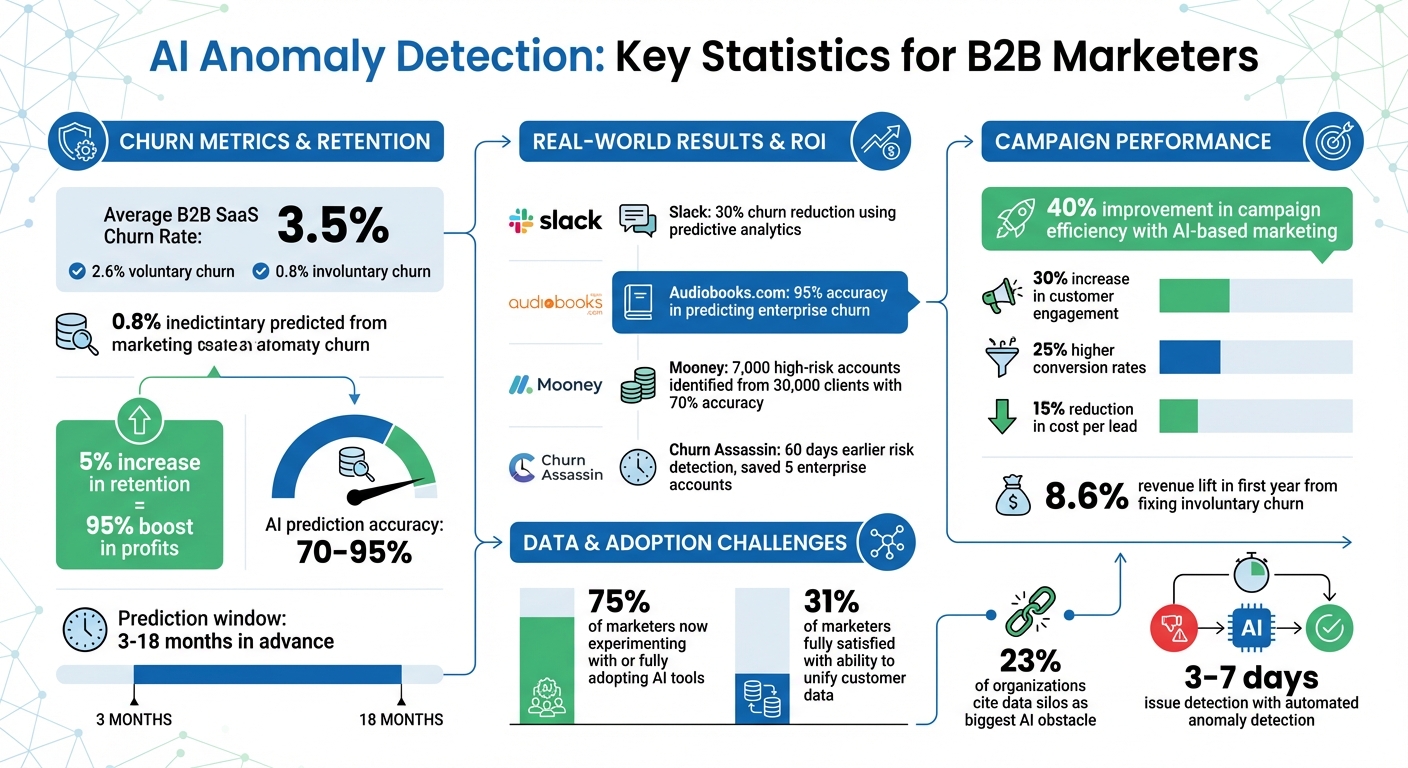
AI Anomaly Detection Benefits and Impact Statistics for B2B Marketing
Common Challenges in B2B Marketing
B2B marketers face several hurdles that can disrupt operations and reduce revenue. Issues like churn, inefficiencies in processes, and low engagement often stem from undetected anomalies in data. These challenges highlight the need for solutions like AI anomaly detection to transform how B2B marketing functions.
Churn: A Silent Revenue Killer
Churn can be voluntary, caused by dissatisfaction, competitor offers, or changing needs, or involuntary, stemming from billing errors or administrative mishaps like expired credit cards. On average, B2B SaaS companies experience a 3.5% churn rate - 2.6% voluntary and 0.8% involuntary.
Key indicators of churn risk include reduced login frequency, increased support tickets, or declining use of features. For instance, in December 2025, a financial services firm working with Hyntelo analyzed the behavior of 30,000 clients. Their AI system flagged 7,000 high-risk accounts with 70% accuracy, allowing the company to focus retention efforts on their most valuable clients before contracts expired.
"Fixing involuntary churn alone can lift revenue by 8.6% in the first year using automated AI tools." - Recurly
However, poor data quality can complicate matters. Fragmented or incomplete data can lead to "hallucinations", where AI identifies patterns that don’t actually exist. A reported 23% of organizations cite data silos as the biggest obstacle to harnessing AI for churn prediction. In B2B settings, anomalies may emerge at the individual user level (e.g., a single user stops logging in) or at the account level (e.g., an entire team reduces usage), both of which can signal larger risks. AI anomaly detection helps identify these early warning signs, enabling marketers to act before it's too late.
Inefficiencies in Marketing Processes
Marketing inefficiencies often show up as wasted ad spend, poorly aligned campaigns, or missed opportunities due to fragmented data. For example, a broken landing page link in a high-budget campaign can lead to substantial losses, while malfunctioning lead forms can cause conversion rates to plummet - issues that traditional analytics might only catch after the damage has been done.
A common culprit is disconnected data. When CRM systems, web analytics, and ad platforms operate independently, gaining a full view of the buyer journey becomes almost impossible. This lack of integration makes it harder to spot bottlenecks or sudden changes in lead quality. In fact, only 31% of marketers report being fully satisfied with their ability to unify customer data.
"If your data is messy, AI will confidently amplify the mess." - Disha Jariwala, Writer, Factors.ai
In December 2025, a subscription-based B2B service worked with Provectus to implement a machine learning model that achieved 95% accuracy in predicting enterprise churn. By spotting anomalies in user behavior, the system triggered automated retention strategies, which significantly reduced monthly churn rates. AI anomaly detection offers real-time insights, helping marketers address inefficiencies before they spiral into larger problems.
Struggles with Engagement and Conversion Rates
Low engagement often points to deeper campaign issues that traditional analytics fail to catch. B2B buyer journeys involve multiple touchpoints and decision-makers, making it challenging to track performance shifts in real time. Problems like technical glitches, misaligned messaging, or changes in buyer intent frequently go unnoticed by standard tools.
Relying on lagging indicators means marketers usually identify conversion rate drops only after the pipeline has already taken a hit. For instance, in December 2025, Slack used predictive analytics to monitor usage patterns across enterprise accounts. By identifying declining engagement - such as reduced feature adoption or team inactivity - they launched proactive campaigns that reduced churn by 30%.
AI-powered tools like lead scoring establish baselines for normal behavior and flag deviations as they happen. Companies using AI-driven marketing strategies have reported up to a 30% increase in customer engagement and a 40% boost in campaign efficiency. By catching anomalies early - such as unexpected drops in product usage or sudden spikes in content consumption - AI allows marketers to act quickly, preventing potential revenue losses.
sbb-itb-6e7333f
How AI Anomaly Detection Solves B2B Marketing Challenges
AI anomaly detection keeps a constant watch on data, spotting irregularities before they turn into costly problems. Instead of waiting for lagging indicators - a common approach that often reveals issues only after revenue has been affected - AI systems analyze incoming data in real time. This allows them to detect patterns that signal potential trouble ahead.
The process starts by establishing a baseline of "normal" behavior. AI does this by analyzing historical conversion data, seasonal trends, and buyer behavior. Once this benchmark is set, the system evaluates multiple factors - like traffic sources, campaign performance, engagement metrics, and market trends - to determine whether a change is an actual anomaly or just standard variation. This ability to incorporate multiple variables provides a level of context that traditional analytics tools simply can't match.
By integrating data from a variety of sources - such as CRM systems, product usage logs, support tickets, and billing platforms - AI creates a comprehensive view of customer health. For example, it can identify complex behavioral patterns that often precede churn, such as a drop in login frequency combined with a spike in support tickets. These patterns, which are hard to spot manually, are flagged quickly by AI, allowing teams to take action before the situation worsens.
This proactive approach shifts B2B teams from reacting to problems to preventing them. Instead of discovering a broken landing page link after wasting thousands of dollars on ads or noticing a drop in conversion rates only after pipeline damage has occurred, AI enables immediate corrective action. With 75% of marketers now experimenting with or fully adopting AI tools, this method is becoming essential for staying competitive in B2B marketing.
Identifying Unusual Customer Behaviors
One of AI's standout strengths is its ability to detect subtle changes that might indicate churn or disengagement. It continuously monitors customer interactions, determining what "normal" looks like for each account and flagging any deviations. This could mean identifying an individual user who stops logging in or spotting team-wide changes, like a decline in feature usage.
AI pulls data from multiple sources to build a detailed risk profile. For example:
- Product usage data: Tracks reduced login frequency or low feature adoption.
- Support data: Flags spikes in support tickets or drops in satisfaction scores.
- Billing data: Identifies payment failures or subscription downgrades.
- CRM data: Monitors unresponsiveness to outreach or missed business reviews.
By analyzing these combined signals, AI catches potential issues that traditional monitoring might miss. It uncovers patterns that reveal a customer's health status long before obvious signs of defection appear.
"AI-powered churn prediction systems can identify at-risk customers before obvious signs of defection." - Frederik Jakobsen, Founder & CEO, Danish Lead Co.
The results can be game-changing. For instance, Audiobooks.com used a machine learning model developed by Provectus and achieved 95% accuracy in predicting which enterprise users were likely to churn. This allowed them to implement automated retention strategies, improving cost efficiency significantly. Unlike traditional approaches that react after a customer is lost, AI provides the foresight to intervene early, enabling marketers to adjust campaigns and retain customers effectively.
Optimizing Campaign Performance with Real-Time Data
AI-powered anomaly detection also transforms how marketers manage campaigns by identifying issues as they happen. Unlike traditional methods that rely on historical data, AI continuously scans for deviations in conversion rates.
For example, when a campaign underperforms, AI determines whether the issue requires action or is simply normal variance. It evaluates traffic sources, audience segments, and market conditions to provide context. This prevents teams from overreacting to minor fluctuations while ensuring they respond quickly to genuine problems, such as a broken lead form or a sudden dip in lead quality.
The benefits of this real-time approach are clear. Companies using AI-based marketing strategies have reported up to a 40% improvement in campaign efficiency and a 30% increase in customer engagement. These gains come from catching technical issues early and reallocating budgets from underperforming campaigns to higher-performing ones.
"With insights from AI, you can spot issues early. Instead of reviewing what went wrong later, you can adjust spend, outreach, routing, or messaging in real-time." - Factors.ai
Real-time alerting systems allow demand generation teams to address problems like broken landing pages or ineffective ad creatives before they drain budgets. By embedding AI insights into daily workflows, marketers can make quick adjustments to messaging, targeting, and budget allocation. This approach also improves revenue forecasting, as today's adjustments feed directly into tomorrow's projections.
Improving Forecasting Accuracy
AI anomaly detection significantly enhances forecasting by identifying pipeline leaks and shifts in lead quality as they occur. Traditional forecasting methods, which rely on static historical data, often fail to capture sudden changes in buyer behavior or market dynamics. AI, on the other hand, establishes a dynamic baseline by analyzing conversion data, seasonal trends, and industry benchmarks, flagging deviations that could affect future revenue.
One key advantage is its ability to spot "lead quality shifts." For instance, lead volume might stay consistent, but conversion rates to Sales Qualified Leads could drop sharply. Without AI, marketers might continue projecting revenue based on top-of-funnel numbers, only to realize later that the pipeline is weaker than expected. By catching these changes early, AI allows teams to adjust forecasts and refine their targeting strategies.
AI also links real-time data with historical performance, helping marketers address risks that previously led to inefficiencies. Machine learning models can even predict cancellations and churn up to 18 months in advance by analyzing historical service and contract data. This long-term visibility supports better resource planning and more accurate revenue projections.
A great example comes from Thinkific, a B2B financial services company. Using Breadcrumbs Reveal to identify data inconsistencies, their team developed a new acquisition scoring model that prioritized leads based on fit and engagement. Within just three months, they doubled their MQL to Opportunity rate.
"We're using data in terms of fit and engagement to really understand how to talk to these people and how to prioritize talking to these people, which has had a tremendous impact." - Christie Horsman, CMO, Thinkific
AI also helps prevent revenue loss from involuntary churn, which accounts for about 0.8% of B2B SaaS churn and often results from administrative issues like failed billing. By flagging these technical problems instantly, teams can address them before contracts are lost. Recurly reports that fixing involuntary churn with automated AI tools can boost revenue by 8.6% within the first year.
Key Benefits of AI Anomaly Detection for B2B Marketers
AI anomaly detection isn't just about spotting issues - it’s about doing so before they snowball into major problems. By processing massive datasets in real time, this technology helps marketers stay ahead of potential revenue risks. Here’s how it makes a difference.
Better Customer Retention
Customer retention is all about catching the warning signs early. AI monitors customer behavior continuously, creating a baseline of what’s “normal” for each account. It flags deviations like reduced login activity, slower feature adoption, spikes in support tickets, or unusual payment patterns - all across thousands of accounts at once.
Why does this matter? Because even a small improvement in retention can drive big results. For example, a 5% increase in retention can boost profits by up to 95%. AI churn prediction models, with accuracy rates between 70% and 95%, can identify at-risk customers as early as 3 to 18 months in advance.
Take Mooney, a B2B financial services company, as an example. In 2025, they partnered with Hyntelo to roll out an AI-powered churn prediction model. Analyzing transactional data for 30,000 clients, the system identified 7,000 high-risk accounts with 70% accuracy. This allowed Mooney to focus their retention efforts where they were needed most.
"Churn Assassin uncovered risks 60 days earlier than our old process. Early action saved 5 enterprise accounts, making a huge impact on revenue."
– Annita Thompson, Customer Success Manager, Churn Assassin
Higher ROI from Marketing Campaigns
AI anomaly detection doesn’t just help with retention - it also ensures marketing dollars are spent wisely. By quickly distinguishing between genuine campaign problems and normal fluctuations, it prevents unnecessary ad spend and redirects budgets to campaigns that are performing well.
The financial upside is clear. AI-powered lead scoring can increase conversion rates by 25% and reduce cost per lead by 15%. It can also recover lost revenue from issues like payment failures or billing errors, with automated tools boosting revenue by 8.6% in just the first year.
A great example comes from Audiobooks.com. By collaborating with Provectus, they developed a machine learning model that predicted enterprise churners with 95% accuracy. This enabled automated, targeted retention messaging that significantly improved cost efficiency. With AI flagging issues in real time, marketers can adjust budgets and targeting before campaigns suffer serious damage.
Data-Driven Decision Making
AI takes the guesswork out of marketing decisions. Instead of relying on traditional analytics that focus on what went wrong, AI uses leading indicators to predict what’s coming next. This shift from reactive to proactive decision-making can transform how teams operate.
One standout feature of AI is its ability to connect the dots across fragmented systems. By doing so, it uncovers subtle trends that traditional tools might miss - like steady lead volume masking a drop in lead quality.
For instance, Mosaic Data Science worked with an enterprise software company to develop a custom machine learning model. This model predicted B2B customer cancellations with over 70% accuracy up to 18 months in advance, giving the company plenty of time to act. With this kind of foresight, teams can fine-tune retention strategies, refine targeting, and forecast revenue with greater accuracy.
"At its core, AI in B2B marketing means using machine learning to process signals faster than humans can, to improve marketing decisions."
– Disha Jariwala, Writer, Factors.ai
The bottom line? AI equips marketers with insights grounded in data rather than opinions. From analyzing call transcripts to tracking feature usage and win-loss trends, it scales effortlessly to monitor thousands of accounts at once - something no human team could replicate. By addressing inefficiencies, reducing churn, and boosting engagement, AI anomaly detection proves itself as an indispensable tool for modern B2B marketing.
Applying AI Anomaly Detection in Email Campaigns
Email campaigns generate a massive amount of data, making it tough to manually catch every performance issue. AI anomaly detection simplifies this by continuously monitoring your campaigns and flagging any unusual activity, so you can act quickly.
Monitoring Anomalies in Email Engagement
AI tools keep a close watch on key metrics like open rates, click-through rates, bounce rates, and unsubscribe rates by establishing baseline numbers [12,13]. For instance, if your average open rate is 20% and it suddenly drops to 5%, the system will send you an alert. Similarly, unexpected spikes in unsubscribes or declines in click-through rates are flagged, helping you uncover problems like broken tracking pixels, deliverability issues, or ineffective content [12,14,16].
Teams using automated anomaly detection often uncover these issues 3–7 days faster than those relying on manual checks. As Klaviyo explains:
"If certain metrics suddenly drop off a shelf, our new 'anomaly detection' feature springs into action, sending you an alert so you can get under the hood, diagnose the issue, and get any broken email or SMS flows back on track." – Klaviyo
To manage responses effectively, you can implement tiered alerts. For example, critical issues like complete tracking failures can trigger immediate notifications, while moderate changes (like a 20–40% deviation) can be summarized in periodic reports.
Optimizing Drip Campaigns and Lead Nurturing
Beyond tracking real-time engagement, AI ensures automated workflows - like welcome emails, abandoned cart reminders, and lead nurturing sequences - run smoothly. Since these flows are often set-it-and-forget-it, they can fail silently due to broken triggers or misaligned integrations. AI anomaly detection keeps tabs on these campaigns by monitoring actions like "Added to Cart" or "Viewed Product", ensuring the underlying data streams stay active.
When something goes wrong, the system notifies you within hours instead of weeks [12,14]. For example, Klaviyo’s feature tracks the daily email volume in automated flows and sends an alert if the number unexpectedly drops to zero.
Maintaining consistent performance in these campaigns is critical for improving ROI and customer retention. To get the most out of your efforts, start by establishing a performance baseline using a 30-day rolling average. Adjust for day-of-week trends - such as lower B2B engagement on weekends - and regularly update baselines to minimize false alarms [12,13].
Using Tools from the Email Service Business Directory
To fully tap into AI capabilities, consider exploring the tools listed in the Email Service Business Directory. This curated resource (https://emailservicebusiness.com) showcases email marketing platforms with built-in AI anomaly detection. Whether you’re managing drip campaigns, lead nurturing, or transactional emails, the directory highlights solutions designed to catch issues early.
Many platforms featured in the directory address common B2B marketing challenges like churn, inefficiencies, and low engagement. When choosing a tool, focus on data quality and integration capabilities. AI systems work best with clean, accurate data that integrates seamlessly with your CRM and marketing platforms. Look for features like real-time alerts, customizable thresholds for severity, and root cause analysis tools to quickly pinpoint and resolve issues. The directory’s comparison tools can help you find a solution tailored to your needs, letting you spend less time on manual monitoring and more time on actionable insights.
Conclusion
Key Takeaways
AI anomaly detection is transforming B2B marketing by shifting focus from reactive fixes to proactive improvements. By identifying issues within hours - whether it's a sudden dip in email engagement, signs of churn from reduced product usage, or inefficient campaign spending - you can tackle major challenges like churn, inefficiencies, and low engagement head-on.
Real-world examples highlight the potential: Slack reduced churn by 30% using predictive analytics to flag at-risk accounts, and Audiobooks.com achieved 95% accuracy in predicting churn, allowing them to send timely retention messages. Similarly, AI-driven lead scoring has shown to boost conversion rates by 25% while cutting lead costs by 15%.
However, success with AI isn't just about the tools. As Factors.ai emphasizes:
"Teams winning with AI use fewer tools and exercise greater discipline. They've built the structure to turn insights into action before they go stale".
To make the most of AI anomaly detection, you need clean, integrated data across your CRM, marketing automation, and analytics platforms. Establish clear ownership - someone who can act on insights within 24 hours - and set baselines to define "normal" performance. This ensures your system flags genuine issues without overwhelming your team with false positives.
These foundational steps position you to integrate AI anomaly detection into your email campaigns effectively.
Next Steps
To build on these performance improvements, consider exploring the Email Service Business Directory at https://emailservicebusiness.com. This resource lists platforms equipped with AI tools specifically designed for B2B marketers facing churn, efficiency, and engagement challenges.
Look for platforms offering real-time alerts, customizable thresholds, and seamless integration with your existing CRM and marketing systems. The directory's comparison tools can help you find the best fit for tasks like optimizing drip campaigns, monitoring lead nurturing sequences, or addressing revenue leaks caused by technical issues. Start with small-scale implementation, establish your performance baselines, and expand as you see measurable results.
FAQs
What data is needed for AI anomaly detection to work well?
High-quality data is the backbone of effective AI anomaly detection. This means using cleaned, accurate information pulled from various sources like website analytics, email campaigns, social media platforms, and ad performance metrics. Having reliable historical data is equally important - it helps create dynamic benchmarks so AI can differentiate between normal variations and actual anomalies. Real-time inputs, such as conversion rates and campaign metrics, add another layer of precision, allowing for quick identification of issues like bottlenecks or failing campaigns.
How do I set baselines and thresholds without tons of false alerts?
To reduce the number of false alerts, consider using dynamic baselines that adjust according to both historical and real-time data. Advanced AI models, such as Isolation Forest or Autoencoders, are particularly effective at identifying anomalies within these adaptive thresholds. It's also essential to clean and transform your data thoroughly - this step enhances detection accuracy and helps cut down on false positives.
How can I act on anomaly alerts fast in B2B email campaigns?
To respond swiftly to anomaly alerts in B2B email campaigns, leverage automated monitoring tools to keep an eye on critical metrics like open rates, bounce rates, and click-through patterns in real-time. Establish clear response protocols - such as pausing campaigns or tweaking strategies - so your team knows exactly how to act. Integrating AI-powered anomaly detection tools with your email platform can streamline this process, allowing you to react faster, reduce potential damage, and keep your campaigns on track.