Looking for secure email options? Here's what you need to know: End-to-end encryption (E2EE) ensures that only the sender and recipient can access email content, making it a must-have for privacy. From protecting sensitive business data to meeting compliance standards like GDPR and HIPAA, encrypted email platforms offer robust solutions. Below are the top seven platforms to consider:
- Proton Mail: Swiss-based, GDPR and HIPAA compliant, with zero-access encryption.
- Tuta Mail: Germany-based with post-quantum encryption and full mailbox protection.
- Mailfence: Belgium-based, integrates OpenPGP encryption with productivity tools.
- Zoho Mail: Affordable email marketing platforms for small businesses, supports S/MIME and TLS encryption.
- Virtru: Easily integrates with Gmail/Outlook, offering granular access controls.
- Cisco Secure Email Encryption: Enterprise-focused with centralized key management.
- Barracuda: Works with Microsoft 365, offering policy-based encryption and DLP.
Quick Comparison
| Platform | Best For | Starting Price | Key Features | Compliance |
|---|---|---|---|---|
| Proton Mail | Privacy & Ecosystem Replacement | $3.99/month | Zero-access, Swiss jurisdiction | GDPR, HIPAA |
| Tuta Mail | High Security & Quantum Safety | ~$3.25/month | Post-quantum encryption, subject line security | GDPR, German laws |
| Mailfence | Privacy with Productivity Tools | $3.50/month | OpenPGP, digital signatures | GDPR, Belgian laws |
| Zoho Mail | Small Businesses | $1/month | S/MIME, TLS encryption | GDPR, HIPAA |
| Virtru | Gmail/Outlook Users | Free | Policy controls, revocation, watermarking | HIPAA, GDPR, CCPA |
| Cisco Secure | Enterprises | Custom Quote | S/MIME, centralized key management | HIPAA, PCI DSS |
| Barracuda | Microsoft 365 Users | Custom Quote | AES 256-bit, policy automation | HIPAA, GDPR, CCPA |
Each platform offers unique encryption features tailored to varying privacy needs and compliance requirements. Whether you're an individual or a business, these options provide secure email solutions for protecting sensitive communications.
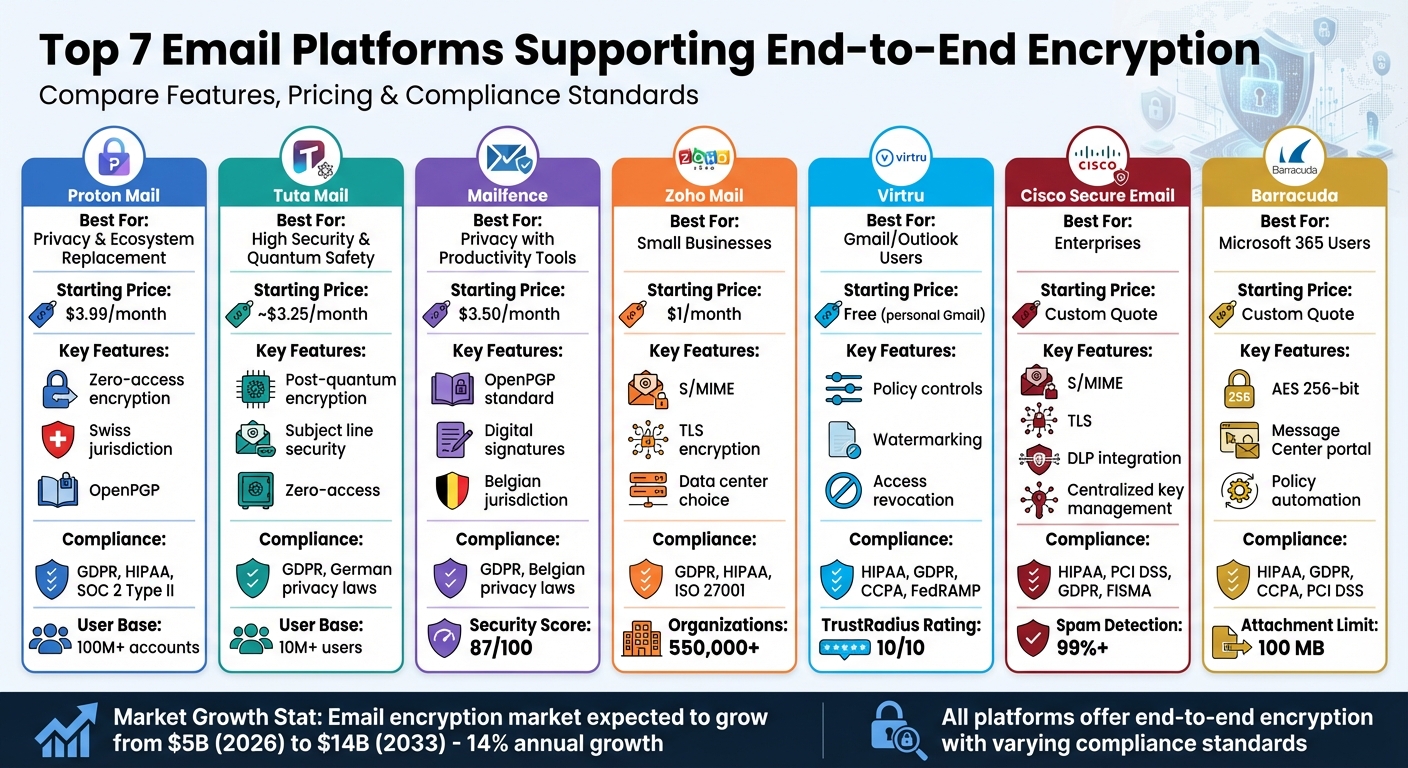
Top 7 Encrypted Email Platforms: Features, Pricing & Compliance Comparison
Email Encryption EXPLAINED (so anyone can get it)
sbb-itb-6e7333f
1. Proton Mail
Proton Mail is a leading encrypted email provider, founded in 2014 by scientists from CERN. Today, it secures communications for over 20,000 EU government organizations.
End-to-end encryption capabilities
Proton Mail makes encryption effortless. Messages between Proton Mail users are automatically end-to-end encrypted, requiring no additional setup. As the company explains:
"Proton's end-to-end encryption and zero-access encryption mean that no one (not even Proton) has the technical means to access your data without your permission."
For non-users, encrypted messages are sent via a password-protected secure link. The platform also encrypts contact details like phone numbers and addresses while using cryptographic signatures to verify email authenticity and prevent tampering.
Compliance standards
Proton Mail meets a wide range of compliance standards, including GDPR, HIPAA, CCPA, CJIS, and PCI. It holds ISO 27001 certification and has passed independent SOC 2 Type II audits. For healthcare organizations, Proton offers a Business Associate Agreement (BAA) upon request to comply with HIPAA requirements. Based in Geneva, Switzerland, Proton Mail benefits from some of the world's strongest privacy laws and operates outside US and EU surveillance jurisdictions.
An Administration & IT Manager at Avocats sans frontières highlighted its impact:
"The implementation of Proton Mail has allowed us to strengthen our security on our platforms and improve our cyber security knowledge... helping us reduce costs by 70%."
These compliance measures, paired with flexible pricing options, make it suitable for both personal and business users.
Pricing plans
Proton Mail offers a free tier for personal users, with premium plans that include additional storage and custom domains. Business plans are tailored to user needs and remain competitively priced.
Unique encryption features
Proton Mail goes beyond basic encryption. Proton Sentinel uses AI and human oversight to block suspicious login attempts, while the Web Key Directory (WKD) simplifies encrypted communication by automatically discovering public OpenPGP keys for external contacts. All Proton apps are open source and undergo regular audits. SignalVault Privacy rated Proton Mail 9.5/10 for its strong security, Swiss jurisdiction, and seamless ecosystem integration.
2. Tuta Mail
Tuta Mail claims the title of the world's first end-to-end encrypted email provider. Headquartered in Germany, it serves over 10 million users and more than 10,000 businesses worldwide.
End-to-End Encryption
Tuta Mail takes privacy seriously by encrypting your entire mailbox. This includes emails, subject lines, attachments, calendars (complete with metadata and reminders), contacts, and inbox rules - all automatically. The platform operates on a zero-knowledge framework, meaning your private keys are encrypted with your password and are completely inaccessible to Tuta employees or external parties.
In March 2024, Tuta Mail became a pioneer in adopting post-quantum cryptography using Kyber-1024, a system designed to protect against potential quantum computer threats. Unlike standard PGP, which leaves subject lines unencrypted and struggles to adapt to quantum resistance, Tuta Mail's encryption strategy is built for both current and future security challenges. This approach aligns with its commitment to meeting rigorous regulatory standards.
Compliance Standards
Tuta Mail's encryption capabilities also support its strong compliance framework. It adheres to GDPR and Germany's Federal Data Protection Act, one of the strictest data protection laws globally. The company offers a legally binding Order Processing Agreement, which helps businesses ensure compliance. While Tuta Mail is marketed as a great option for the medical sector due to its encryption and GDPR alignment, it does not explicitly claim HIPAA certification in its documentation.
All of Tuta Mail's clients - whether on web, Android, iOS, or desktop - are open source, allowing independent security audits. Additionally, the platform operates entirely on renewable energy, reinforcing its commitment to sustainability.
Pricing Plans
Tuta Mail offers flexible pricing to meet different needs:
- Free Plan: Includes 1 GB of storage, one calendar, and three labels.
- Revolutionary Plan: Priced at $38 per year, it offers 20 GB of storage, unlimited calendars, 15 additional email addresses, and three custom domains.
- Legend Plan: Typically costs $104 annually (about €8 per month) but is currently available at $39 for the first year as part of a Birthday Deal, offering 500 GB of storage, 30 additional email addresses, and 10 custom domains - a 62% discount.
Distinctive Encryption Features
Tuta Mail stands out with several privacy-focused features. It uses its own infrastructure to prevent third-party data leaks. For instance, it has a custom captcha system and an Android push notification service that bypasses Google. Users also appreciate that no phone number is required for registration, adding an extra layer of anonymity. The platform's mobile apps enjoy high ratings, reflecting its strong emphasis on user privacy.
As one user, Fernando Silva, shared:
Tuta is a cost-effective email service in the market. It has the same main features as most mail providers. The difference is that Tuta cares about your privacy.
3. Mailfence
Mailfence, established in Belgium in 1999, is a privacy-focused platform that combines secure email with tools like a calendar, document management, and group collaboration. Operating under stringent European Union privacy laws, it complies fully with GDPR regulations. Belgium's legal framework, including a 2021 ruling by the Constitutional Court that invalidated the country's data retention law, provides additional layers of privacy for users. Another advantage? Mailfence is outside the "Five Eyes" intelligence alliance.
End-to-End Encryption Capabilities
Mailfence employs the OpenPGP standard for encryption, ensuring compatibility with other OpenPGP services. All encryption and decryption processes happen locally in your browser, meaning no plain-text data ever touches Mailfence's servers. The platform also features an integrated keystore, enabling users to generate, import, publish, and manage OpenPGP keys without needing third-party plugins.
For those communicating with non-PGP users, Mailfence offers Password Encrypted Messages (PEM). These messages are encrypted with a shared password and can be decrypted through a link provided to the recipient. Additionally, Mailfence supports digital signatures, which verify the sender's identity and ensure the message's integrity.
This robust encryption framework is complemented by stringent legal and physical security measures, making Mailfence a reliable choice for secure communication.
Compliance Standards
Belgium’s privacy laws provide a strong foundation for Mailfence’s operations. Data requests must be backed by a valid Belgian court order, and the company is not subject to U.S. gag orders or National Security Letters. With its advanced encryption and digital signature features, Mailfence is particularly suitable for industries such as legal, financial, and healthcare.
Between July 2018 and February 2023, EU regulators issued 1,576 GDPR fines totaling over $6.5 billion, highlighting the importance of platforms that prioritize data protection. Mailfence’s servers are located in Belgium, safeguarded by biometric security, surveillance systems, and physical barriers. The platform also uses technologies like Perfect Forward Secrecy (PFS) and HTTP Strict Transport Security (HSTS) to further protect user communications. In a 2025 security framework evaluation, Mailfence achieved an impressive score of 87/100.
Pricing Plans
Mailfence offers five pricing plans, catering to a variety of user needs:
| Plan | Monthly Price (Billed Yearly) | Email Storage | Document Storage | Key Features |
|---|---|---|---|---|
| Free | $0 | 500 MB | 500 MB | Encryption, Keystore, 2FA |
| Base | ~$2.70 | 5 GB | 6 GB | 10 Aliases, Email support |
| Entry | ~$3.80 | 10 GB | 30 GB | 50 Aliases, POP/IMAP/SMTP, ActiveSync |
| Pro | ~$8.15 | 30 GB | 48 GB | 100 Aliases, Priority support, Custom domain |
| Ultra | ~$27.15 | 60 GB | 165 GB | 200 Aliases, Priority support, 15% donation to EFF and EDRi |
Organizations can mix different plans to reduce costs, but managing more than four users requires an administrator with a Pro plan.
Unique Encryption Features
Mailfence goes beyond encryption by integrating privacy with productivity tools, offering a seamless solution for both secure communication and collaboration. Unlike many platforms, Mailfence removes IP addresses from email headers and maintains full control over its servers.
The company is clear in its stance on privacy:
We have never and will never create backdoors or government shadow access that could be used to spy on our users.
Given that Business Email Compromise (BEC) attacks accounted for 73% of all reported cyber incidents in 2024, with average losses exceeding $125,000 per attack, Mailfence’s digital signature feature is a critical tool for ensuring message authenticity and integrity.
4. Zoho Mail
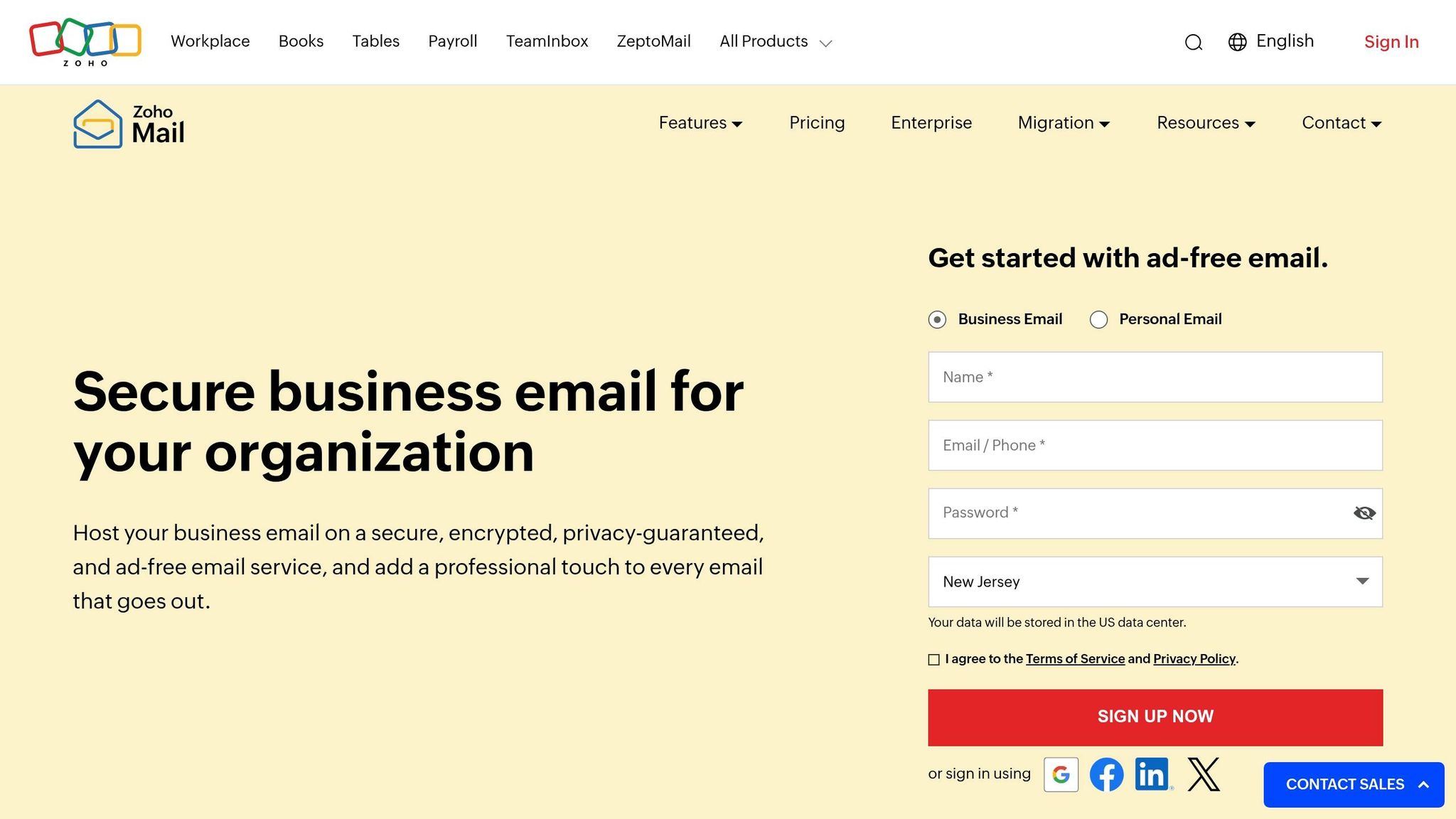
Zoho Mail is a secure email platform trusted by over 550,000 organizations worldwide. It places a strong emphasis on encryption and user privacy, adhering to a clear principle: "Your data is yours, and we never monetize it for advertisement purposes". The platform also avoids third-party tracking, ensuring an ad-free experience for its users.
End-to-End Encryption Capabilities
Zoho Mail employs end-to-end encryption using both OpenPGP and S/MIME protocols, ensuring that only the sender and recipient can access the content of messages. Data stored on its servers is encrypted with AES 256-bit or 128-bit keys (AES_CBC, AES_GCM), and information is fragmented and encrypted before being written to disk. Additionally, all communications are secured with TLS and HTTPS to prevent eavesdropping.
A standout feature is the TLS Indicator, which lets users know if the recipient's email provider supports TLS encryption before sending an email. Zoho Mail also allows users to encrypt and sign emails directly through its webmail interface using OpenPGP. For added security, S/MIME provides digital signatures to verify sender identity and protect against unauthorized interception.
These encryption measures help Zoho Mail comply with stringent legal and regulatory standards.
Compliance Standards
Zoho Mail meets a wide range of compliance and certification requirements, including ISO 27001, ISO 27017, ISO 27018, ISO 27701, and SOC 2 Type II. It is fully compliant with GDPR and HIPAA regulations (the latter requiring a signed Business Associate Agreement). The platform retains email logs for 90 days and administration logs for one year. Organizations on Premium plans also benefit from eDiscovery tools, which make it easier to retain, search, and recover emails for legal and compliance purposes. Zoho Mail guarantees 99.9% uptime, ensuring reliability for its users.
Pricing Plans
Zoho Mail offers a variety of pricing options, with advanced encryption tools like S/MIME and OpenPGP available in higher-tier plans:
| Plan | Monthly Price (Billed Yearly) | Storage | Encryption Features |
|---|---|---|---|
| Forever Free | $0 | 5 GB/user (up to 5 users) | TLS encryption |
| Mail Lite | ~$1.00/user | 5–10 GB/user | TLS encryption, 2FA |
| Mail Premium | ~$4.00/user | 50 GB/user | S/MIME, OpenPGP, eDiscovery, Email Retention |
| Workplace Standard | ~$3.00/user | 30 GB/user | TLS encryption, Secure Pass |
| Workplace Professional | ~$6.00/user | 100 GB/user | S/MIME, OpenPGP, eDiscovery, Email Retention |
Unique Encryption Features
Zoho Mail adopts a zero-access encryption model, meaning its servers do not store the decryption keys. This approach is especially important in light of statistics showing that 82.6% of phishing emails are now AI-generated. Administrators can also enforce multi-factor authentication (MFA), set IP restrictions, and define email retention policies to enhance security.
Carolina Astaiza M, Vice President of Talent & Acquisition, shared her thoughts on the platform:
Zoho Mail is an excellent email service. It is sleek and fast and offers better protection against fake emails.
In addition, Zoho Mail includes Streams, a collaboration tool that transforms long email threads into social-media–style conversations. This feature allows users to tag colleagues, share files, and comment - all within a secure, encrypted environment.
5. Virtru
Virtru is a client-side encryption platform trusted by over 6,100 customers. Unlike many traditional email encryption tools that come with complicated setups, Virtru integrates seamlessly as a browser plugin for Gmail and an add-on for Microsoft Outlook, allowing users to encrypt emails directly within their existing email platforms. The platform is built on the Trusted Data Format (TDF), an open standard originally developed by Virtru's co-founder for the U.S. Intelligence Community.
End-to-End Encryption Capabilities
Virtru uses AES-256 encryption to provide end-to-end protection, ensuring data remains secure. This encryption is applied through both client-side browser plugins and automated server-side encryption via its Data Protection Gateway, which scans and encrypts sensitive information based on Data Loss Prevention (DLP) rules.
The platform offers granular controls, allowing senders to disable forwarding, set expiration dates, or revoke access at any time. Recipients don’t need to install extra software or create new passwords - they can authenticate using their existing Google or Microsoft accounts or a one-time verification code. Mark Dieterich, Director of IT and Security at Brown University, shared:
"With Virtru, we found a solution that met our security and compliance requirements, was easy enough to ensure widespread adoption, and gave us the audit and control features we wanted".
For organizations needing complete control over their encryption keys, the Virtru Private Keystore allows hosting keys on-premises or in a private cloud. This ensures data sovereignty and prevents third-party access.
These robust encryption features make Virtru a reliable choice for meeting compliance requirements.
Compliance Standards
Virtru supports a wide range of regulatory standards, including HIPAA, GDPR, CMMC 2.0, ITAR, FERPA, CJIS, and the FTC Safeguards Rule. For HIPAA compliance, Virtru offers a signed Business Associate Agreement (BAA) starting with its Starter plan. Additionally, it helps organizations address 27 of the 110 CMMC Level 2 controls through encryption and fine-tuned access management.
One global engineering firm saved over $1 million by using Virtru for Microsoft Outlook instead of upgrading to Microsoft Office GCC High for CMMC 2.0 and ITAR compliance [44, 47]. Similarly, a "Big 4" bank saw a 90% drop in support tickets while securely sharing more than 700,000 data objects daily with Virtru.
Pricing Plans
Virtru offers four annual pricing tiers:
| Plan | Monthly Price | Users Included | Key Compliance Standards |
|---|---|---|---|
| Starter | $119 | 5 | HIPAA (includes BAA) |
| Business | $219 | 5 | GDPR, CCPA, CJIS, FERPA |
| Compliance | $399 | 5 | CMMC, ITAR, FedRAMP, PCI DSS |
| Enterprise | Custom | 50+ | All standards + SaaS protection |
The median contract value is about $10,498 per year, with larger deployments often negotiated at rates between $6 and $10 per user per month. Sunshine Miller, Director of Technology at Newfield Central School District, remarked:
"It's very rare that a company gives you the full product, at a reasonable price that a school district like ours can afford".
Unique Encryption Features
Virtru stands out with its persistent protection, which ensures encryption and access policies remain intact no matter where the data is shared or stored. Additional features include watermarking attachments to deter unauthorized sharing and detailed audit trails for compliance reporting. Dave Steck, VP of IT Infrastructure, highlighted:
"We like the control features. For example, being able to revoke a message, and have an audit trail, really sets Virtru apart".
Virtru earned a 10/10 TrustRadius rating for 2026, with users praising its ease of use compared to traditional portal-based encryption methods and its affordability compared to other enterprise solutions.
6. Cisco Secure Email Encryption
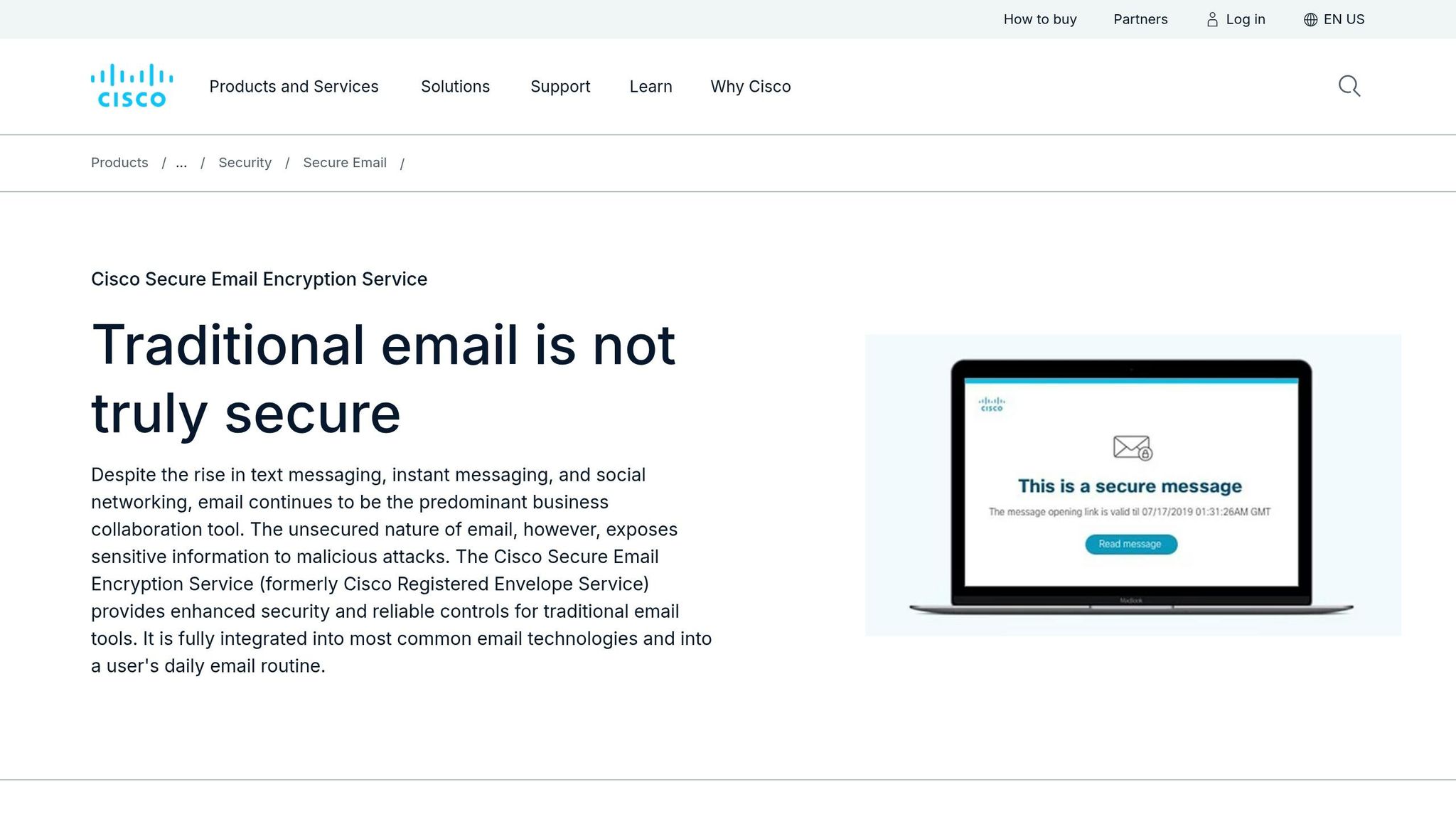
Cisco Secure Email Encryption (previously known as IronPort) is a centralized email security solution tailored for enterprises. It employs a cloud-based key management system to handle recipient registration, authentication, and encryption keys for each message, ensuring that only authorized users can access the content. Unlike standalone email services, Cisco integrates seamlessly with existing email infrastructures, assessing email platform compatibility to ensure smooth deployment, offering both cloud-hosted and on-premises deployment options. This setup complements the encryption features of other platforms.
End-to-End Encryption Capabilities
Cisco employs AES-256 encryption with 14 rounds of encryption, providing robust protection against modern brute-force attacks. The platform offers two delivery methods for encrypted messages:
- Push encryption: Sends an encrypted HTML envelope directly to the recipient.
- Pull encryption: Directs recipients to a secure portal to access the message.
With features like "Easy Open" and "Registered Envelopes", recipients can read messages on any device without needing additional software.
Senders have fine-grained control over their messages. Options include setting expiration dates, disabling forwarding or replies, and using "Guaranteed Message Recall" to revoke access by expiring the decryption key. Additional tools like read receipts notify senders once a recipient has authenticated and decrypted the message. For added security, Cisco supports two-step verification and integrates with SAML 2.0 identity gateways, enabling recipients to use their corporate credentials for decryption.
Compliance Standards
Cisco Secure Email Encryption adheres to key regulatory standards, including HIPAA, GDPR, PCI DSS, and CJIS. It also helps businesses comply with state-level privacy laws, such as Nevada Rev. Statute 597.970 and Massachusetts 201 CMR 17.00. Outbound scanning features ensure sensitive information isn’t unintentionally leaked, helping organizations maintain their regulatory compliance.
"Email security isn't just about preventing spam or phishing - it's about safeguarding your organization's most valuable communication channel".
To support compliance efforts, Cisco offers nearly 200 prebuilt DLP policies aligned with global government and industry regulations. The platform's anti-spam system achieves a spam detection rate above 99%, with a false-positive rate of fewer than one in one million. These compliance tools are integrated into Cisco's flexible subscription plans.
Pricing Plans
Cisco Secure Email operates on a tiered subscription model with three main bundles: Essentials, Advantage, and Premier. Licensing is calculated per user (or per mailbox), with subscription terms available in 1, 3, or 5-year increments. Email encryption is included in the Advantage and Premier tiers but is an optional add-on for the Essentials package.
Pricing is customized based on the number of mailboxes supported, and organizations can request a free 45-day trial of the Cisco Secure Email Cloud Gateway. Beyond pricing flexibility, Cisco includes advanced encryption features to strengthen message security.
Unique Encryption Features
Cisco's "Envelope Encryption" technology gives senders the ability to lock messages even after they’ve been sent. The encryption key is stored in the cloud, while the message content stays on the gateway, enhancing security. The platform supports three encryption models:
- Endpoint-to-Endpoint: Encrypts the message throughout its entire journey.
- Gateway-to-Endpoint: Encrypts messages from the gateway to the recipient.
- Gateway-to-Gateway: Encrypts only during internet transit.
The "Personal Security Phrase" feature allows recipients to verify the authenticity of encrypted envelopes, reducing phishing risks. Cisco also offers plug-in applications for Outlook, iOS, and Android, improving the user experience. Additionally, the platform integrates with Cisco Talos threat intelligence and supports sender authentication standards like DKIM and SPF to validate sender domains.
7. Barracuda
Barracuda stands out as an email platform that integrates encryption directly into its security suite, offering a streamlined solution for secure communications.
Barracuda Email Protection doesn't operate as a standalone service. Instead, it works alongside existing infrastructures like Microsoft 365, layering encryption to secure email data. It uses TLS to protect data in transit and AES 256-bit encryption to safeguard data at rest, ensuring security throughout the email lifecycle.
End-to-End Encryption Capabilities
Barracuda uses a Message Center model for encrypted emails. When you send an encrypted message, it’s stored securely in the Barracuda Message Center. Recipients access it through a secure HTTPS link, setting a password for their first visit. Any replies sent through the portal are automatically encrypted as well.
"Barracuda encrypts all email and attachments on every server where they reside. If a user replies to an encrypted message, the reply is also automatically encrypted."
The platform includes policy-based automation, allowing administrators to set encryption rules based on factors like sender, recipient, domain, or specific keywords (e.g., Social Security numbers or credit card details). Encryption keys are managed by Barracuda and stored in geographically separated data centers for added security.
Compliance Standards
Barracuda supports key compliance standards such as HIPAA, GDPR, CCPA, and PCI DSS, thanks to its integrated Data Loss Prevention (DLP) features. For healthcare organizations, the platform provides tools to encrypt emails containing sensitive health information (PHI). Its DLP suite also scans outgoing emails to prevent unauthorized sharing of sensitive data.
"Encryption policies ensure that your organization complies with regulations designed to protect customer data, such as HIPAA."
The Data Inspector feature further enhances compliance by scanning platforms like OneDrive and SharePoint for personal data and malicious files, aiding in GDPR and CCPA adherence. Additionally, Barracuda offers cloud-based archiving for legal needs, including e-discovery, litigation holds, and long-term retention policies. These compliance tools are included in the platform’s flexible pricing structure.
Pricing Plans
Barracuda Email Protection offers custom pricing based on three tiers: Advanced, Premium, and Premium Plus. All plans include email encryption and DLP, while additional features are available in higher tiers.
| Feature | Advanced Plan | Premium Plan | Premium Plus Plan |
|---|---|---|---|
| Email encryption & DLP | Included | Included | Included |
| AI-powered threat defense | Included | Included | Included |
| Email continuity | Included | Included | Included |
| Microsoft 365 backup | Not available | Included | Included |
| PII & malware file scanning | Not available | Included | Included |
| Cloud archiving | Not available | Not available | Included |
| Security awareness training | Not available | Not available | Included |
The Advanced plan focuses on core security, including AI threat defense, phishing protection, encryption, and DLP. Premium adds features like unlimited Microsoft 365 backup and file scanning for PII and malware. Premium Plus takes it a step further with cloud archiving and security awareness training.
Noteworthy Encryption Features
Barracuda simplifies encryption key management by storing keys in separate physical locations, enhancing security. It also supports attachments up to 100 MB, which is larger than what many competitors offer. Beyond encryption, Barracuda filters outbound emails to prevent IP blacklisting caused by botnet spam or accidental malware distribution. Additionally, its Email Continuity feature ensures uninterrupted email service, even if your primary server experiences downtime.
Platform Comparison Table
When picking an encrypted email platform, it's essential to consider your specific needs, budget, and compliance obligations. The seven platforms discussed in this article cater to various users, from individuals prioritizing privacy to large organizations managing sensitive data under strict regulations. Here's a quick overview of each platform's key features and compliance standards:
| Platform | Best Use Case | Starting Price (USD) | Main Encryption Features | Compliance |
|---|---|---|---|---|
| Proton Mail | General privacy & ecosystem replacement | $3.99/month | OpenPGP, Zero-access architecture, Swiss-based servers | GDPR, HIPAA, SOC 2 Type II |
| Tuta Mail | Maximum security & quantum resistance | ~$3.25/month | TutaCrypt (post-quantum), Subject line encryption, Zero-access | GDPR, German privacy laws |
| Mailfence | Integrated productivity with native OpenPGP | $3.50/month | OpenPGP standard, Digital signatures, Belgian jurisdiction | GDPR, Belgian privacy laws |
| Zoho Mail | Budget-conscious businesses | $1/month | S/MIME, TLS encryption, Data center choice | GDPR, HIPAA, ISO 27001 |
| Virtru | Gmail/Outlook users seeking invisible encryption | Free (personal Gmail) | Policy-based encryption, Watermarking, Access revocation | HIPAA, GDPR, CCPA, FedRAMP |
| Cisco Secure Email Encryption | Large enterprises with complex IT infrastructure | Custom quote | S/MIME, TLS, DLP integration, Centralized key management | HIPAA, PCI DSS, GDPR, FISMA |
| Barracuda | Microsoft 365 users needing layered security | Custom quote | AES 256-bit, Message Center portal, Policy automation | HIPAA, GDPR, CCPA, PCI DSS |
Proton Mail leads the pack with over 100 million accounts as of 2026, making it the most widely adopted privacy-focused email service. Its Swiss jurisdiction ensures stronger legal protections by operating outside the Five Eyes intelligence-sharing alliance, a significant advantage for those concerned about government data requests.
Tuta Mail shines with its ability to encrypt subject lines and headers, a feature many competitors lack. Mailfence, meanwhile, combines productivity tools like calendars and document collaboration with robust OpenPGP encryption standards. Zoho Mail is hard to beat for small businesses, offering entry-level encryption at just $1/month. Virtru makes encryption accessible for individuals by providing free personal use for Gmail users, especially on Chrome.
For larger enterprises, Cisco Secure Email Encryption and Barracuda cater to organizations with complex IT needs. Both platforms offer custom pricing and advanced compliance features, making them ideal for industries with strict regulatory requirements. Whether you're an individual or a business, this table provides a clear starting point to find the right encrypted email solution.
Conclusion
Picking the right encrypted email platform depends on your specific privacy needs and budget. For general privacy, budget-friendly options like Proton Mail's free tier can work well. But if you're dealing with sensitive data, like HIPAA-regulated information, or are concerned about state-level surveillance, you’ll need a provider offering true end-to-end encryption with a zero-knowledge setup - like the ones mentioned earlier.
The email encryption market is on a steep growth trajectory, expected to jump from $5 billion in 2026 to $14 billion by 2033, with an annual growth rate of 14%. This surge is fueled by increasing regulatory demands, including eight new U.S. state privacy laws set to take effect in 2025, and heightened government scrutiny. For instance, Google complied with about 80% of over 400,000 government data requests in 2024.
Where a provider is based matters more than you might think. A service that advertises encryption but keeps server-side access to your emails offers minimal protection. Proton Mail, based in Switzerland, benefits from some of the world’s strongest privacy laws, while Germany-based Tutanota goes a step further by encrypting not just email bodies but also subject lines and headers. These legal and technical details should factor into your decision.
Don’t forget to enable two-factor authentication - ideally with hardware keys like YubiKey - for added security. Testing out free trials can also help ensure the service meets your expectations and privacy requirements.
FAQs
What’s the difference between end-to-end encryption and TLS email encryption?
End-to-end encryption (E2EE) and TLS encryption address different aspects of email security. TLS protects emails while they’re being transmitted between servers, ensuring they’re safe from interception during that process. However, once the email reaches the recipient’s server, it may no longer be encrypted. On the other hand, E2EE takes privacy to the next level by encrypting the message directly on the sender’s device and allowing only the intended recipient to decrypt it. This method ensures that even the servers handling the email can’t access its content, offering a much higher level of security.
How can I send an encrypted email to someone who doesn’t use the same provider?
To send an encrypted email to someone using a different email provider, consider using services that support OpenPGP or similar encryption protocols. Options like Proton Mail or Mailfence make it possible to securely communicate across different platforms. Another approach is to use PGP (Pretty Good Privacy) encryption with an email client that supports it, ensuring your messages stay encrypted, even across providers.
Which platform is best for HIPAA compliance in the U.S.?
A 2025 blog reviewing email hosting providers sheds light on the leading platform for HIPAA compliance in the United States. It emphasizes the critical security features and compliance standards that healthcare organizations should prioritize to meet HIPAA requirements.
When choosing a platform, focus on these key areas:
- Encryption: Ensure the platform offers robust encryption protocols to protect sensitive data during transmission and storage.
- Data Protection: Look for advanced measures like access controls, audit logs, and secure backups to safeguard patient information.
- Provider Certifications: Verify that the provider holds relevant certifications, such as those demonstrating compliance with HIPAA and other regulatory standards.
Selecting a platform with these features ensures not only compliance but also the security of protected health information (PHI).