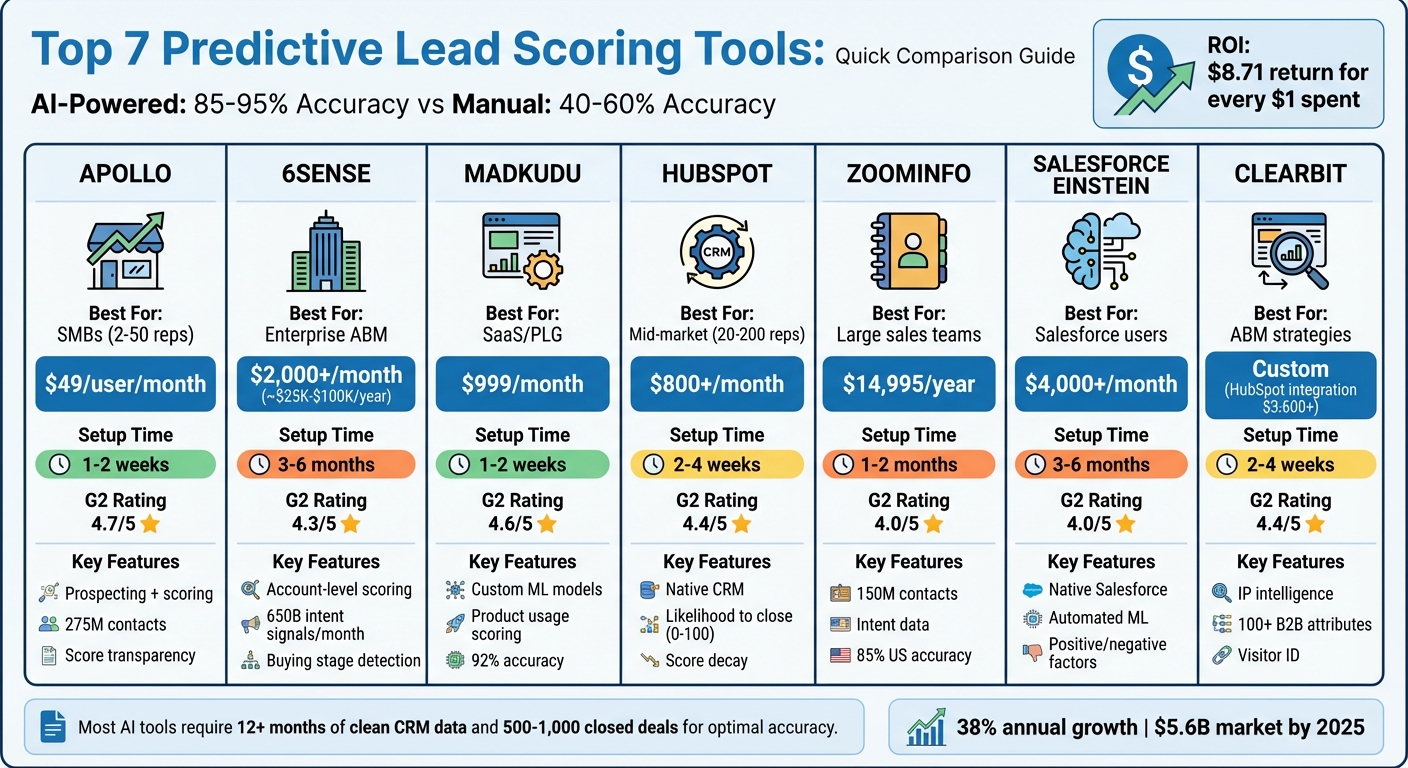
Predictive lead scoring tools use AI and machine learning to identify which leads are most likely to convert into customers. These tools analyze historical data, behavioral signals, and firmographics to prioritize leads, saving time and boosting sales efficiency. While manual systems achieve 40–60% accuracy, AI-powered tools reach 85–95%, helping sales teams focus on high-quality prospects.
Here are the top tools:
- Apollo: Affordable for SMBs, combines prospecting and scoring with a vast database.
- 6sense: Ideal for enterprise ABM strategies, focuses on account-level insights.
- MadKudu: Tailored for SaaS and product-led growth, uses custom models for precision.
- HubSpot: Integrated into its CRM, offers "Likelihood to Close" scores for mid-market teams.
- ZoomInfo: Provides extensive B2B data and intent signals, great for large sales teams.
- Salesforce Einstein: Built into Salesforce, automates lead prioritization with machine learning.
- Clearbit: Enriches data for real-time lead scoring, strong for ABM strategies.
Quick Comparison
| Tool | Best For | Starting Price (Monthly) | Key Features | Setup Time |
|---|---|---|---|---|
| Apollo | SMBs (2–50 reps) | $49/user | Prospecting, scoring, transparency | 1–2 weeks |
| 6sense | Enterprise ABM | $2,000+ (≈$25K/year) | Account-level scoring, intent data | 3–6 months |
| MadKudu | SaaS/PLG | $999 | Product usage scoring, custom models | 1–2 weeks |
| HubSpot | Mid-market teams | $800+ | CRM integration, score decay | 2–4 weeks |
| ZoomInfo | Large sales teams | $14,995/year | B2B database, intent signals | 1–2 months |
| Salesforce Einstein | Salesforce users | $4,000+ | Native CRM sync, automated scoring | 3–6 months |
| Clearbit | ABM strategies | Custom | Data enrichment, visitor identification | 2–4 weeks |
Each tool has unique strengths, but the right choice depends on your team size, budget, and data readiness. Start with a free trial or pilot to see which solution delivers the best results for your sales process.
Predictive Lead Scoring Tools Comparison: Features, Pricing & Best Use Cases
Use Predictive Lead Scoring in Dynamics 365 Sales for Better Lead Conversions 📈
sbb-itb-6e7333f
1. Apollo
Apollo combines a massive database of over 275 million verified contacts with AI-powered scoring to help sales teams pinpoint high-converting prospects - all without needing multiple tools. By analyzing historical win/loss data and integrating your CRM with Apollo’s firmographic and behavioral data, the platform generates real-time lead scores directly in search results.
Core Predictive Features
Apollo’s AI-driven auto-scores learn from your past deals, uncovering patterns that lead to successful conversions. You can also create custom scoring models by setting specific criteria and weightings, blending your CRM data with Apollo's insights. A standout feature is its score transparency: Apollo clearly explains why each lead ranks high, whether it’s due to recent funding, tech stack usage, or intent signals.
"Having used other scoring solutions, Apollo's scores are in a league of their own due to their wealth of data. Setting up score models is a breeze, and the results are lightning-fast." - Kaleb Jessee, VP of Sales, Talent Quest
Pricing (in USD)
Apollo offers a free tier with limited credits, perfect for testing the waters. Paid plans start at $49 per user/month for the Basic tier, $79 per user/month for Professional, and go up to $119 per user/month for larger teams. One company shared that switching to Apollo helped them cut annual tool costs from $35,000 to $12,000 [7,9,10].
Ideal B2B Use Case
Apollo is a great fit for high-growth SMBs and mid-market companies with fewer than 20 sales reps, making it one of the best email marketing platforms for small business needs. It’s especially effective for sales-led teams that need a single platform for prospecting, scoring, and outreach - ideal for quickly identifying and reaching individual prospects rather than managing complex enterprise campaigns.
Limitations
While Apollo shines in lead-level scoring, it falls short in delivering the deep account-level intent data needed for enterprise ABM strategies. Users have also flagged occasional CRM sync issues and inconsistent data quality outside the U.S. [7,9]. Despite these drawbacks, Apollo maintains an impressive 4.8/5 rating on G2 from over 7,500 reviews. However, some experts note that its scoring doesn’t quite match the precision of specialized enterprise-focused engines [7,9].
2. 6sense
6sense is designed for enterprise teams managing advanced ABM strategies and closing six-figure deals. Instead of focusing on individual leads, 6sense targets entire accounts, providing insights tailored for large-scale transactions. The platform monitors over 200 million companies and 700 million contacts, helping identify accounts actively researching solutions - even before they land on your website. Let’s dig into its standout features, pricing, ideal use cases, and potential drawbacks.
Core Predictive Features
6sense processes an impressive 650 billion intent signals each month, capturing the 97% of B2B research that happens before prospects fill out forms. Its predictive engine uses several advanced models:
- Account Temperature: Combines first-party web data with third-party B2B activity to gauge interest.
- Profile Fit Analysis: Scores accounts based on how closely they align with your Ideal Customer Profile (ICP), drawing from historical closed/won data.
- Buying Stage Detection: Classifies accounts into stages like Awareness, Consideration, Decision, or Purchase.
The 6sense Qualified Accounts (6QAs) feature highlights accounts with high intent and strong ICP alignment, enabling sales teams to focus their outreach. This is powered by over 500 terabytes of technographic and firmographic data.
"Would you rather spray and pray, wasting resources, or target somebody who's raising their hand? That's the 6sense difference." - Chris Kein, National Business Development
These capabilities are powerful but come with a price tag, as outlined in the next section.
Pricing (in USD)
6sense’s pricing aligns with its enterprise focus. Costs vary depending on the plan and organization size:
- Team Tier: Starts around $25,000 per year.
- Growth Plan: Typically ranges from $50,000 to $75,000 annually.
- Enterprise Deployments: Generally exceed $75,000, with some setups surpassing $100,000 depending on modules and scale.
The median annual contract value is $58,617. Additionally, implementation fees range from $10,000 to $50,000, and setup can take anywhere from 3 to 6 months.
Ideal B2B Use Case
6sense is best suited for mid-market to enterprise organizations handling deals over $100,000, especially when multiple stakeholders are involved. It’s particularly effective for companies with annual revenues above $10 million that aim to identify in-market accounts before traditional lead capture. Industries benefiting most include:
- Marketing (8,009 customers)
- Digital Marketing (7,194 customers)
- Technology (5,612 customers)
Limitations
The platform’s high cost, starting at $25,000 to $50,000 annually, makes it less accessible for smaller businesses, especially those with lower-value contracts. Additionally, 6sense requires at least a year of clean CRM data and around 1,000 leads to train its predictive models effectively, achieving over 80% accuracy. Its complexity means teams need ongoing training and change management for consistent use. While 6sense excels at capturing broad B2B intent signals, it misses niche metrics like GitHub activity, which could be critical for developer-focused companies. Despite these challenges, 6sense holds a 4.3/5 rating on G2 from more than 1,900 reviews.
3. MadKudu
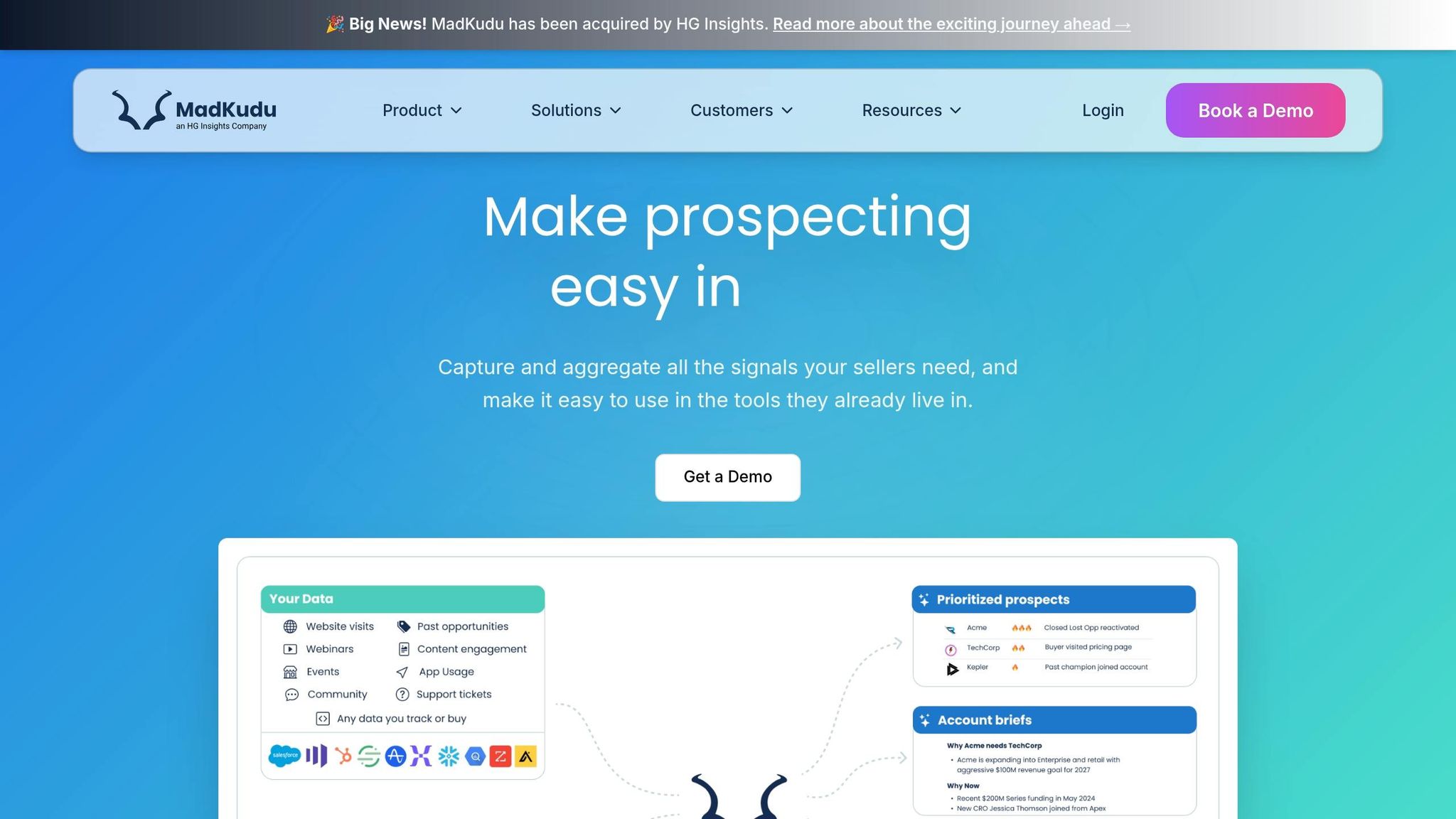
MadKudu stands out by creating custom machine learning models tailored to your company's historical data. Unlike generic algorithms, these models are specifically trained to reflect your business's unique patterns, making it a go-to predictive lead scoring tool for B2B marketers. This is especially helpful for B2B SaaS companies, where product usage signals often carry more weight than traditional firmographic data. By analyzing thousands of data points across Fit (firmographics, demographics, technographics) and Behavioral (email, web, and in-app activity) categories, MadKudu delivers an impressive 92% prediction accuracy. Sales teams also gain transparency into lead scores through decision trees and "Lead Signals", which help rebuild confidence in automated scoring systems. Companies using MadKudu report a 3x improvement in lead velocity, a 50% boost in lead-to-opportunity conversions, and a significant reduction in time spent on unqualified leads.
Core Predictive Features
MadKudu integrates seamlessly with product analytics tools like Segment, Mixpanel, and Amplitude to score leads based on in-app behavior. It identifies key actions - such as feature usage, inviting teammates, or completing onboarding - that indicate buying intent, even before prospects formally engage with sales. This capability is a game-changer for Product-Led Growth (PLG) businesses, where users often explore products independently before reaching out to sales teams.
The platform assigns lead grades that guide the ideal buyer journey and adjusts sales actions in real time based on engagement. Instead of relying on basic point-based systems, MadKudu's machine learning uncovers hidden patterns in conversion data that other tools might overlook. With these advanced features, MadKudu offers flexible pricing plans to meet different business needs:
Pricing (in USD)
| Plan | Monthly Cost | Lead Volume | Key Features |
|---|---|---|---|
| Growth | $1,999 | Up to 2,000 leads | Real-time scoring, tech integrations |
| Pro | $3,499 | Up to 6,000 leads | PQLs, smart retargeting, Slack support |
| Enterprise | Custom | Unlimited | Custom models, SLA guarantees |
Onboarding fees typically range from $5,000 to $20,000, with setup times averaging 1–2 weeks for most teams. The median annual contract value is $32,288. Be aware of potential overage fees if lead volumes exceed your tier and additional costs for third-party data enrichment from providers like ZoomInfo or Clearbit.
Ideal B2B Use Case
MadKudu is best suited for Series B+ SaaS companies with complex products and sales cycles longer than 30 days. It’s particularly effective for Product-Led Growth businesses, where product usage data plays a critical role in conversions. To get the most out of the platform, companies need at least 100–200 historical closed-won or closed-lost deals to train the custom models. Early-stage startups with limited data may find it challenging to achieve meaningful results.
Limitations
The starting price of $1,999 per month can be a barrier for early-stage startups and small businesses. While setup typically takes just 1–2 weeks, the initial configuration requires careful mapping of data outcomes, which can be time-intensive. Users have also reported occasional delays with Salesforce integrations and a learning curve when working with decision tree logic. Despite these challenges, MadKudu maintains a strong 4.6/5 rating on G2, based on feedback from over 110 verified users.
4. HubSpot Predictive Lead Scoring
HubSpot's predictive lead scoring is integrated into its platform for Marketing Hub Enterprise and Sales Hub Enterprise users. This feature calculates a "Likelihood to Close" score ranging from 0 to 100, which reflects the probability of a contact converting within 90 days. For instance, a score of 22 indicates a 22% chance of conversion during that time frame. HubSpot also segments contacts into four priority tiers - Very High, High, Medium, and Low - helping sales teams quickly pinpoint which leads require immediate focus.
Core Predictive Features
HubSpot's predictive scoring leverages thousands of data points from behavioral and firmographic sources. Behavioral insights include website visits, email engagement, social media interactions, and CRM activities. On the firmographic side, HubSpot's Breeze Firmographic Enrichment adds context with details like annual revenue, technology usage, and employee count to determine whether a lead aligns with your ideal customer profile.
The platform also uses AI-Powered Recommendations to analyze historical data - such as transitions from Marketing Qualified Leads (MQLs) to Sales Qualified Leads (SQLs) - to create scoring criteria based on patterns of successful conversions.
"HubSpot uses blackbox machine learning to provide predictions... it's not possible to know exactly how each input contributes to a contact's score." - HubSpot Knowledge Base
A standout feature is Score Decay, which gradually lowers engagement scores over time (at intervals of 1, 3, 6, or 12 months). This ensures that older, inactive leads don’t remain categorized as high-priority. Additionally, the Multi-Object Scoring capability allows users to prioritize not just contacts, but also companies and deals, making it a comprehensive tool for managing high-volume B2B pipelines.
Pricing (in USD)
Predictive lead scoring is included with Marketing Hub Enterprise and Sales Hub Enterprise subscriptions. There’s no extra charge for these predictive features, but your account must meet certain thresholds: at least 100 contacts are needed for Contact Priority values to appear, and the AI model requires a minimum of 50 contacts (25 converted and 25 non-converted) to generate scores.
This means the feature may not be ideal for small businesses or startups without a significant number of historical conversions. For teams that don’t meet these requirements, HubSpot offers manual lead scoring at the Professional tier, which relies on clear, rule-based criteria.
Ideal B2B Use Case
HubSpot’s predictive scoring shines in enterprise-level organizations managing thousands of leads each month. It’s especially useful for businesses with complex, multi-touch sales cycles where manual scoring becomes inefficient. The 90-day prediction window aligns well with B2B companies whose deals typically close within 30 to 120 days. By automating lead prioritization, the system helps reduce bias and streamline collaboration between sales and marketing teams.
Limitations
One of the main challenges with HubSpot's predictive scoring is its "blackbox" nature. While you can view the data inputs, the exact weight of each input in the final score remains unclear. This lack of transparency can frustrate teams looking to understand why specific leads rank higher or lower. Additionally, the fixed 90-day prediction window may not suit businesses with significantly shorter or longer sales cycles, and the system offers limited customization options.
"The biggest lift in lead scoring is not defining how many points something is worth, it's making sure everyone internally is aligned." - Ryan Durling, Inbound Consultant, HubSpot
To mitigate these limitations, many teams combine predictive scoring with manual scoring to improve clarity. Setting up automated workflows can also help turn scores into actionable outcomes, such as routing high-priority leads to specific sales reps or triggering personalized nurture campaigns. This approach ensures that predictive scores are not just theoretical but actively drive results.
5. ZoomInfo
ZoomInfo taps into one of North America's largest B2B databases, combining it with AI-powered scoring to identify accounts that are ready to buy. With over 150 million professional contacts and 20 million company profiles, the platform boasts an 85% accuracy rate for US-based data. Its predictive scoring evaluates three key dimensions: Fit (how closely a prospect matches your ideal customer profile), Opportunity (timing signals like funding events or leadership changes), and Intent (indicators of active research behavior).
ZoomInfo offers several standout tools: the GTM Context Graph, which integrates its database with CRM data, sales conversations, and behavioral signals; ZoomInfo Copilot, which prioritizes leads and delivers instant account insights; and WebSights, which identifies anonymous website visitors and links them to potential decision-makers within their companies. These tools collectively power the platform's predictive capabilities.
Core Predictive Features
The Account Fit Score uses AI to show how well each lead aligns with your ideal customer profile. Intent data highlights companies actively researching relevant topics, giving teams the chance to connect with prospects before they even fill out a form. Custom signals allow businesses to track buying behaviors unique to their needs, while score decay ensures inactive leads are deprioritized, keeping the focus on engaged prospects.
"Opportunity lives at the intersection of fit and timing." - ZoomInfo
These features directly enhance sales efficiency. For example, ZoomInfo's own sales team routes only 32-34% of form submissions to frontline sales, with the rest sent to nurture programs because they don't meet qualification criteria yet. Additionally, data shows that the likelihood of booking a demo drops by about 50% if more than 30 minutes pass after a site visit.
Pricing (in USD)
ZoomInfo's pricing reflects its enterprise-level capabilities and requires annual contracts - no monthly payment options are available.
- Professional Plan: Starts at $14,995 per year for up to three users but does not include intent data.
- Advanced Plan: Begins at $24,995 annually and includes intent data and automation features.
- Elite/Enterprise Plans: Cost $40,000 or more per year, offering custom integrations and dedicated support.
- ZoomInfo Lite: A free tier for individuals, though it requires sharing email contacts and limits users to 10-25 monthly credits.
Most implementations cost between $25,000 and $60,000 annually after adding necessary features. To avoid automatic contract renewal, a 60-day notice is required.
Ideal B2B Use Case
ZoomInfo is especially effective for mid-market and enterprise organizations with at least 10 sales reps focused on high-volume prospecting in the US. It's a strong fit for account-based marketing strategies, where teams prioritize entire accounts rather than individual leads. To fully leverage its machine learning models, businesses need at least six months of consistent lead flow and a clean CRM with a minimum of 50 closed deals.
The platform shines for teams employing fast-response strategies, helping them identify and engage in-market accounts early in the buying process. Users of ZoomInfo Copilot reportedly generate twice as many opportunities as their peers.
Limitations
While ZoomInfo is powerful, it does have its drawbacks. Its intent data has a 52% false positive rate, often flagging interest based on a single employee’s activity, such as reading an article, rather than signals from a full buying committee. For international operations, data accuracy drops significantly to 50-60% outside the US and UK, making it less reliable globally.
"ZoomInfo delivers unmatched B2B contact data for US markets... However, the $14,995+ annual cost and poor international data quality mean it's only worth it for large enterprise sales teams." - Max-Productive.ai Editor
Additionally, the platform has a steep learning curve, often requiring months and dedicated sales operations support to achieve full ROI. Its high entry cost and rigid annual contracts make it less accessible for small businesses and startups. Organizations with fewer than 100 closed deals are better off starting with simpler, rules-based scoring systems until they have enough historical data to benefit from ZoomInfo's advanced features.
6. Salesforce Einstein Lead Scoring
Salesforce Einstein Lead Scoring brings machine learning directly into your CRM, using historical conversion data to predict which leads are most likely to close. It automatically tests algorithms like Logistic Regression, Random Forests, and Naive Bayes, selecting the one that performs best for your business needs. Each lead is assigned top positive and negative scoring factors - things like industry, job title, or engagement patterns - giving sales reps valuable context on why certain leads are prioritized higher.
To create a custom model, the platform requires at least 1,000 leads and 120 conversions from the past six months. If your data doesn’t meet these thresholds, Salesforce uses a Global Model until enough local data is available. Scores are refreshed every one to four hours, and predictive models retrain every 10 to 30 days.
Core Predictive Features
Einstein evaluates up to 100 fields on the Lead object, including both standard and custom fields, to identify conversion patterns. On average, sales reps spend 8% of their time prioritizing leads and opportunities, but Einstein simplifies this by automating lead sorting and routing high-priority prospects through Process Builder. It also considers negative scoring factors - like generic email domains or unrelated geographic regions - to filter out low-quality leads before they reach your sales team.
These predictive tools integrate smoothly into the Salesforce ecosystem, making them practical for businesses already using the platform.
Pricing (in USD)
Einstein Lead Scoring is included in the Performance ($500 per user/month) and Unlimited ($330 per user/month) editions. For Enterprise Edition users ($165 per user/month), it’s available as a $50 per user/month add-on through the Sales Cloud Einstein package. Implementation costs range from $150 to $300 per hour, with data migration and cleaning services costing between $15,000 and $50,000. For a 10-person team, annual expenses can exceed $40,000.
"The cost of implementation is quite high for small businesses and also it is a little difficult to use the product for those who are new to AI." - Senior Associate Business Manager, Education Sector
Ideal B2B Use Case
Einstein’s ability to automate lead prioritization boosts sales efficiency, aligning well with predictive scoring strategies. It’s especially effective for mid-market and enterprise-level organizations already using Salesforce with a minimum of 1,000 leads and 120 conversions in their CRM. The tool is particularly helpful for teams managing large lead volumes, as it prioritizes prospects based on fit rather than just engagement. Companies employing AI-driven lead scoring can see up to 70% higher ROI by focusing efforts on high-conversion prospects.
Limitations
The 10-day model retraining cycle can cause delays in adapting to rapidly changing market conditions. Additionally, the "black box" nature of Einstein’s scoring sometimes frustrates sales teams when results don’t align with their instincts. The tool also doesn’t incorporate real-time behavioral data from non-Salesforce sources. By default, Einstein analyzes all CRM fields, including irrelevant ones, which can lead to misleading correlations. To improve accuracy, you’ll need to manually exclude unnecessary fields during setup. For smaller businesses with fewer than 1,000 leads, simpler scoring methods may be a better fit until sufficient data is available.
7. Clearbit
Clearbit wraps up our list by offering a powerful data enrichment tool that supports predictive scoring. Rather than functioning as a standalone scoring system, it acts as a data enrichment layer. Clearbit identifies anonymous website visitors using IP intelligence and enhances lead records with over 100 B2B attributes. These attributes include firmographics like company size and revenue, along with technographics that show the software a prospect uses. The enriched data can be seamlessly integrated into your CRM or existing scoring platforms.
Core Predictive Features
Clearbit Reveal allows you to identify and score companies visiting your website - even before they fill out a form. Once an email is captured, the platform instantly enriches the record with accurate company details, enabling immediate sales routing or personalized nurturing sequences. You can also implement negative scoring to exclude low-value leads, such as those from specific industries or smaller companies.
"We use Clearbit to route leads based on location or industry, score leads, and train machine learning models. Clearbit offers clear and comprehensive sales data." - Dharmesh Shah, CTO and Co-Founder, HubSpot
These features make Clearbit a versatile tool with pricing tailored to enterprise needs.
Pricing (in USD)
Clearbit Reveal starts at $99/month for basic visitor identification. For the full platform, pricing is customized based on data volume and enrichment needs, emphasizing its enterprise-level focus. Since HubSpot acquired Clearbit, its predictive features have been incorporated into HubSpot Marketing Hub Enterprise, which starts at $3,600/month.
Ideal B2B Use Case
Clearbit is a great match for high-growth B2B teams using Account-Based Marketing (ABM) strategies. It helps identify high-value accounts in real time as they explore solutions. For example, Patrick Edmonds, CMO at Proposify, uses Clearbit's data to pinpoint leads that align with their ideal customer profile. These leads are then routed directly to the inbound sales team. This approach ensures that valuable opportunities don’t slip through the cracks by providing instant qualification context.
Limitations
While Clearbit enriches data for predictive scoring, it requires integration with a CRM or automation tools to handle final scoring and routing workflows. Additionally, its pricing structure is not transparent and only available through custom quotes, which can complicate budgeting. Building effective predictive models also requires over 12 months of historical data. Some users have noted issues with outdated contact information, and implementing the API may require technical expertise.
Tool Comparison Table
Here's a breakdown of seven predictive lead scoring tools, comparing pricing, features, setup time, and the ideal business size. Use this guide to align your team's goals and budget with the most suitable platform.
| Tool | Best For | Pricing (Monthly) | Key Features | Setup Time | G2 Rating |
|---|---|---|---|---|---|
| Apollo | SMB (2–50 reps) | $49–$119/user | All-in-one prospecting and scoring, waterfall enrichment | 1–2 weeks | 4.7/5 |
| 6sense | Enterprise ABM | $2,000+ (≈$25K–$100K+/year) | Intent data, anonymous buyer ID, account-level scoring | 3–6 months | 4.3/5 |
| MadKudu | SaaS and PLG | $999–$2,499 | Transparent AI, product usage patterns, explainable scores | 1–2 weeks | 4.6/5 |
| HubSpot | Mid-market (20–200 reps) | $800–$3,600 | Native CRM integration, likelihood to close, score decay | 2–4 weeks | 4.4/5 |
| ZoomInfo | Mid-market/Enterprise | $2,000+ (≈$25K+/year) | 250M+ contact database, real-time intent signals, Copilot AI | 1–2 months | 4.0/5 |
| Salesforce Einstein | Salesforce power users | $4,000–$15,000 | Automated machine learning, identification of positive/negative factors, native CRM sync | 3–6 months | 4.0/5 |
| Clearbit | HubSpot users (ABM) | Custom (integrated with HubSpot starting ≈$3,600+) | IP intelligence, 100+ B2B attributes, visitor identification | 2–4 weeks | 4.4/5 |
For small businesses working with tighter budgets, Apollo is a solid choice, starting at $49/user/month, while HubSpot Professional offers another option at $800/month. Both tools have relatively quick setup times, taking between 1 and 4 weeks.
Mid-market SaaS companies might find MadKudu particularly effective for prioritizing leads, thanks to its transparent scoring system. Alternatively, ZoomInfo is a great fit for teams that need access to a massive, enriched contact database.
Enterprise teams focusing on account-based marketing can turn to 6sense, which provides powerful intent data and account-level scoring. However, it does require a longer setup period. Similarly, Salesforce Einstein is ideal for companies already committed to the Salesforce platform, though it works best when you can supply at least 1,000 leads for training the model.
It's worth noting that most predictive AI tools need at least 12 months of clean CRM data and 500–1,000 closed deals to build accurate scoring models.
Conclusion
Picking the right predictive lead scoring tool boils down to three main factors: your data readiness, budget, and sales process. If your CRM history is still growing, start with rule-based scoring until you've built up at least 12 months of clean data and closed 500–1,000 deals. At that point, you'll be ready to transition to AI-powered predictive scoring. This step-by-step approach matches the capabilities of the tools we’ve covered.
Predictive tools are designed to cut down inefficiencies in lead prioritization. And they work - AI-powered systems boast 85–95% accuracy in identifying conversions, compared to the 40–60% accuracy typically achieved through manual methods. Plus, the return on investment is hard to ignore: lead scoring delivers an average ROI of $8.71 for every $1 spent within the first year.
Based on the tools highlighted earlier, here’s some guidance: SaaS and product-led growth teams might find MadKudu’s $999/month plan appealing for its clear scoring transparency, showing exactly why a lead ranks high or low. For Enterprise ABM teams, 6sense offers account-level intent data, though it requires a 3–6 month setup period. If you’re already using Salesforce or HubSpot, their native tools - Salesforce Einstein or HubSpot Predictive Lead Scoring - are the easiest options to avoid data integration headaches. These choices reflect the insights shared in the comparison table above.
To make an informed decision, take advantage of free trials by running a 30-day pilot with 3–5 key users. Compare the AI-generated scores to your historical conversion data and ensure the tool integrates smoothly with your CRM and email systems. Otherwise, you risk spending more time troubleshooting integrations than scoring leads.
With the predictive lead scoring market growing at 38% annually and projected to hit $5.6 billion by 2025, now is the time to streamline your pipeline. Choose a tool that aligns with your team’s needs, implement it with clean data, and see measurable conversion gains sooner rather than later.
FAQs
How much clean CRM data do I need for predictive lead scoring to work well?
To build a reliable predictive lead scoring model, it's essential to have a solid foundation of clean CRM data. Specifically, you'll need at least 40 qualified leads that have been both created and closed. This provides the model with enough data to make accurate and meaningful predictions.
Which tool is best for lead-level scoring vs account-based (ABM) scoring?
The right tool for you hinges on your specific needs. If you're focused on lead-level scoring, tools like Chronexa's AI SDR Engine and HubSpot Breeze are great choices. They provide adaptable logic and integrate smoothly with CRMs. On the other hand, for ABM (Account-Based Marketing) scoring, 6sense shines. It excels in leveraging advanced intent data and targeting intricate buying committees. Your decision should align with whether your priority is scoring individual leads or implementing account-focused strategies.
How can I run a 30-day pilot to validate lead score accuracy and ROI?
To kick off a 30-day pilot, start by selecting a predictive lead scoring tool that offers real-time analytics. Set clear success metrics - think conversion rates and ROI - to measure the tool's effectiveness. Make sure to integrate the tool seamlessly with your CRM, then use it to prioritize leads based on their scores.
Throughout the pilot, monitor key outcomes like engagement levels and conversion rates. At the end of the 30 days, review how high-scoring leads performed. This is your chance to evaluate the tool's accuracy and determine its overall impact on your bottom line.