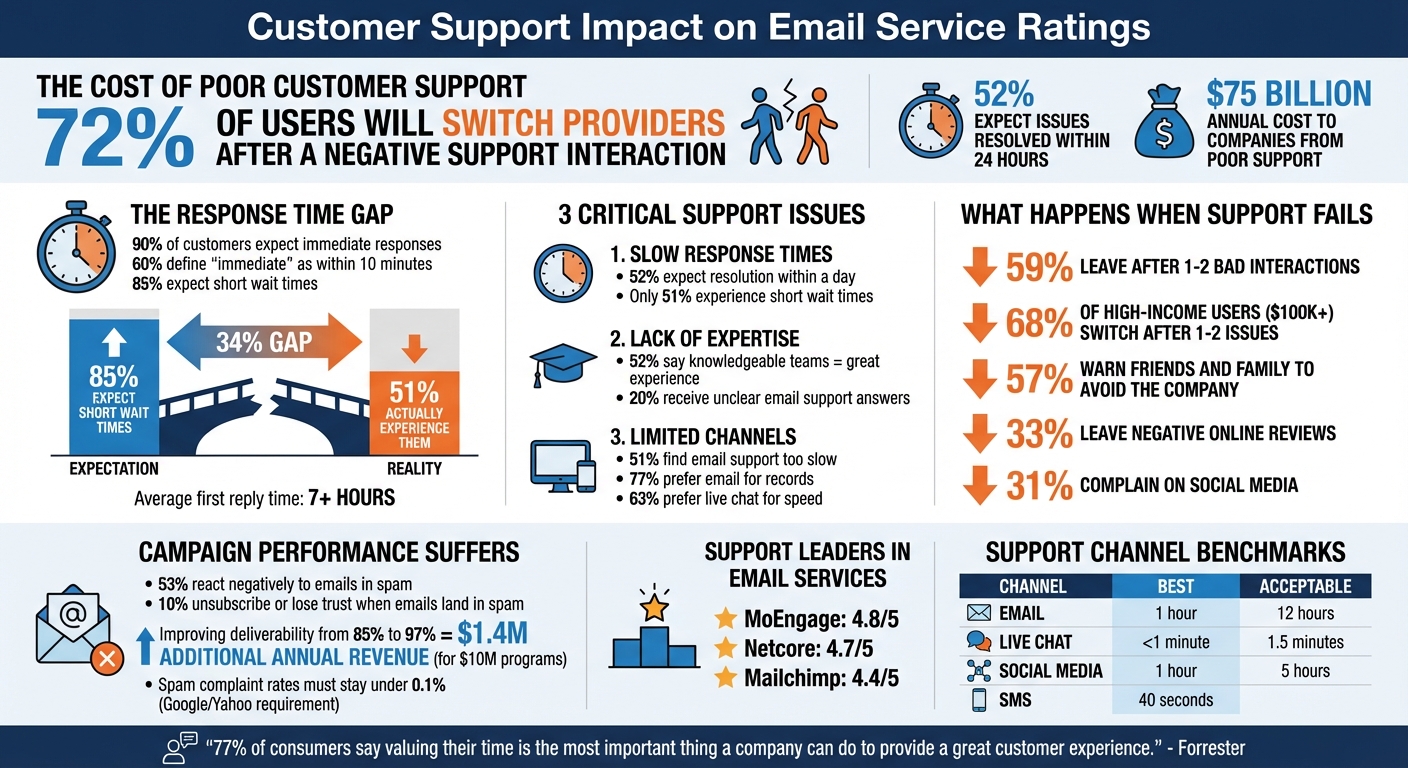
When managing email marketing, customer support can make or break your experience. A single negative interaction can lead 72% of users to switch providers, and 52% expect their issues resolved within a day. Poor support causes delays, missed opportunities, and frustration - all of which impact service ratings.
Key Takeaways:
- Support quality directly impacts ratings: Slow responses, unhelpful answers, and limited channels lead to negative reviews and customer churn.
- Common issues: Long wait times, lack of email-specific expertise, and limited support options frustrate users.
- What users want: Fast, knowledgeable support through multiple channels like live chat, phone, and self-service tools.
- Impact on performance: Unresolved issues hurt deliverability, engagement rates, and revenue.
Quick Tips to Improve Support:
- Offer faster, multi-channel support (e.g., live chat, phone, email).
- Train teams on email-specific problems like deliverability and authentication.
- Use technology like ticketing systems and AI tools to manage inquiries efficiently.
Support isn’t just about solving problems - it shapes trust, satisfaction, and your platform’s reputation. If you’re choosing an email platform, prioritize one with reliable, responsive support.
How Customer Support Quality Impacts Email Service Provider Ratings and User Retention
Common Customer Support Problems in Email Marketing Services
Even the top email marketing platforms can lose their edge when customer support falls short. Users frequently highlight three recurring issues that significantly impact their overall experience. Let’s dive into these challenges and understand their effects on user satisfaction.
Slow Response Times
Imagine being locked out of your account or struggling to send a campaign. In these moments, every second feels like an eternity. For 90% of customers, an "immediate" response is essential, with 60% defining "immediate" as a reply within just 10 minutes. Unfortunately, most email service providers fail to meet this expectation.
The numbers paint a clear picture: while 85% of users expect short wait times as a standard, only 51% actually experience them - a 34% gap that creates real frustrations. This delay can have serious consequences. If you're stuck waiting hours (or worse, days) for help with a deliverability issue, your campaign is at a standstill. Time-sensitive promotions miss their mark, and potential revenue slips through the cracks.
It’s not just about productivity; the emotional toll is real too. Sending a support request and hearing nothing back leaves customers anxious, wondering if their issue has even been acknowledged. While 52% of users expect their problems resolved within a day, many platforms struggle to meet this benchmark - especially for technical challenges that require deeper investigation.
Lack of Email-Specific Knowledge
When your emails are ending up in spam or your DKIM authentication isn't working, generic support replies simply won’t help. Email marketing comes with its own set of technical complexities, and when support agents lack expertise, users are left with vague, unhelpful responses that waste time and add to their frustration.
Here’s the reality: 52% of customers say a "great" experience hinges on knowledgeable support teams. Yet, 20% of users report receiving unclear answers through email support. This lack of expertise often means agents can’t troubleshoot crucial issues like SPF records or sudden drops in engagement rates. As a result, tickets are escalated, wait times grow longer, and frustration mounts.
The repercussions aren’t just personal - they’re financial. Poor support costs companies an estimated $75 billion annually. And when users are forced to repeat their issues to multiple agents, they start questioning whether the platform is worth their time and money.
Limited Support Channels
Email support alone doesn’t cut it for today’s users. While email is great for documentation, 51% of customers find it too slow. People now expect a variety of support options: live chat for quick fixes, phone support for urgent issues, and self-service tools for common questions. Limiting support to email-only creates unnecessary roadblocks.
Different channels serve different needs. For instance, 77% of users prefer email for keeping records, but 63% lean on live chat for immediate answers. Phone support is invaluable for complex problems that require detailed back-and-forth discussions. Yet, many email marketing platforms stick to email-only support, often with long response times. This lack of options becomes especially frustrating during off-hours. If you face a critical issue late on a Friday night and your only option is to send an email, you might not get help until Monday - leaving your campaigns in limbo.
This lack of accessibility directly affects satisfaction. Users increasingly expect support to be available when and how they need it, not just during standard business hours. When platforms fail to meet these expectations, it’s no surprise that frustration grows.
How Poor Support Damages Email Service Ratings
When customer support falls short, the consequences hit hard and fast: complaints pile up, trust erodes, and campaign performance suffers. All of this directly impacts email service ratings, and here’s why it matters for your business.
More Complaints and Unsubscribes
Poor support experiences drive customers away in record time. In fact, 59% of users will leave after just one or two bad interactions. This isn’t a slow trickle - it’s an immediate wave of departures that drags service ratings down.
The ripple effect doesn’t stop there. A whopping 57% of dissatisfied customers will warn their friends and family to avoid the company. In email marketing, where word-of-mouth plays a huge role, this can snowball quickly. One unresolved ticket doesn’t just lose one customer - it could mean losing dozens of potential sign-ups.
The stakes are even higher with high-income users. Among those earning over $100,000 annually, 68% will switch providers after just one or two negative experiences. These customers often manage larger campaigns with more valuable accounts, making their departure especially costly. Add to this the frustration caused by slow issue resolution or inaccurate information - cited by 54% of users as a major pain point - and you’ve got a recipe for accelerated churn and plummeting ratings.
Negative Reviews and Lost Trust
When customers leave, the damage doesn’t end there. Many take their frustrations public. About 33% of upset users will leave a negative review online, while 31% will vent on social media. These complaints stick around, influencing potential customers long after the initial incident.
Unclear responses from support teams - something 20% of users report experiencing through email support - only add fuel to the fire. When tickets go unanswered or take too long to resolve, users start questioning the platform’s reliability. For businesses relying on email providers to handle sensitive marketing data, this loss of confidence is devastating.
"77% of consumers say valuing their time is the most important thing a company can do to provide a great customer experience." - Forrester
Time is money, and when users feel their time isn’t respected, the fallout is swift. Slow or unhelpful support sends a clear message: their business isn’t valued. This frustration often leads to public warnings and negative sentiment, further eroding trust. With 52% of U.S. customers switching providers in a single year due to poor experiences, the link between bad support and lost business couldn’t be clearer.
Lower Deliverability and Engagement Rates
Support issues don’t just hurt relationships - they can also tank campaign performance. When technical problems, like setting up SPF, DKIM, or DMARC, go unresolved, emails start landing in spam folders. This has a direct impact: 53% of users react negatively to emails in spam, and 10% will unsubscribe or lose trust in the brand entirely.
Here’s the financial kicker: improving deliverability from 85% to 97% can add up to $1.4 million in annual revenue for an email program generating $10 million. When support teams fail to help users hit these benchmarks, they’re not just offering bad service - they’re costing businesses real money, which inevitably drags down service ratings.
"Failing to receive messages from customer support will quickly erode trust in your brand." - Kasey Steinbrinck, Sr. Content Marketing Manager, Sinch Mailjet
The situation worsens when customer service emails share the same infrastructure as marketing emails. Poor practices can harm the sender’s reputation, causing critical support emails - like password resets or account notifications - to end up in spam. While 71% of users will search their spam folder for these missing messages, the damage to brand perception is already done. And with Google and Yahoo requiring spam complaint rates under 0.1%, inadequate support can push users into “Gmail jail,” where recovering reputation can take months - a luxury most businesses can’t afford.
How to Improve Customer Support for Email Services
Making smart changes in response speed, team training, and technology can dramatically enhance customer support, boosting satisfaction and service ratings.
Add Faster, Multi-Channel Support
Did you know that 90% of customers expect immediate responses, yet the average first reply time is over 7 hours? That’s a big gap. To close it, email service providers should offer multiple support channels like live chat, phone, SMS, and even WhatsApp. These faster options help address urgent issues - like billing or technical problems - more quickly by directing them away from slower channels.
Take Vacasa, for example. In 2024, they adopted the Hiver customer service platform to better manage support emails. This move allowed them to handle emails 80% faster, not by hiring more staff, but by improving how tasks were distributed and routed internally.
Setting clear Service Level Agreements (SLAs) is another way to improve response times. Teams that commit to specific goals - like answering 90% of emails within four hours - are more likely to meet customer expectations and stay accountable.
| Channel | Best in Class Response Time | "Good Enough" Response Time |
|---|---|---|
| 1 hour | 12 hours | |
| Live Chat | < 1 minute | 1.5 minutes |
| Social Media | 1 hour | 5 hours |
| SMS | 40 seconds | N/A |
By pairing faster response channels with well-trained teams, you can ensure email-specific challenges are addressed more effectively.
Train Support Teams on Email-Specific Issues
Email support isn’t just about hitting “reply.” Teams need to understand complex topics like deliverability problems, spam filtering, and SPF/DKIM/DMARC setups. Yet, only 20% of companies resolve customer questions fully on the first reply. That leaves 80% of users sending follow-ups, dragging out resolution times and creating frustration. With specialized training, agents can resolve issues faster, cutting down the average 2.4 emails needed per case.
Tone and empathy are just as important as technical skills. Around 38% of customers find robotic responses frustrating. Agents should acknowledge the emotional side of complaints before diving into solutions. As Mailchimp put it:
"The emotional damage of feeling dismissed often outweighs the practical value of the solution provided".
Regular calibration sessions - where teams review anonymized email threads - help maintain consistency in tone and problem-solving. A “phrases to avoid” guide, with alternatives like swapping "You need to…" for "We recommend…", can also improve interactions and leave customers feeling heard.
While training builds a strong foundation, the right technology can take support efficiency to the next level.
Use Technology to Improve Support Efficiency
Technology is a game-changer for customer support. Start with a ticketing system that turns incoming emails into organized tasks. This ensures no message slips through the cracks and allows for automated routing based on urgency or issue type. For instance, emails flagged with keywords like "urgent" or "fraud" can be prioritized automatically.
AI-powered tools are also becoming essential. Chatbots and virtual agents can handle repetitive inquiries 24/7, freeing human agents to focus on more complicated issues. Some companies report that AI now handles up to 93% of support tickets without human intervention. For email services, this means instant responses to common questions like password resets or billing inquiries.
Liberty London, for example, saved over $21,000 annually by using Zendesk AI to streamline customer support operations. As Ian Hunt, their Director of Customer Services, explained:
"With Zendesk AI, I am seeing an exciting opportunity to streamline and be more efficient. That will allow our team to have more time to work on projects of importance to the business".
Other tools like macros and saved replies can speed up responses to frequently asked questions while still allowing for personalization, such as adding order details or account specifics. AI assist tools can even draft initial replies or summarize lengthy email threads, saving agents valuable time.
Finally, a robust knowledge base empowers customers to solve problems on their own. Between May and August 2024, Ministry of Supply launched a "Customer Hub" for self-service tasks like order tracking. In just under four months, this hub handled over 650 self-service interactions, significantly reducing support ticket volume.
Integrating support tools with your CRM can also make a big difference. Teams with access to complete customer histories are better equipped to provide seamless, personalized support. In fact, companies that align their marketing and service efforts are 156% more likely to exceed their goals.
sbb-itb-6e7333f
Using the Email Service Business Directory to Find Better Support
We’ve already seen how poor customer support can negatively impact service ratings. Now, let’s dive into how the Email Service Business Directory can help you pinpoint platforms that excel in providing reliable support. Since a platform’s support quality can make or break your campaigns, this directory offers a curated list of email services, rigorously vetted through real-world testing. It’s a tool designed to make your comparisons more informed and effective.
Finding Email Platforms with Strong Support Ratings
The directory uses a weighted scoring system to evaluate support quality. This includes factors like the depth of the knowledge base, available self-help formats, support channels, and response times. To ensure accuracy, expert reviewers conduct hands-on tests by reaching out to support teams with specific questions, assessing both the quality of answers and the speed of responses.
Top-performing platforms like MoEngage (4.8/5), Netcore (4.7/5), and Mailchimp (4.4/5) stand out for their exceptional support, as confirmed by expert evaluations and user reviews. Additionally, the directory highlights "Willingness to Recommend" scores, which reflect how satisfied users are with the support they’ve received. These peer-driven ratings can help you avoid platforms that might lead to frustrating experiences.
Comparing Support Options in the Directory
The directory’s comparison tools make it easy to evaluate and contrast support features. You can use side-by-side tables to see at a glance which platforms offer live chat, phone support, or 24/7 availability. This is especially important considering that 39% of customers cite long wait times as their biggest frustration. For international businesses, the directory also includes filters for language support, helping you find providers with fluent and accessible assistance.
Self-service options are another critical factor to consider. With 52% of users preferring to solve issues on their own, platforms with robust knowledge bases - complete with articles, video tutorials, and tooltips - can significantly cut down on support ticket volumes.
While AI-powered chatbots are becoming more common, 38% of customers feel bots can’t fully understand their problems. That’s why the directory emphasizes platforms that prioritize human representatives for handling complex issues. Reviewers test these platforms for response times, the quality of answers, and language support to ensure they meet real-world needs.
Lastly, the directory’s "Total Score" incorporates ease-of-use metrics, such as onboarding support and navigation simplicity. This helps you differentiate between basic ticketing systems and more advanced helpdesks that align with the complexity of your email marketing operations.
Conclusion
Customer support plays a vital role in shaping email service ratings. A single negative support experience can drive 72% of customers to switch providers, and 52% are likely to share their frustrations with others. Delays in responses or unclear guidance can disrupt crucial email campaigns, cause deliverability issues, or derail time-sensitive automations.
Quick responses, knowledgeable support agents, and multiple channels for assistance foster trust and loyalty. On the flip side, slow replies and limited help options lead to dissatisfied users, negative reviews, and lower platform ratings. With 52% of customers expecting their issues to be resolved within 24 hours, meeting these expectations is crucial for maintaining customer satisfaction.
This strong connection between support quality and ratings highlights the importance of dependable assistance.
"Customers seek quick, frictionless solutions. Provide the right answer the first time, save their time, and deliver a smooth experience - whether through humans or AI - to build lasting trust, confidence, and stronger relationships." - Shep Hyken, Customer Service/CX Expert
The Email Service Business Directory is a valuable resource for evaluating platforms based on their support capabilities. It offers transparent comparisons of response times, support channels, and real user satisfaction scores, helping you identify providers that excel in customer care. Whether you require 24/7 live chat, detailed knowledge bases, or multilingual support, these vetted evaluations can guide you toward platforms that meet your needs and avoid costly missteps.
Use these insights and the Email Service Business Directory to find a provider that truly supports your email marketing goals.
FAQs
How does the quality of customer support influence email service ratings?
The way customers experience support can make or break their opinion of an email service provider. When support is responsive, helpful, and friendly, users are more likely to feel satisfied, leave positive reviews, and stick around. But if support is slow or unhelpful, frustration sets in, leading to negative feedback and customers jumping ship to competitors.
To boost customer satisfaction and improve ratings, prioritize timely and knowledgeable support. Offering clear communication options like live chat or phone support and resolving issues quickly can leave a lasting positive impression on your users.
What are the biggest customer support challenges in email marketing services?
The challenges of customer support in email marketing services often revolve around three key issues:
- Slow response times: Nobody likes waiting, especially when dealing with a problem. Long delays in support responses can leave customers frustrated and even drive them to switch to competitors. Speedy replies are essential to keeping users happy.
- Poor communication: When support agents rely on overly robotic or unclear language, customers can feel ignored or misunderstood. A little empathy and clear, human communication go a long way in resolving issues effectively.
- Platform limitations: Users often reach out for help when they encounter limitations like a lack of automation, insufficient reporting tools, or restrictive design options. These shortcomings can lead to frustration and a higher volume of support requests.
To enhance customer satisfaction, companies should prioritize faster response times, invest in better training for support teams, and carefully choose email service providers (ESPs) with strong features and responsive support. For a helpful comparison, the Email Service Business Directory is a great resource for finding platforms that align with your needs.
How can email service providers enhance customer support to improve user satisfaction and ratings?
Email service providers can elevate user satisfaction and improve ratings by prioritizing top-notch customer support. A great starting point is offering personalized responses that directly address each customer's unique concerns. Using clear and empathetic language helps build trust and makes interactions feel more human, steering clear of robotic or overly stiff tones.
Speed matters too - responding to inquiries within quick, defined timeframes shows that you respect your customers' time. To keep improving, regularly monitor response times and resolution rates to spot bottlenecks and refine your processes. When providers make customer support a key focus, they can build loyalty and see a noticeable boost in their service ratings.