Email automation can save businesses time and money - and RetailCo’s story proves it.
By replacing manual email processes with automation, RetailCo cut its annual costs by 50% (from $500,000 to $250,000) and saved over 100 hours of work each month. Their approach included advanced tools like drip campaigns, abandoned cart recovery, CRM integration, and real-time analytics. These changes not only reduced expenses but also improved email performance and revenue.
Key Takeaways:
- Cost Savings: $250,000 saved annually by eliminating manual processes.
- Time Efficiency: Over 100 hours saved per month with automated workflows.
- Revenue Growth: Email campaigns drove higher conversions and doubled the subscriber base.
RetailCo’s success highlights the importance of choosing the best email marketing platforms, centralizing customer data, and maintaining a clean email list. Their journey shows how businesses can streamline operations and unlock growth through automation.
WP Fusion's 2X Email Growth for 90% Savings: Here's How!
sbb-itb-6e7333f
Company Background and Initial Challenges
RetailCo, a mid-sized e-commerce retailer, found itself grappling with skyrocketing costs tied to its manual email campaign processes. The company was spending an eye-watering $500,000 annually just to maintain its email campaigns - an expense driven almost entirely by labor-intensive workflows and outdated practices.
A closer look at the data revealed just how inefficient these processes were. Staff devoted 40 hours every week to tasks like sorting contact lists, building campaigns, and triggering email sends manually. This not only drained resources but also pulled focus away from initiatives that could have fueled growth.
High Operational Costs
The financial toll of these inefficiencies was impossible to ignore. Despite a hefty $500,000 yearly email budget, the returns were underwhelming. The absence of automation meant that everything - from data entry to campaign deployment - was done by hand. Worse, customer data was scattered across disconnected systems, making it nearly impossible to deliver personalized messaging or react to customer behavior in real time.
The lack of automation also hurt revenue opportunities. RetailCo’s manual abandoned cart emails recovered just 1% of potential sales, a shockingly low figure when you consider that cart abandonment rates in retail hover between 60% and 80%. Each abandoned cart that went unrecovered represented revenue slipping through the cracks - money that could have been saved with a more efficient system.
"Retail moves fast, but manual marketing can really slow you down. You need to replace repetitive tasks, track real-time customer behavior, and deliver personalized customer experience at scale." – Mikaela Clavel, Head of Content, Voyado
The financial burden was only part of the problem. These outdated processes also consumed an extraordinary amount of employee time, exacerbating the company's struggles.
Time-Consuming Email Management
RetailCo’s team was spending 40 hours a week - essentially a full-time job - on email-related tasks. Employees were stuck in a cycle of repetitive work, manually segmenting lists, building campaigns, and coordinating emails for various customer groups. This left little to no room for experimenting with new strategies or digging into performance data to refine their efforts.
As the company grew and its customer base expanded, the workload only became more overwhelming. Without automated workflows or behavior-based triggers, every email required someone to step in and manage it. This manual approach made it nearly impossible to meet customer expectations for timely, relevant communication, and valuable engagement opportunities were slipping away.
These operational challenges made it clear that RetailCo needed to embrace email automation - and fast.
Email Automation Implementation Process
To tackle rising costs and inefficiencies, RetailCo turned to the Email Service Business Directory to find an automation solution that would integrate seamlessly with its existing systems.
Choosing the Right Platform
Manual email methods were no longer cutting it for RetailCo. They needed a platform that could integrate with tools like Microsoft Business Central and Shopify while offering advanced segmentation capabilities. Their goal was to move past the outdated "batch and blast" approach and adopt behavior-based targeting. This would allow them to send emails triggered by specific actions, such as browsing history, cart value, or past purchases. After a thorough evaluation, RetailCo chose a platform priced at $999 per month. It provided the sophisticated features they needed, along with unlimited contact capacity.
Key Features Implemented
RetailCo introduced four essential features to address its challenges:
-
Drip Campaigns
These automated 5–7 email sequences nurtured leads and educated customers over time, removing the need for manual follow-ups. -
Abandoned Cart Recovery
This feature sent automatic reminders to about 70% of shoppers who left items in their carts, recovering 10% to 30% of lost revenue. -
CRM Integration
By connecting behavioral and transactional data, the CRM integration gave the team a real-time view of each customer without requiring manual data updates. -
Advanced Analytics
Real-time tracking of metrics like open rates, click-through rates, and ROI replaced guesswork with actionable insights.
"Automation isn't just for conversion, it's for connection." – Kiran Pius, expert in cross-channel marketing strategies at CleverTap.
Timeline and Setup
The entire implementation process took three months. RetailCo started by aligning the platform's features with its business goals and integrating customer data from their CRM, e-commerce, and point-of-sale systems. To quickly demonstrate value, they prioritized high-impact programs like welcome series and post-purchase flows. Training played a key role, with staff learning to design visual customer journeys, create mobile-friendly email templates, and run A/B tests on subject lines and calls-to-action. By the end of the third month, RetailCo had launched its first automated campaigns and was already seeing early signs of improved efficiency. This efficient setup paved the way for the gains detailed in the following section.
Measured Results and ROI
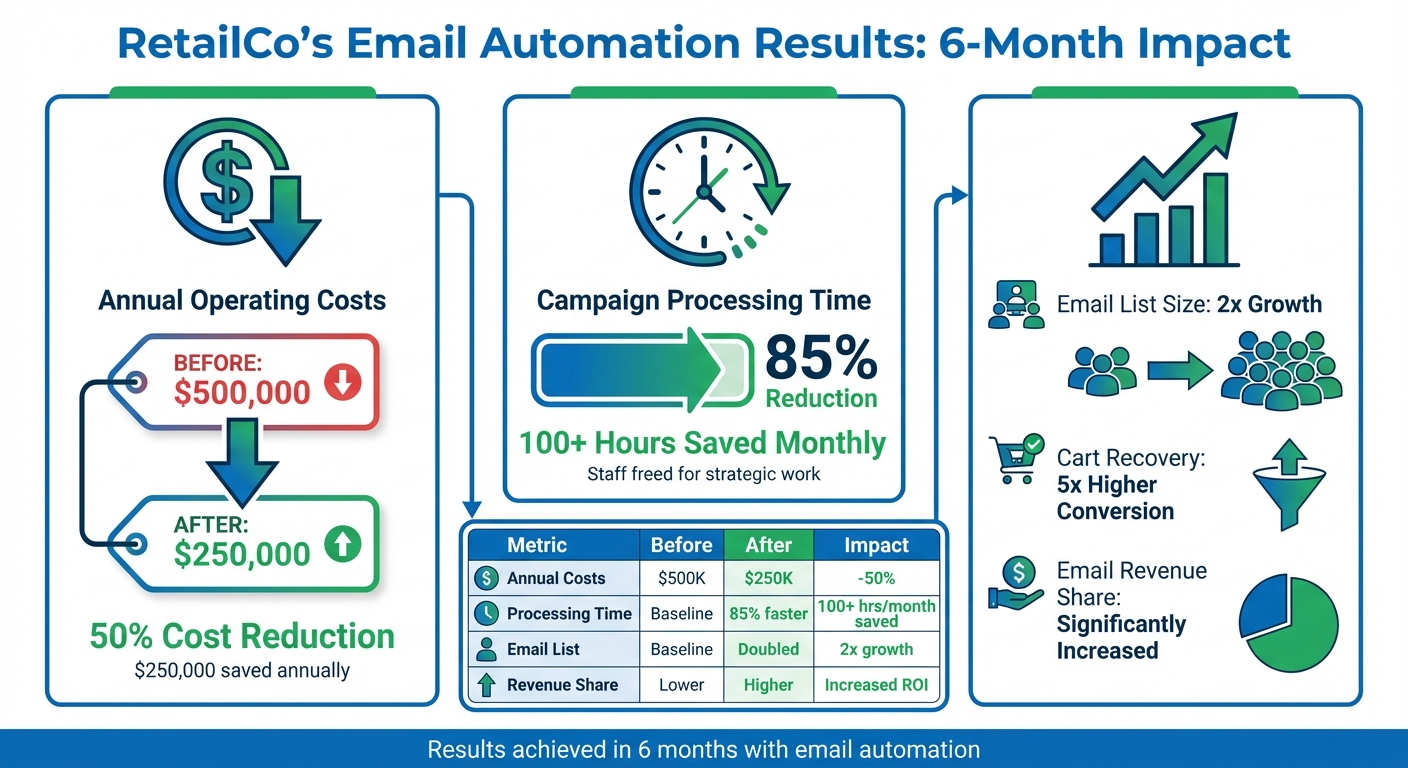
RetailCo Email Automation ROI: Cost Savings and Performance Metrics
RetailCo's automation journey delivered results faster than expected. Within just six months of implementation, the company saw noticeable improvements in efficiency and revenue.
Operational Cost Reduction
RetailCo managed to cut its annual operational costs in half, slashing expenses from $500,000 to $250,000. This impressive 50% reduction was achieved by eliminating expensive third-party services and minimizing labor hours. By integrating Power Automate with Microsoft Business Central, tasks like daily customer record entry and email sorting became fully automated, streamlining operations.
Time Savings and Efficiency Gains
Automation also transformed how RetailCo managed its campaigns. Processing times dropped by 85%, saving the team over 100 hours every month. This freed up employees to focus on strategic and creative work, adding more value to the business. Zuzana Martins, Digital Marketing Manager at Lowes, praised the impact of automation:
"The SmartMail team successfully helped us minimize our email spend, but also dramatically improve all of our key metrics."
These efficiency improvements not only reduced costs but also created opportunities for growth.
Business Growth Metrics
RetailCo’s email marketing efforts saw a massive boost. Automated signup forms and behavior-triggered flows doubled the size of their email list. Additionally, email campaigns began contributing a much larger share of total revenue. This aligns with similar automation case studies where digital revenue shares doubled. Another standout success was in abandoned cart recovery - automated reminders converted at rates five times higher than manual promotional emails.
The overall impact of these changes highlights the transformative role of automation:
| Metric | Before Automation | After Automation | Impact |
|---|---|---|---|
| Annual Operating Costs | $500,000 | $250,000 | 50% reduction |
| Campaign Processing Time | Baseline | 85% reduction | 100+ hours saved monthly |
| Email List Size | Baseline | 2x growth | Doubled subscriber base |
| Email Revenue Share | Lower baseline | Significantly increased | Higher ROI per campaign |
These results demonstrate how RetailCo successfully leveraged automation to cut costs, save time, and accelerate business growth.
Lessons Learned and Future Scalability
Prerequisites for Successful Automation
RetailCo's success didn’t happen by chance - it was built on a strong foundation of preparation. A key step was data centralization. By merging fragmented data from their website, ERP, and CRM systems, they created unified customer profiles. This comprehensive view allowed them to send personalized, behavior-based emails rather than generic mass emails.
Another critical factor was list hygiene. Inspired by Notino's approach to aggressive list cleaning, RetailCo realized that a smaller, more engaged email list is far more effective than a large, unresponsive one. Internal alignment also played a big role. By securing support from IT, finance, and creative teams, they ensured smooth infrastructure updates and established realistic expectations for the automation process.
Long-Term Benefits and Scalability
RetailCo’s groundwork paved the way for strategies that continue to deliver results. As Alex Butcher, Head of Marketing at Low Cost Glasses, aptly described:
"The automation programs are always working continuously, working hard for the brand behind the scenes like an invisible extra employee."
With a steadily growing subscriber base, RetailCo is preparing to upgrade to the "All in" plan at $2,999/month. This plan offers unlimited scalability, dedicated support, and the infrastructure needed to handle millions of emails seamlessly.
Scalability isn’t just about handling more emails - it’s about generating revenue across the customer journey. RetailCo has implemented specialized flows like welcome sequences, VIP rewards, win-back campaigns, and replenishment reminders. These flows allow them to engage customers at every stage of the lifecycle. Other brands have reported that fully scaled automated emails can contribute 40% to 60% of total e-commerce revenue.
Recommendations for Similar Businesses
Businesses looking to replicate RetailCo’s success should focus on targeted email automation strategies. Start with high-impact flows like abandoned cart reminders and welcome sequences, which deliver quick results. Prioritize aggressive list cleaning to maintain sender reputation and improve email deliverability. Shift away from generic batch emails and instead use behavior-driven triggers. Additionally, structured A/B testing can help continuously refine and improve campaign performance.
Choosing the right platform is equally important. The Email Service Business Directory (https://emailservicebusiness.com) is a helpful resource for finding platforms suited to your business needs, avoiding the hassle of costly migrations.
Conclusion
RetailCo's experience highlights how email automation can significantly cut costs while boosting customer engagement. By leveraging automated workflows and maintaining a clean subscriber list, they achieved tangible financial gains. In fact, businesses adopting similar methods have reported cutting operational costs by as much as 50% and saving over $30,000 annually through database optimization.
What set RetailCo apart was their strong foundation. By centralizing data, integrating systems, and designing scalable workflows, they essentially created a virtual team member working tirelessly in the background. This approach turned email marketing into a revenue-generating asset rather than a financial drain, setting the stage for long-term growth and efficiency.
Making the right platform choice is crucial to avoid unnecessary expenses and inefficiencies. The Email Service Business Directory (https://emailservicebusiness.com) offers a helpful resource for comparing platforms, ensuring businesses align their technical needs with their strategic goals before committing to a solution.
RetailCo's story serves as a reminder that a well-thought-out automation strategy can transform email marketing into a powerful growth engine. With the right tools, careful planning, and precise execution, email automation doesn’t just streamline operations - it reduces overhead, frees up valuable resources, and drives sustainable success far beyond the inbox.
FAQs
What should I automate first to cut costs fast?
To cut costs quickly with email automation, start by automating crucial points in the customer journey. Prioritize behavior-driven email sequences such as cart abandonment reminders, post-purchase follow-ups, and re-engagement campaigns. These automated emails not only save time but also boost revenue by focusing on your existing leads and customers. Pair this with segmentation and lifecycle mapping to deliver personalized messages at the right moments, increasing engagement while reducing the need for manual work.
How do I centralize customer data for automation?
To bring all your customer data together for automation, it's essential to integrate all your data sources into one unified system, like a Customer Data Platform (CDP). This type of platform pulls in information from various places - your CRM, website activity, purchase history, and more - giving you a complete view of your customers. With this consolidated data, you can create highly personalized and automated email campaigns.
The process involves connecting your data sources using APIs or other integrations. Once that's done, you’ll need to set up workflows that continuously update customer profiles. This ensures your automation runs on accurate, up-to-date information, making your campaigns more effective.
How can I measure ROI from email automation?
To figure out the ROI of email automation, you’ll need to compare the revenue generated from automated email campaigns against the costs involved. These costs might include platform fees, content creation expenses, and management efforts. Keep an eye on key metrics like open rates, click-through rates, and the revenue directly tied to these emails.
For instance, targeted automation campaigns have been known to drive noticeable revenue growth. By regularly analyzing these metrics, you can better understand the financial impact and ensure your efforts are worth the investment.