Want to personalize emails without breaking privacy laws? Here's the deal: customers love tailored experiences, but privacy regulations like GDPR and CAN-SPAM come with hefty fines if you get it wrong. This guide gives you a step-by-step checklist to balance personalization and compliance.
Key takeaways:
- Get clear consent: Use double opt-in and avoid pre-checked boxes.
- Be transparent: Clearly explain data usage and link your privacy policy.
- Track data: Organize what you collect, match it to user consent, and avoid repurposing data without permission.
- Review third-party tools: Use Data Processing Agreements (DPAs) and verify vendor compliance.
- Respect user rights: Add easy unsubscribe links and handle data requests promptly.
- Stay up-to-date: Regularly update your privacy policy and ensure it's accessible.
This checklist helps you deliver personalized emails while staying on the right side of privacy laws.
Getting Consent and Collecting Data Properly
Check Your Opt-In Methods
When it comes to signup forms, active participation is a must. Pre-checked boxes? Those are a no-go under GDPR and CASL guidelines. Users need to manually opt in by clicking, ensuring their consent meets the standard of being "freely given, specific, informed, and unambiguous".
Using a double opt-in process is a smart move. It not only verifies email addresses but also creates a clear audit trail. Make sure to log key details like the date, time, IP address, form used, and the exact wording of the agreement. To go a step further, separate marketing consent from your Terms of Service or Privacy Policy acceptance. Provide individual checkboxes that let users choose what they want - like newsletters, product updates, or personalized offers - rather than lumping everything into one "catch-all" subscription.
These practices aren't just about ticking compliance boxes; they help maintain accurate records and align with broader data privacy goals.
Explain How You'll Use Their Data
Once you've secured proper consent, the next step is transparency. Be upfront about how you plan to use the data you collect. For example, if you're tracking browsing history, purchase behavior, or location to personalize emails, say so in clear, simple terms. It’s worth noting that 76% of consumers expect brands to understand their needs and provide tailored experiences.
Make it easy for users to trust you. Include a direct link to your privacy policy near the signup form, and use reassuring phrases like "No spam + unsubscribe anytime." If you're gathering zero-party data - such as responses to polls or preference questions - explain how this helps you deliver content that’s more relevant to them.
| Law | Consent Model | Key Transparency Requirement |
|---|---|---|
| GDPR | Explicit opt-in | Must explain data access, correction, and deletion rights |
| CAN-SPAM | Opt-out model | Must identify messages as advertisements and include a valid address |
| CASL | Express consent | Must clearly state the purpose and identify the sender |
| CCPA/CPRA | Opt-out model | Must disclose what data is collected and whether it is sold or shared |
sbb-itb-6e7333f
Track What Data You Collect and How You Use It
List All Personal Data You Collect
Start by creating a detailed inventory of every piece of personal data you collect across your platforms - whether it's from your email service provider, CRM, analytics tools, or other systems. Export the data from each platform and carefully review the column headers to identify what’s being gathered. Organize the data into three categories: zero-party data (voluntarily shared through surveys, quizzes, or preference centers), first-party data (behavioral data like email opens, clicks, or purchase history), and inferred data (predictions made by AI based on user behavior).
To maintain accuracy and avoid confusion, standardize your data entries. For example, use drop-down menus and separate fields for details like City, State, and Country. This prevents inconsistencies like "US" versus "United States" or "NC" versus "North Carolina".
It’s also crucial to keep thorough records of user consent in line with regulatory guidelines. For instance, under CASL, businesses are advised to retain consent records for at least three years after the end of a customer relationship.
Once your data inventory is complete, ensure that every piece of data is used strictly within the boundaries of the consent provided by the user.
Match Data Use to User Consent
After organizing your data, the next step is to align its usage with the consent you've received. This means ensuring that data is only used for the purposes the user agreed to. Known as purpose limitation under GDPR and similar laws, this rule prohibits repurposing data without obtaining additional consent. For example, if someone subscribes to your weekly newsletter, you cannot automatically include them in a behavioral profiling campaign or share their information with third parties unless they’ve explicitly agreed to it.
Maintaining a disciplined data inventory not only enhances personalization but also builds trust by ensuring compliance. Research shows that 37% of people would cut ties with a company over concerns about data misuse, and GDPR violations in 2024 carried an average cost of $4.35 million per incident.
To stay compliant, secure granular consent for specific communication types such as newsletters, product updates, personalized recommendations, or third-party data sharing. If you’re using AI for decisions like pricing or content access, be upfront about it. Some regulations even require you to explain how these automated decisions are made.
Finally, implement a last-mile suppression filter to ensure unsubscribed users are excluded before any emails are sent. This step is critical for avoiding costly mistakes - violations of CAN-SPAM, for example, can result in penalties of up to $51,744 per individual email.
GDPR Compliance for Email Marketing Explained (Tutorial Included!)
Review Third-Party Tools and Contracts
When managing data handling and user consent, it’s crucial to extend compliance efforts beyond your internal processes. This means taking a close look at the third-party tools and contracts you rely on.
List All Third-Party Platforms You Use
Start by creating an inventory of every third-party platform that interacts with your email data. This includes tools like your email marketing platform, CRM, analytics software, data enrichment services, and advertising pixels from platforms such as Meta or TikTok. Organize these vendors into categories: Processors, which follow your instructions, and Third Parties, which may use your data for their own purposes.
For each tool, document key details such as where the data is stored, whether it’s used in AI models, the vendor’s breach history, risk level, and the status of any contracts. Keep all this information in a centralized Record of Processing Activities (ROPA). This record is essential to determine which privacy laws apply to your business. For instance, if you’re using a U.S.-based vendor to handle data from EU customers, you’ll need to implement specific safeguards. Failure to do so can lead to hefty penalties, like the €290 million fine Uber received in 2024 for improperly transferring driver data.
Make sure to update your ROPA whenever you add or remove a tool. Once your inventory is complete, formalize your relationships with vendors through strong data processing agreements.
Set Up Data Processing Agreements
Securing Data Processing Agreements (DPAs) with all vendors that process personal data is a must for managing risk. These agreements are not just best practices - they’re legally required under GDPR Article 28 and various U.S. state laws. A well-drafted DPA should clearly outline what data the vendor can process, how it will be protected, and the steps to take if something goes wrong.
Key components of a DPA include:
- Clear processing instructions
- Confidentiality requirements
- Security measures
- Rules for sub-processors
- Support for data subject rights
- Breach notification timelines
- Data deletion protocols
- Audit rights [23,24]
Avoid vague terms like "reasonable security." Instead, specify concrete measures such as AES-256 encryption for stored data, TLS 1.3 for data in transit, multi-factor authentication, and regular penetration testing.
Breach notification timelines deserve special attention. Insist on precise timelines, such as 24 to 72 hours. For example, in 2025, Digital Marketing Pro faced a €25,000 fine after their vendor delayed reporting a breach for eight days, missing GDPR’s 72-hour deadline. In contrast, TechFlow avoided a €50,000 penalty because their DPA included clear terms that allowed them to quickly address an international data transfer issue.
"Treat DPAs not as bureaucratic paperwork but as essential risk management tools that protect both your business and your subscribers."
– Yanna-Torry Aspraki, Email Strategist, Review My Emails
For vendors outside the European Economic Area, include Standard Contractual Clauses (SCCs) in your DPAs [23,26]. It’s also wise to verify that vendors hold certifications like SOC 2 Type II or ISO 27001, which independently validate their security practices [27,28]. Considering that 73% of data breaches in 2025 involved a third party and cost an average of $4.45 million, these agreements act as your first line of defense against potential liabilities when a vendor’s security fails. By taking these precautions, you not only protect your business but also maintain the trust of your customers.
Respect User Rights and Preferences
When it comes to data collection and third-party agreements, prioritizing user rights is essential for building a strong compliance framework. Once you've ensured proper third-party data handling, the next step is giving subscribers control over their personal information. This completes your approach to creating privacy-conscious, user-focused email practices.
Add Clear Unsubscribe Links
Every marketing email you send must include an easy-to-find unsubscribe link in the footer. Avoid vague terms - stick with "Unsubscribe" to make the option unmistakable. The opt-out process should be simple and quick, ideally a single click. Forcing recipients to fill out long forms, navigate multiple pages, or log into accounts just to unsubscribe is a big no-no.
According to CAN-SPAM regulations, opt-out links need to remain functional for 30 business days after the email is sent. While the law gives you up to 10 business days to process unsubscribe requests, acting within 24–48 hours is a better practice for maintaining trust. The consequences for non-compliance are steep: each CAN-SPAM violation can result in fines of up to $53,088 per email. For example, in 2023, the FTC fined Experian $650,000 after users reported issues with their unsubscribe process. Similarly, Verkada faced a $2.95 million penalty for failing to include opt-out options and ignoring direct unsubscribe requests.
To stay compliant, regularly test your unsubscribe links and keep suppression lists updated. This ensures you don’t accidentally email users who have opted out.
Handle Data Requests Quickly
Just like opt-out processes, responding promptly to data requests is crucial for maintaining subscriber trust. Set up a streamlined system for handling requests related to data access, updates, or deletion. Start by logging the request and verifying the user’s identity - without collecting unnecessary sensitive information. Then, search all relevant systems, including databases, CRMs, email platforms, analytics tools, and backups, to locate the requested data. If a user asks for data erasure or correction, notify any third-party providers who also manage that data.
| Regulation | Response Deadline | Key Data Rights |
|---|---|---|
| GDPR | 1 Month | Access, Rectification, Erasure, Portability, Objection |
| CAN-SPAM | 10 Business Days | Opt-out of commercial messaging |
| CCPA | Varies (Promptly) | Access, Deletion, Opt-out of data sale |
Keep detailed records of all requests and actions for compliance audits. Use tools designed to log consent, track updates, and generate reports. Additionally, train your marketing and customer service teams to recognize and escalate data requests immediately, ensuring deadlines aren’t missed.
Keep Your Privacy Policy Current and Easy to Find
Your privacy policy is more than just a legal formality - it’s a cornerstone of trust between you and your users. It outlines how you collect, use, and safeguard subscriber data. Keeping it updated and accessible reinforces your commitment to responsible data practices and aligns with broader privacy compliance efforts.
Update Your Privacy Policy Regularly
Set a schedule to review and refresh your privacy policy at least once a year, or sooner if major changes occur. For instance, if you adopt AI-driven personalization, switch service providers, or implement automated decision-making tools, your policy should reflect these updates immediately. Organizations that frequently integrate new technologies might benefit from a quarterly review of system changes, paired with an annual in-depth assessment.
When significant updates affect how you handle subscriber data, let your users know. Send notifications via email or display a prominent notice on your website. For major changes - like introducing AI-powered content recommendations - it’s a good idea to request user re-consent. Before rolling out high-risk features, conduct a Privacy Impact Assessment (PIA) to identify and mitigate potential risks. Don’t forget to include a "Last Updated" date at the top of your policy so users can easily confirm it’s current.
Once your policy is updated, the next step is ensuring it’s easy to find.
Make Your Privacy Policy Easy to Access
Even the most well-written policy won’t serve its purpose if users can’t locate it. Make it simple to find by placing links in key areas like your website footer, signup forms, registration pages, login screens, emails, and cookie banners. Companies like Nike, Forbes, and Medium do this effectively by embedding policy links prominently in their digital communications.
Use straightforward, jargon-free language to explain your data practices. For example, describe how you use behavioral tracking or predictive algorithms in terms that anyone can grasp. A "layered" approach works well here - start with a brief summary of key points, then provide links to more detailed sections for users who want to dive deeper. This approach balances transparency with accessibility, ensuring your audience feels informed and respected.
Check Compliance with Privacy Laws
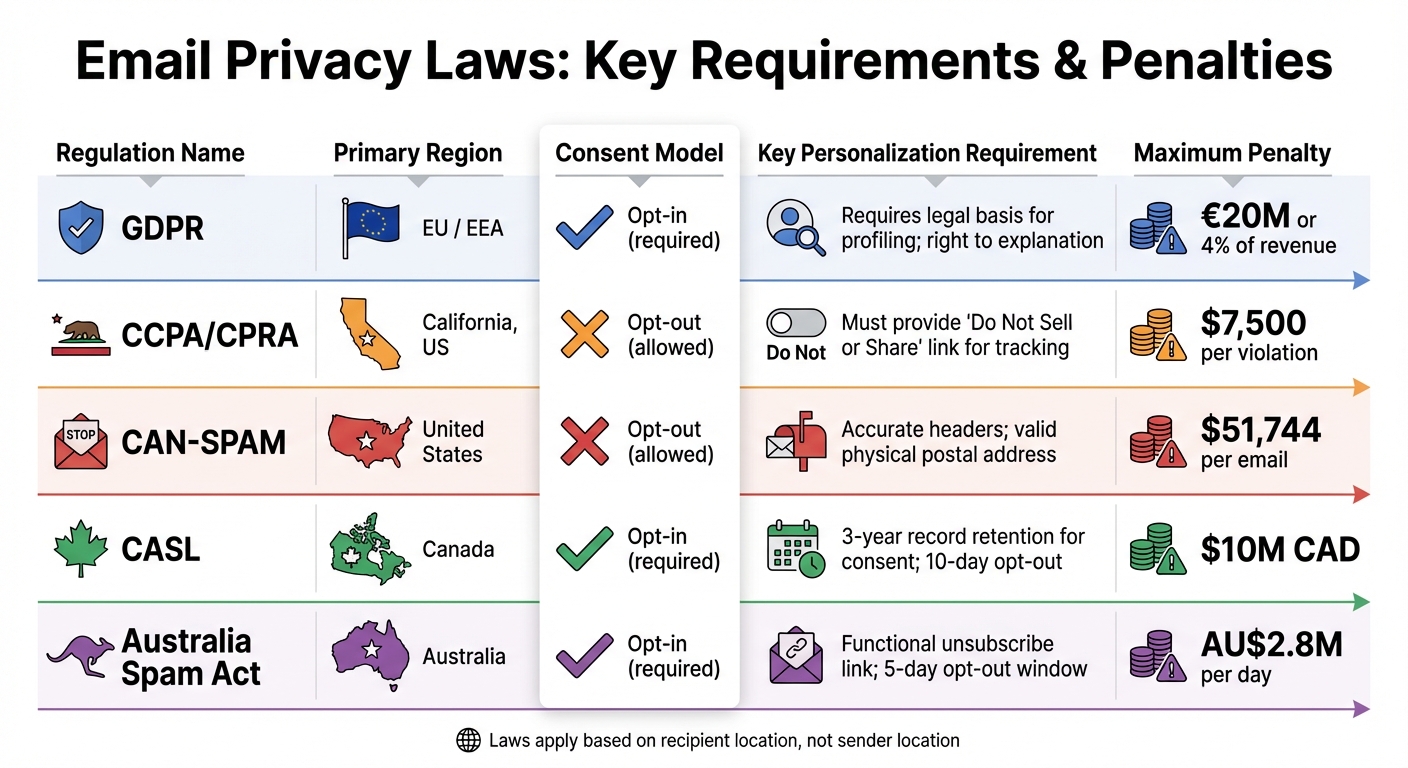
Email Privacy Laws Comparison: GDPR, CCPA, CAN-SPAM, CASL Requirements
Ensuring your email personalization practices align with privacy laws is a critical step. Different regulations come with distinct requirements, and knowing which ones apply to your business can help you avoid hefty fines while fostering trust with your subscribers.
Compare Your Practices to GDPR, CCPA, and Other Laws
Privacy laws vary in how they handle consent, data use, and penalties. For instance, GDPR and CASL mandate opt-in consent before sending personalized emails, while CAN-SPAM and CCPA allow an opt-out approach, meaning you can email recipients without prior consent as long as they can easily unsubscribe. Here's a breakdown of key differences:
| Regulation | Primary Region | Consent Model | Personalization Requirement | Max Penalty |
|---|---|---|---|---|
| GDPR | EU / EEA | Opt-in | Requires legal basis for profiling; right to explanation. | €20M or 4% of revenue |
| CCPA/CPRA | California, US | Opt-out | Must provide "Do Not Sell or Share" link for tracking. | $7,500 per violation |
| CAN-SPAM | United States | Opt-out | Accurate headers; valid physical postal address. | $51,744 per email |
| CASL | Canada | Opt-in | 3-year record retention for consent; 10-day opt-out. | $10M CAD |
| Australia Spam Act | Australia | Opt-in | Functional unsubscribe link; 5-day opt-out window. | AU$2.8M per day |
The stakes are high: GDPR fines alone exceeded €1.6 billion in 2024, with Meta facing a €1.2 billion fine in 2023. Similarly, CAN-SPAM violations can cost up to $51,744 per email by 2026. To simplify compliance, many businesses adopt a universal compliance approach, adhering to the strictest standards - like GDPR or CASL - which often covers less stringent laws as well.
Determine Which Laws Apply to You
Privacy laws depend on the recipient's location, not the sender's. For example, if you email someone in the EU from the U.S., GDPR applies. Likewise, emailing California residents means you must follow CCPA/CPRA, regardless of where your business is based.
CCPA applies to for-profit businesses meeting at least one of these criteria: annual revenue over $25 million, handling data for 100,000 or more California residents, or earning 50% or more of revenue from selling or sharing personal data. GDPR applies if your business has a presence in the EU - such as a branch, agent, or employee - or if you target EU residents with goods or services. Even B2B emails fall under GDPR if they include identifiable personal data, such as name.surname@company.com.
Use this as a guide to ensure your practices align with the relevant regulations step-by-step.
Next Steps
Main Points to Remember
To ensure compliant email personalization, focus on four key areas: explicit consent, data transparency, user rights, and regulatory alignment. Use active, double opt-in methods to create a reliable audit trail and meet global compliance standards. Collect only the data you truly need - not just to minimize liability but also to improve conversion rates. Always make your identity clear in the "From" field and include a valid physical address in every email footer.
Be prompt when handling requests for data access, deletion, or opt-out to uphold user rights. Protect your sender reputation by implementing strong technical safeguards. As Javid from MailDiver emphasizes:
"Getting it right protects both your business and your customers while building the trust that makes email marketing effective".
Every step in this checklist plays a role in balancing personalization with privacy compliance. These principles should guide your next actions as you work through this process.
How to Use This Checklist
Follow these steps to incorporate best practices into your email marketing strategy:
- Tackle each section of this checklist methodically.
- Perform an internal audit annually to evaluate your consent mechanisms, data handling practices, and unsubscribe link functionality.
- Update your privacy policy whenever your data processing methods change. Keep detailed documentation, including timestamps, consent language, and collection methods, to remain GDPR-compliant.
- Train your teams on privacy regulations and consider adopting the strictest standards, such as GDPR or CASL, to streamline compliance across multiple jurisdictions.
FAQs
What counts as valid consent for personalized emails?
Valid consent for personalized emails needs to be explicit, informed, and given voluntarily. This means using clear opt-in methods, such as single or double opt-in, to obtain permission. Regulations like GDPR strictly forbid practices like pre-checked boxes or assuming consent based on existing business relationships. Be upfront with users by offering clear, straightforward options to opt in or opt out of personalized email communications. Transparency is key.
How do I know which privacy laws apply to my email list?
To figure out which privacy laws apply to you, think about three key factors: where your recipients are located, your industry, and the type of data you handle. Privacy regulations differ depending on the region. For example, Europe follows GDPR, the US has CAN-SPAM, and Canada enforces CASL. On top of that, some US states have their own specific rules. Start by identifying where your recipients live, then review the relevant laws in those areas to stay compliant.
What should a DPA include for my email vendors?
A Data Processing Agreement (DPA) for email vendors needs to clearly define several crucial elements. These include the subject matter, duration, and nature of processing. It should also specify the types of personal data involved and the categories of data subjects.
Additionally, the agreement must outline the processor's responsibilities, such as maintaining confidentiality and implementing robust security measures. Other key aspects to address are handling data subject requests, providing breach notifications, allowing audits, and detailing the terms for data return or deletion once the contract ends. These provisions are essential to ensure compliance with privacy regulations.