Most B2B email programs do better when they stop sending the same message to everyone. My takeaway is simple: pick one outcome, use clean CRM, email, website, product, and billing data, keep segments to 3-5 core groups, and track results with metrics like conversion rate and revenue per recipient.
Here’s the short version:
- I use predictive segmentation to estimate what a contact or account may do next
- I start with one job - like lead conversion, deal movement, product interest, or churn risk
- I rely on clean inputs and clear past-outcome labels such as closed-won, renewed, or churned
- I keep scoring tied to action - each segment should trigger one email flow or sales step
- I watch for stale data, weak labels, small audience sizes, and score distrust from sales
A few facts stand out: B2B contact data can decay by about 2% per month, inactive contacts often need review after 60-90 days, renewal tracks often start 6-8 weeks before renewal, and tests may need 1,000+ recipients per variation with 48-72 hours to read results.
If I had to boil the article down to one line, it would be this: <u>predictive segmentation works when the data is clean, the goal is narrow, and the score leads straight to action.</u>
B2B Email Marketing That Drives SQLs
sbb-itb-6e7333f
The Data Foundation for Predictive Segmentation
Predictive segmentation starts with connected data from your CRM, email platform, website, product, and billing systems. If those systems don’t line up, the model won’t have much to work with.
Before any scoring starts, teams need reliable inputs from each source and consistent field definitions across them. Otherwise, the model ends up reading messy signals and treating similar things as if they’re different.
Core Inputs from CRM, Email, Website, Product, and Billing Systems
Most models pull from five core systems. Each one tells you something different:
| Data Source | Key Inputs | Primary Use |
|---|---|---|
| CRM | Job title, industry, company size, tech stack, hiring plans | ICP fit and buying readiness |
| Clicks, last activity date, engagement frequency | Engagement propensity | |
| Website | Pricing page visits, demo requests, content downloads | Intent and deal stage |
| Product | Feature usage, login frequency, support tickets | Churn risk and expansion potential |
| Billing | Renewal dates, ARR/MRR, purchase history | Retention and lifetime value |
A simple way to think about it: CRM tells you who the account is, email and website data show what they’re doing, product data shows how they use what they bought, and billing data shows what the relationship is worth.
Training Labels, Data Hygiene, and Account-Level vs. Contact-Level Design
Those inputs only mean something when they’re tied to past outcomes. A model needs clear training labels before it can score anyone. That usually means accounts that closed-won, churned, renewed, or upsold within a set time window. Labels like “engaged” sound nice, but they’re too loose to train a strong model.
Then there’s the design choice: contact-level or account-level modeling. In B2B, one person rarely makes the whole buying decision. A deal might involve a user, a manager, procurement, and an exec sponsor. That’s why platforms that roll up signals across contacts in the same account often do a better job predicting buying intent than contact-only scoring.
Data hygiene is where many teams stumble. B2B contact data deteriorates at about 2% per month. That adds up fast. And small inconsistencies can cause big problems. If one record says “VP” and another says “Vice President,” the model may treat them as separate roles unless those values are standardized first.
That cleanup work isn’t a nice-to-have. It comes before modeling. Once inputs, labels, and account structure are set, teams can move from raw data to dynamic segments.
How to Build Predictive Segments and Turn Scores Into Usable Audiences
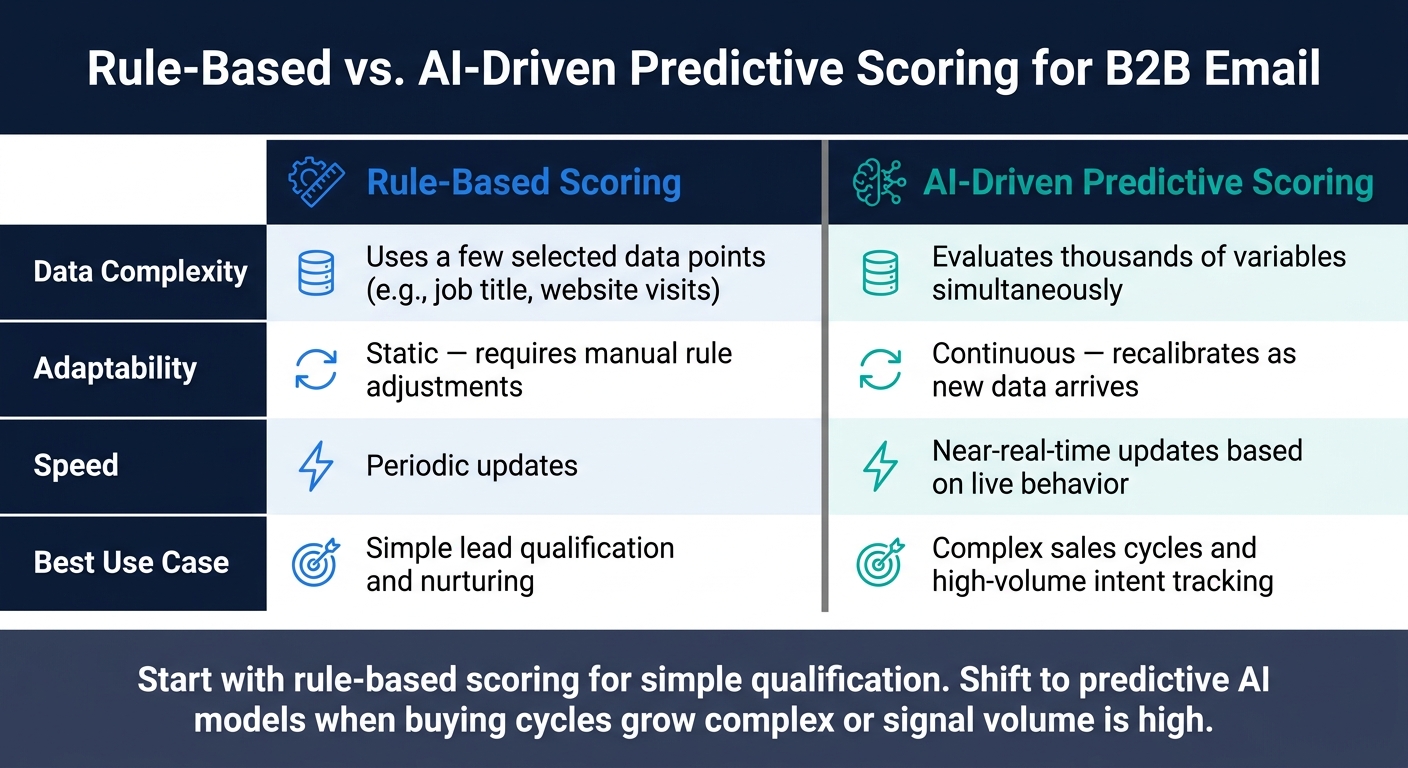
Rule-Based vs. Predictive Segmentation: B2B Email Scoring Compared
Once your inputs are clean, keep it simple: pick one outcome and turn that score into a segment your team can use right away. Then decide which score ranges should become active audiences.
Choose the Prediction Goal and Model Approach
Start with one goal - lead conversion, deal progression, product interest, or renewal/churn risk. The outcome comes first because it shapes everything that follows: the score, the segment, and the trigger.
| Feature | Rule-Based Scoring | AI-Driven Predictive Scoring |
|---|---|---|
| Data Complexity | Uses a few selected data points, such as job title and website visits | Evaluates thousands of variables simultaneously |
| Adaptability | Static; requires manual adjustment of rules | Continuous; recalibrates as new data becomes available |
| Speed | Periodic updates | Near-real-time updates based on behavior |
| Use Case | Simple lead qualification and nurturing | Complex sales cycles and high-volume intent tracking |
Rule-based scoring fits simple qualification. Predictive models make more sense when buying cycles get messy or when signal volume is high. As teams get better at this, they can shift toward smaller dynamic audience groups instead of leaning only on static firmographics. After the goal is set, tie each score to one campaign action.
Convert Scores Into Dynamic Segments for Campaigns
Turn scores into a small set of clear audience rules - not a maze of tiny segments. A raw score by itself doesn't do much. What matters is how you combine score thresholds with added logic.
Many email marketing platforms and CRMs support dynamic lists that automatically add or remove contacts when they meet or miss predictive scoring rules. AI-driven models should refresh scores in near real time when new behavior shows up - like a prospect hitting a pricing page - so sales can step in while intent is still high.
If several stakeholders shape the deal, roll contact signals up to the account level. Define each segment by the next move it should trigger. In most cases, 3-5 core segments are enough, such as Engaged vs. Unengaged. Each one should be large enough to matter, but narrow enough to stay relevant. If a segment only has a few contacts, it's often better to handle it with direct outreach instead of an automated campaign.
Validate Results and Monitor Model Drift
Check segments against business results: conversion rate, revenue per recipient, unsubscribes, and bounces. If a high-scoring segment falls flat, that's usually a sign the scoring logic needs work.
You can test the segment logic itself with A/B tests. For example, compare whether job title or company size does a better job predicting conversion for a given campaign. Refresh contact lists every 1-2 months, and move inactive contacts into a re-engagement segment if they haven't opened or clicked within 60-90 days. For testing, aim for at least 1,000 recipients per variation and run the test for 48-72 hours to reach statistical confidence.
Use those checks before expanding the segment set.
How B2B Teams Use Predictive Segments in Email Campaigns
Once your segments are validated, the next move is simple: put them into live campaign flows. The aim is to match the right message to the right contact at the right point in the buying or product-use journey.
Lead Nurture and Deal-Stage Email Flows
Not every lead belongs in the same email sequence. Contacts with high scores should move into high-intent flows, and sales should get an alert when those contacts cross the set threshold. Lower-propensity or early-stage leads can stay in longer education tracks built around category awareness. Sales-ready leads, on the other hand, should get proof points coordinated with sales and sent when the right sales signals show up.
That same trigger logic works after the sale too. Scores can guide expansion campaigns, renewal outreach, and save efforts.
Product-Interest, Renewal, and Churn-Risk Campaigns
Predictive segments become even more useful after someone becomes a customer. For product-interest targeting, models can shape content around likely pain points and interests. A technical lead might get detailed specs, while an executive gets content centered on ROI.
For current customers, expansion-propensity scores can trigger expansion-focused use cases or early-access offers.
For renewal and churn risk, timing matters more than email volume. Customers nearing renewal should enter a dedicated track 6-8 weeks out. That track can include success summaries and ROI recaps that remind them what they’ve already gained. Customers with declining usage or falling engagement scores need a different approach. A "save" campaign can name the gap directly and offer a clear path to support or one-to-one outreach.
"Predictive insights enable marketers to anticipate needs, proactively address issues, and deliver timely, personalized communications, effectively moving from reactive to proactive engagement." - Email Service Business
Choosing Platforms and Services That Support Predictive Workflows
Predictive segments only do their job if your platform can turn scores into live audiences and trigger sends on its own. Tools like Iterable and Braze support real-time automation rules that send emails based on live predictive scores. HubSpot and Salesforce can host dynamic Smart Lists that update as CRM data changes.
If your team is still sorting out its stack, the Email Service Business Directory is a curated resource for comparing email platforms, tools, and service providers that support predictive workflows.
Limits, Governance, and Next Steps
Common Failure Points in B2B Predictive Segmentation
After activation, governance is what keeps predictive segments useful over time. In practice, three things break most programs: weak labels, oversplit audiences, and low sales adoption.
Sparse or biased labels are one of the biggest failure points. If the model is trained on thin, uneven, or skewed outcome data, predictions get shaky fast. And once you move past 3-5 core segments, audiences often become too small to automate in a useful way. At that point, the system may look neat on paper but fall apart in execution.
Another common issue is trust. Sales teams tend to ignore scores that don't explain themselves. If reps can't see what pushed a lead to a high score - like pricing page visits, repeat product views, or content downloads - they're less likely to act on it. Explainability makes the score usable. It turns a marketing output into something sales can work with.
| Failure Point | Business Impact | Mitigation |
|---|---|---|
| Sparse or biased labels | Model predicts poorly on rare outcomes | Extend the data window; use proxy labels early on |
| Over-segmentation | Segments become too small to automate | Cap at 3-5 core groups; route tiny lists to direct outreach |
| Black-box scores | Sales ignores marketing-generated leads | Surface score drivers and full engagement history |
| No defined goal per segment | Becomes a data exercise instead of a revenue tool | Assign a specific outcome before building |
Before launch, apply suppression lists for competitors, customers, and do-not-contact records. That step helps protect deliverability and lowers compliance risk.
Conclusion: Start with Clear Outcomes, Clean Data, and Simple Activation
Once the model is live, keep the rules simple and review them on a regular cadence.
Start with one outcome, clean data, and direct activation inside your CRM or MAP. Use clean, standardized data from the start. Begin with behavior, then add firmographic and role data on top, with standardized values and regular hygiene checks.
Track conversion rate and revenue per recipient by segment so email activity ties back to pipeline and expansion revenue.
Run a quarterly audit of your segment criteria. Buyer behavior changes. Your ICP shifts. A model trained on older data can drift away from who is buying now. When a segment underperforms, treat it as a signal to inspect the inputs, rules, and timing - not as proof the whole approach is broken.
FAQs
How do I choose the right prediction goal first?
Match the prediction goal to your business objective and the lead stage you're working on. Start with the main problem you're trying to fix: use churn models when retention is slipping, propensity models when you want more customer acquisition, and lifetime value models when the focus is revenue optimization.
Then make sure the goal lines up with your ICP and can be checked against historical data. If you can't test it against past results, it's hard to know whether the model will improve conversions in a way that matters.
Should I score contacts or accounts?
In B2B, scoring accounts is often a must because buying decisions usually involve more than one person. Predictive intelligence works best when it brings together fit, opportunity, and intent data at both the account and contact levels.
Contact scores on their own can point you in the wrong direction. A high-intent signal from one person may not matter if that contact can’t approve a purchase, while account-level behavior gives you the context you need.
What should I do if sales does not trust the scores?
Treat the model like a living project. It needs regular checks, input from the team, and updates as results come in.
Run A/B tests. Compare predicted outcomes with actual sales results. Review the model every quarter so thresholds stay in line with current performance.
Bring sales in early to sharpen the scoring criteria, and make it clear why each score was assigned. Use historical data to calibrate thresholds so scores line up better with actual conversion trends.