Outdated data costs businesses millions annually, wastes time, and derails marketing campaigns. Real-time data quality is the solution. By instantly updating customer profiles and verifying information, businesses can reduce errors, improve targeting, and boost conversions. Here’s why it matters:
- Data decay is fast: B2B contact data becomes outdated at a rate of 22.5% annually. This leads to wasted marketing efforts and unqualified leads.
- Poor data is expensive: Companies lose an average of $12.9 million annually due to bad data, with 25% of revenue impacted.
- Real-time data boosts performance: Companies using real-time systems report 38% higher conversion rates and save hundreds of hours on manual data cleanup.
To succeed in B2B marketing, prioritize real-time data validation, automation, and tools like Customer Data Platforms (CDPs). These strategies reduce errors, improve campaign outcomes, and save time by automating repetitive tasks.
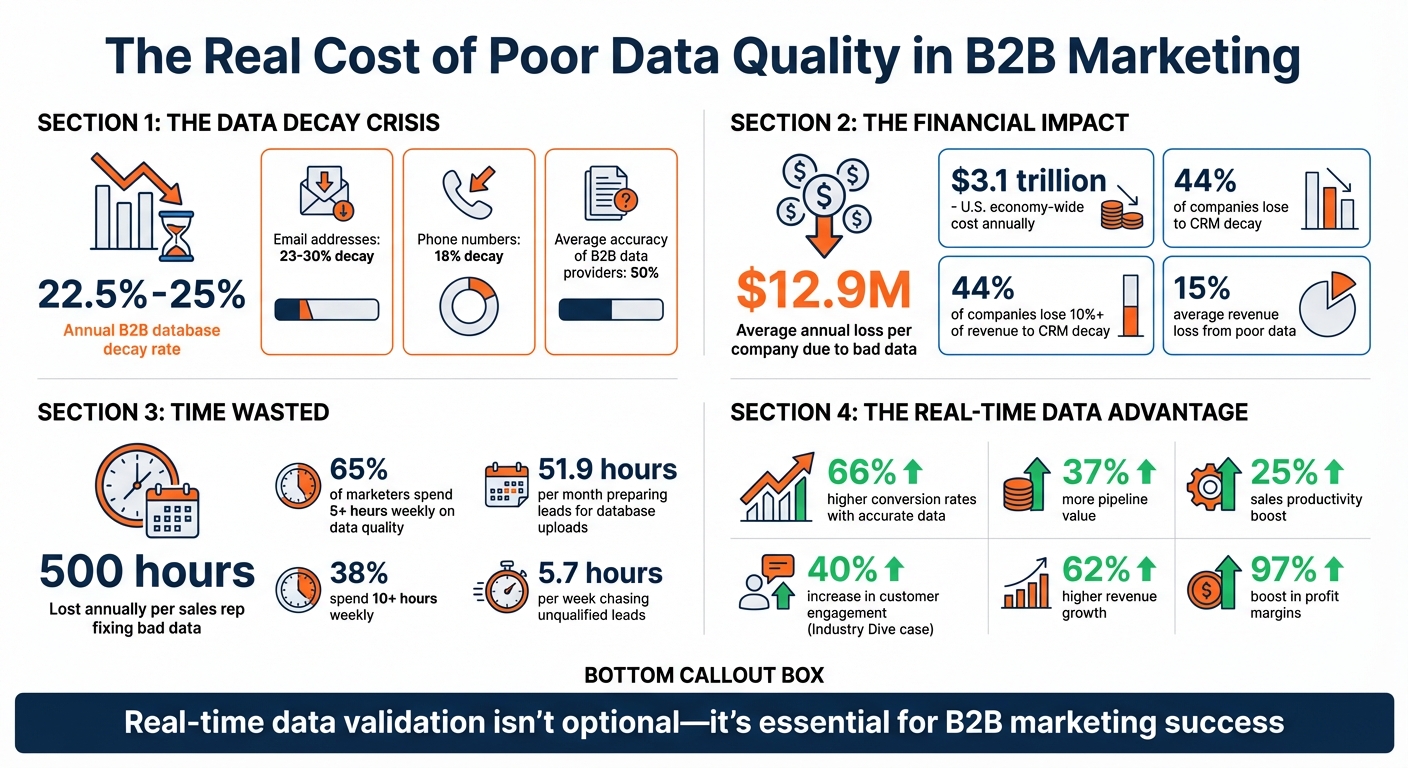
The Cost of Poor Data Quality in B2B Marketing: Key Statistics
Data Decay and Accuracy Statistics
Accuracy Rates and CRM Decay
When it comes to B2B data providers, the numbers are striking: on average, their accuracy hovers around just 50%. This means half of the data businesses purchase is either incorrect or outdated right from the start. And as time passes, the problem only gets worse.
The financial hit from decaying data is massive. Forty-four percent of companies lose over 10% of their annual revenue due to CRM data decay alone. In the U.S., poor data quality costs businesses an estimated $3.1 trillion every year. For the average organization, this translates to an annual impact of $12.9 million.
Different types of contact data deteriorate at different speeds, creating specific challenges for marketing teams:
| Data Type | Annual Decay Rate | Marketing Impact |
|---|---|---|
| Email Addresses | 23% - 30% | High bounce rates, damaged sender reputation, increased risk of spam filter blocks |
| Phone Numbers | 18% | Unsuccessful cold calls, ineffective SMS campaigns, outreach disruptions |
| Overall B2B Database | 22.5% - 25% | 15% average revenue loss |
With decay rates like these, manual intervention becomes unavoidable. About half of all acquired leads need cleaning, and nearly 50% of new records contain at least one critical error.
Time Spent on Manual Data Management
The fallout from poor data quality doesn’t stop at financial losses - it also eats up time. Marketers and sales teams are left to handle the mess, often at the expense of more strategic or revenue-generating activities.
Here’s the reality: 65% of marketers spend over 5 hours every week just managing lead data quality, and 38% report dedicating more than 10 hours weekly to these tasks. For sales teams, the numbers are equally grim - they lose an average of 500 hours annually, or roughly 62 working days, fixing bad prospect data. This translates to nearly 25% of their selling time wasted on data issues.
The impact stretches even further. Marketing teams, for instance, spend an average of 51.9 hours per month preparing leads for database uploads. That’s more than an entire workweek each month spent on nothing but data preparation. These delays not only slow down campaign execution but also compound revenue losses, creating a vicious cycle of inefficiency.
How Data Quality Affects Marketing Performance
Revenue and Conversion Rate Gains
Accurate contact data can be a game-changer. Companies working with precise data see 66% higher conversion rates compared to those relying on low-quality data. This kind of improvement separates campaigns that succeed from those that fall flat.
But the benefits don’t stop at conversions. High-quality data also leads to 37% more pipeline value and boosts sales productivity by as much as 25%. These advantages ripple through every marketing effort, from email campaigns to account-based marketing strategies.
Take Industry Dive as an example. Around May 2025, under Robin Re's leadership, they introduced a real-time customer data platform. The result? A 40% increase in customer engagement by bridging gaps in customer data visibility.
To put the impact into perspective, here’s how high-accuracy data stacks up against low-accuracy data:
| Metric | High-Accuracy Data (97%+) | Low-Accuracy Data (Avg. 50%) |
|---|---|---|
| Conversion Rate | 66% higher | Baseline |
| Pipeline Value | 37% more | Baseline |
| Sales Productivity | 25% gain | 500 hours lost per year per rep |
| Revenue Impact | 16.5% lower total cost | 15% average revenue loss |
| Email Bounce Rate | Below 1% | 5–7% |
"Impressions are the metric of a failed marketing campaign…If you're not getting the conversions, it means you weren't hitting the right audience."
– Steve Rude, Land O'Lakes
For B2B marketers, especially those focused on email campaigns, the stakes are even higher. Real-time data validation tools, such as those found in the Email Service Business Directory (https://emailservicebusiness.com), can significantly enhance email marketing performance by ensuring data accuracy.
However, while high-quality data drives impressive results, poor data quality can derail even the best marketing efforts.
Problems Caused by Poor Data Quality
Poor data quality doesn’t just slow things down - it creates a cascade of problems across marketing and sales. Sales reps lose 5.7 hours per week chasing unqualified leads due to bad data. Meanwhile, marketing teams spend up to 20% of their time fixing data issues instead of focusing on actual campaigns.
This inefficiency erodes trust. In fact, 64% of B2B marketing leaders admit their organizations don’t trust their marketing metrics for decision-making, largely because the underlying data is unreliable. When sales teams lose faith in the CRM, they stop updating it. This lack of trust leads to a downward spiral where data quality worsens over time.
The ripple effects don’t end there. Poor data makes it nearly impossible for companies to embrace advanced strategies like account-based marketing, personalization, or intent-driven targeting.
"The majority of respondents acknowledge that great data quality is critical for improved performance, but many have not taken the steps required to ensure they have great data quality. Because of that, omnichannel marketing, account‐based marketing, and personalization are simply buzzwords."
– Josh Mueller, SVP of Global Marketing at Dun & Bradstreet
Operationally, the damage is significant. 60% of teams report that poor data disrupts lead handoffs and slows down sales productivity. Instead of leveraging automation, teams are stuck with manual processes. Decision-making is delayed because no one trusts the numbers, and organizations end up losing an average of 15% of their revenue due to inaccurate data. These losses are entirely avoidable but grow worse over time if left unchecked.
Research Findings and Case Studies
ROI from Data Verification
According to Gartner, poor data quality costs organizations an average of $12.9 million annually, while bad data costs the U.S. economy over $3 trillion every year. These staggering numbers highlight just how expensive low-quality data can be and emphasize the importance of real-time data verification.
Automated lead management has been shown to increase opportunities by a whopping 240%. Meanwhile, 93% of companies using a Customer Data Platform to unify and clean their data report lower customer acquisition costs. Early adopters of AI strategies powered by high-quality data have experienced an average revenue increase of 15.8% and a productivity boost of 22.6%.
The operational benefits are equally impressive. Automated real-time verification not only drives revenue growth of up to 15.8% but also saves over 3,000 hours in manual lead processing. Currently, nearly 50% of marketing teams spend over 10 hours each month on manual data hygiene tasks, time that could instead be directed toward strategic efforts.
"Data quality is no longer an IT afterthought; it's a strategic business priority. Organizations that embrace real-time, automated verification are better positioned to reduce risk, accelerate onboarding, and unlock long-term growth." – Phil Maitino, Chief Technology Officer, Melissa
These findings clearly demonstrate the financial and operational benefits of prioritizing data quality, with real-world case studies further validating these results.
Email Campaign Results with Accurate Data
Accurate, real-time data isn't just about saving time - it can also transform the performance of email campaigns. Teams that prioritize data accuracy consistently achieve hard bounce rates under 2%, spam complaint rates below 0.1%, and inbox placement rates of 90% or higher.
The secret to these results lies in keeping data up to date. B2B email data decays by at least 28% annually, driven by role and company changes. To combat this, organizations that re-verify their active email lists every 90 to 180 days see much better results. Additionally, performing dynamic data aggregation and verification 24 to 48 hours before launching campaigns ensures maximum deliverability and avoids the risk of domain blacklisting.
For B2B marketers, leveraging real-time data validation tools - like those listed in the Email Service Business Directory (https://emailservicebusiness.com) - can significantly improve email marketing outcomes by ensuring data accuracy and reliability.
sbb-itb-6e7333f
Best Practices for Real-Time Data Quality
Using Automation and AI for Data Validation
Automating data validation at the point of entry can drastically improve the quality of your data. Tools like real-time enrichment engines (e.g., Clearbit, Default) can instantly add over 100 verified attributes - such as job title, tech stack, and company size - when a lead submits a form. This proactive approach prevents inaccurate or incomplete data from ever reaching your CRM.
AI-powered platforms, including ZoomInfo and Apollo.io, take things a step further by handling tasks like removing duplicates, standardizing formats, refreshing outdated CRM entries, and even using natural language processing (NLP) to fix errors and analyze unstructured data. These tools can boost the accuracy of data standardization by up to 99%. Similarly, identity resolution technologies from FullContact and Adobe Real-Time CDP use AI to link customer identities across various channels - emails, phone numbers, and device IDs - creating unified and accurate customer profiles.
Default also leverages predictive AI to score leads in real time. This allows businesses to filter out low-intent prospects and ensure that qualified leads can book meetings immediately.
"It takes the headache out of inbound scheduling and qualification. We're able to set qualification parameters so if someone signs up and meets our ICP, they can instantly book a meeting with a sales rep, eliminating the back and forth and saving us hours." – Brandon P., Verified G2 Reviewer
No-code orchestration tools are another game-changer, empowering RevOps teams to manage complex data validation and routing workflows without relying on developers. When combined with automated processes, integrating Customer Data Platforms (CDPs) can further streamline data consolidation and provide actionable insights.
Integrating Customer Data Platforms
Customer Data Platforms (CDPs) are essential for creating a unified, real-time view of your customers by consolidating data from various sources. These platforms pull together information from CRMs, marketing automation tools, and behavioral logs to provide a comprehensive view of both individual leads and account-level structures. This is crucial, especially when 45% of the data used by marketing teams is estimated to be incomplete, inaccurate, or outdated.
Advanced CDPs take this a step further with real-time identity resolution, enabling businesses to track individuals even as they change jobs or interact across multiple channels. Preconfigured B2B schemas, like Adobe's XDM, ensure incoming data is structured to seamlessly integrate with popular CRMs such as Salesforce and Marketo, making auditing and activation easier.
This centralized data approach not only simplifies audience segmentation but also enhances data governance. By applying automated tools during the data ingestion process, CDPs help ensure compliance with legal regulations and internal business policies. This is especially important given that nearly 75% of marketers believe at least 10% of their lead data is inaccurate, outdated, or non-compliant. With unified data, marketers can create precise audience segments and export them to platforms like LinkedIn and Google Ads for consistent omnichannel campaigns. Even modest improvements in data quality - just 15% - can lead to a 28% boost in campaign performance.
For businesses looking to refine their real-time data quality efforts, the Email Service Business Directory (https://emailservicebusiness.com) offers curated resources to help select the best platforms for accurate email marketing operations.
How to Power Your AI Tools with Better B2B Data
Conclusion
Real-time data quality isn't just a nice-to-have; it's a revenue driver. Companies that prioritize accurate and timely data see 62% higher revenue growth and an impressive 97% boost in profit margins. On the flip side, poor data quality costs organizations dearly, with average annual losses of $12.9 million per company. And if that wasn’t enough, B2B databases deteriorate quickly - about 25% of data becomes outdated every year. Clean, reliable data not only saves time but also enhances performance. For example, it eliminates the 5.7 hours per week that sales teams waste chasing unqualified leads and improves marketing campaign effectiveness by 28%. These numbers make one thing clear: maintaining high-quality data isn’t optional - it’s essential for staying competitive in B2B marketing.
"If you are working with flawed and poor-quality data, the most advanced AI analytics in the world will still only give you flawed and poor-quality insights."
– Lee McCance, Chief Product Officer at Adverity
To avoid the pitfalls of bad data, marketers need to move beyond reactive fixes and adopt real-time, automated validation. This means verifying data at the point of entry, using Customer Data Platforms to create unified customer views, and leveraging AI tools for data enrichment. These practices don’t just clean up your data - they turn it into a strategic advantage, enabling quicker responses to opportunities and more personalized customer experiences.
For B2B marketers, accurate data is the backbone of everything you do. Without it, your account-based marketing efforts, personalization strategies, and AI-driven campaigns are likely to fall short. But with it, you can achieve faster pipeline velocity, stronger cross-team alignment, and scalable growth without ballooning costs. Need help finding the right tools to maintain data accuracy in your email marketing? The Email Service Business Directory (https://emailservicebusiness.com) offers curated resources to guide you in selecting the best platforms for your needs.
FAQs
How does high-quality real-time data enhance B2B marketing campaigns?
High-quality real-time data empowers B2B marketers to send precise, personalized messages right when prospects are actively engaging. This not only strengthens customer retention and loyalty but also fuels revenue growth by ensuring every interaction feels relevant and timely.
On top of that, real-time data streamlines lead handoffs, allowing sales teams to respond faster and speed up pipeline movement. With access to accurate, up-to-the-minute information, businesses can make smarter decisions and fine-tune every phase of their marketing strategies.
What challenges does outdated data create for B2B marketers?
Outdated or wrong data can throw a wrench into B2B marketing efforts. Issues like wrong job titles, invalid email addresses, or frequent changes in job roles can drain your ad budget and waste valuable sales resources. Beyond that, these inaccuracies can hurt your credibility, clutter your database with duplicate or outdated records, and bog down your lead management process.
On top of all this, poor data quality can slow your sales pipeline, cut into your sales team's efficiency, and even lead to missed revenue opportunities. Tackling these problems head-on is key to running effective marketing campaigns and driving steady business growth.
What are the best practices for implementing real-time data validation in B2B marketing?
To ensure real-time data validation works seamlessly, start by placing validation checks at every point where data enters your system - whether through web forms, CRM imports, or email platforms. Leverage API-based tools to instantly verify details like email syntax, domain accuracy, and company information. These tools can even fill in missing details, ensuring your leads are complete right from the beginning. To avoid duplicates, use techniques such as hashing or fuzzy matching to detect and merge similar records.
For handling larger volumes of data, consider routing incoming information through a real-time streaming platform. This setup applies validation rules continuously as data flows in, enabling tasks like enrichment, anomaly detection, and record updates in real time - eliminating the need for batch-only cleanups. Keep an eye on key metrics like bounce rates or complaint rates, and make it a point to re-verify active lists every 90 to 180 days to maintain their accuracy.
Incorporate data governance into your processes by establishing quality standards, assigning responsibility for validation rules, and setting up alerts for any failed records. Platforms listed in the Email Service Business Directory can provide built-in real-time validation features tailored to your marketing requirements. By adopting these practices, you’ll maintain high-quality data that supports better audience targeting, stronger campaign performance, and improved deliverability.