Sales and marketing misalignment costs U.S. companies $1 trillion annually, yet only 8% of businesses report strong collaboration between these teams. When aligned, companies experience 32% revenue growth, close deals 67% more effectively, and generate 208% more marketing-driven revenue. The disconnect often lies in differing priorities and poor communication, with 79% of marketing leads failing to convert due to weak handoff processes.
The solution? Focus on shared metrics that bridge the gap:
- Marketing Qualified Leads (MQLs): Ensure leads meet clear criteria for sales-readiness.
- MQL to SQL Conversion Rate: Track how well marketing efforts translate into sales opportunities.
- Time-to-First Contact: Measure how quickly sales engages new leads - 78% of buyers choose the first responder.
- SQL to Customer Conversion Rate: Evaluate the percentage of sales-qualified leads that become paying customers.
- Sales Cycle Length: Shorter cycles indicate better-prepared leads and smoother processes.
- Customer Lifetime Value (CLV): Higher CLV reflects targeting the right customers and delivering consistent experiences.
Using shared tools like unified CRMs, real-time dashboards, and clear Service Level Agreements (SLAs) can help both teams work toward common revenue goals. Companies with aligned sales and marketing teams outperform their peers, achieving faster growth, higher retention, and stronger profitability.
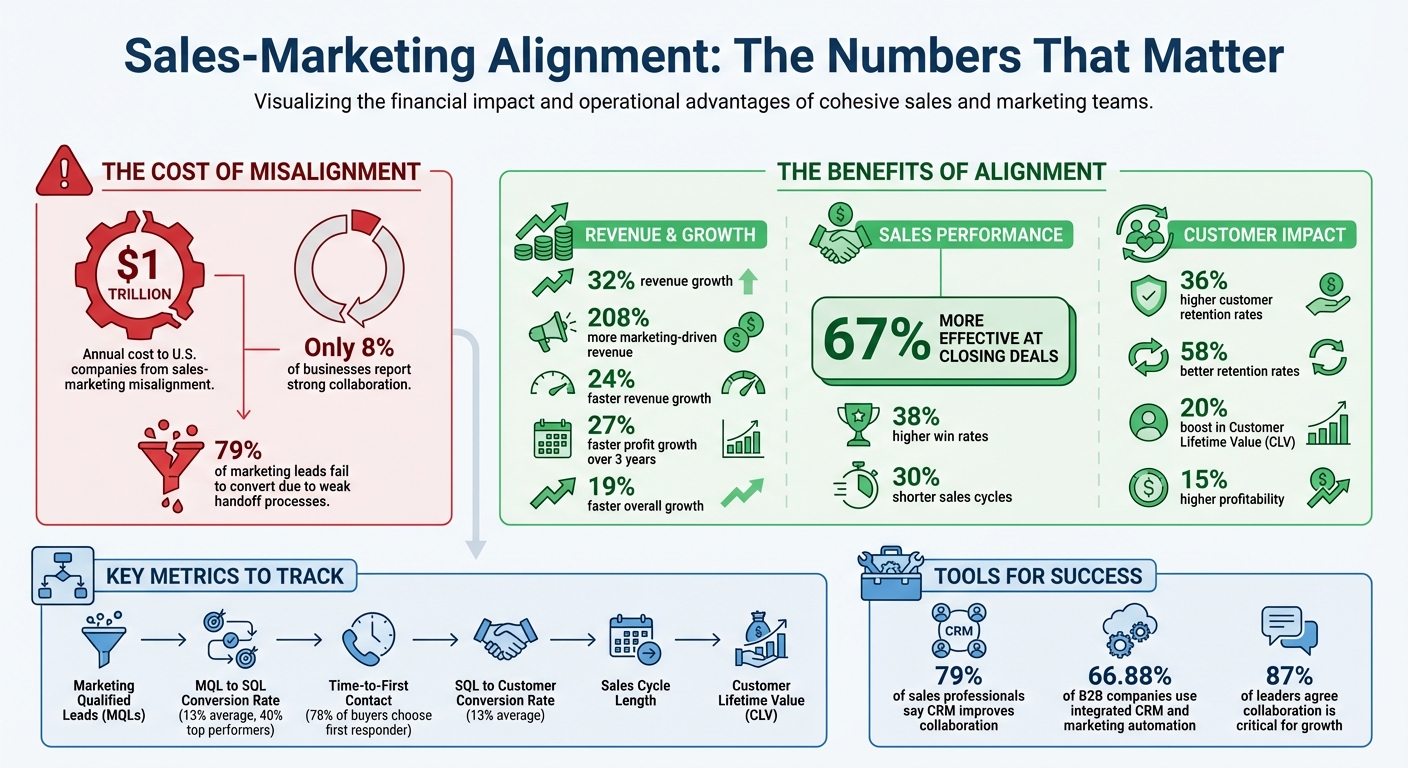
Sales-Marketing Alignment Impact: Key Statistics and ROI Metrics
The Top Metrics for Sales & Marketing Alignment (ft. Ray Rike)
sbb-itb-6e7333f
Core Metrics for Sales-Marketing Alignment
Tracking the right metrics turns alignment goals into measurable results. These metrics act as critical links, connecting lead quality to timely sales engagement. Below are three key metrics that highlight how well sales and marketing teams are working together.
Marketing Qualified Leads (MQLs) and Lead Quality
A Marketing Qualified Lead (MQL) represents a prospect who fits your Ideal Customer Profile and has shown genuine interest through specific actions like attending webinars or downloading high-value content. MQLs serve as a checkpoint, ensuring sales teams aren't flooded with unqualified leads. The criteria for MQLs are based on two factors: firmographic details (such as company size, industry, and job role) and behavioral engagement (like visiting a pricing page or participating in a webinar).
"An MQL is marketing's commitment to sales: 'We have vetted this lead. They align with our Ideal Customer Profile and have demonstrated sufficient interest to warrant your professional attention.'" - MarTech Do
HubSpot, for example, adopted an AI-driven lead scoring system in November 2025. This system analyzed engagement metrics such as email platform engagement, click-through rates, and social media activity, leading to a 30% increase in sales-qualified leads by prioritizing higher-quality prospects. Many companies use point-based systems to evaluate leads. For instance, requesting a demo might score 50 points, while opening an email might add just 1 point.
Establishing clear MQL criteria builds trust between sales and marketing, ensuring that only high-intent prospects move forward. This process directly impacts the MQL to SQL conversion rate, improving overall efficiency.
MQL to SQL Conversion Rate
The MQL to SQL conversion rate evaluates how well marketing’s efforts translate into sales-ready opportunities. It highlights the "qualification gap", where marketing might focus on lead volume while sales prioritizes high-intent buyers. On average, this conversion rate is around 13%, but top-performing B2B teams using behavioral lead scoring can reach rates as high as 40%. For 2026, top teams are expected to achieve conversion rates between 25% and 35%, while the general average remains between 18% and 22%.
"Marketing measures success by MQL→SQL conversion. Sales measures success by SQL→Opportunity conversion." - Factors.ai
A low conversion rate often points to issues like targeting the wrong audience or delays in follow-up. Implementing strict Service Level Agreements (SLAs), such as contacting leads within 1 to 24 hours, along with qualitative feedback on rejected SQLs, can help bridge this gap. Companies with well-aligned sales and marketing teams report 24% faster revenue growth and 27% faster profit growth over three years.
Time-to-First Contact
Time-to-first contact measures how quickly sales teams engage with new leads. This metric depends on marketing’s ability to provide real-time notifications and sales’ commitment to quick responses. Studies show that 78% of buyers purchase from the first business to respond to their inquiry, and the first salesperson to connect with a buyer wins the deal 50% of the time.
High-performing teams often aim to respond to high-priority leads (those scoring 80+ on fit and intent) within five minutes, while the broader industry standard is under one hour. Some teams adopt tiered SLAs, where "A" leads (high fit and intent) require contact within 10 minutes, "B" leads within 24 hours, and "C" leads are funneled into automated nurture campaigns. Real-time alerts, such as notifications for pricing page visits, help sales teams engage prospects during peak interest.
"A score without an SLA is just a number." - SalesWings
Advanced Alignment Metrics
These advanced metrics go beyond the basics, offering deeper insights into how well marketing and sales work together to drive revenue growth and build customer loyalty.
SQL to Customer Conversion Rate
The SQL to Customer conversion rate (often called the SQL-to-Win rate) is a critical measure of alignment. It tracks the percentage of sales-qualified leads (SQLs) that turn into paying customers. A high rate means marketing is targeting the right audience and sales agrees on what makes a lead worth pursuing.
On average, SQL-to-Win rates hover around 13% across industries, but B2B pipelines often see much lower rates, closer to 6%. Companies that actively monitor this metric report 28% higher win rates and 33% more accurate revenue forecasts. Lead quality also plays a big role - referrals convert at 14.7%, while purchased lead lists lag far behind at just 0.9%.
A low conversion rate can point to issues with lead readiness or scoring. To tackle this, consider holding monthly "lead review" meetings where sales provides feedback on why certain SQLs didn’t close. This helps marketing fine-tune both their scoring models and messaging. When calculating this metric, align the timeframe with your average sales cycle. For example, if deals typically take 90 days to close, compare wins this month to SQLs from three months ago.
| Lead Source | SQL to Win Conversion Rate |
|---|---|
| Customer/Employee Referral | 14.7% |
| Social Media | 8.5% |
| Email Campaigns | 7.8% |
| Webinars | 2.5% |
| Events | 1.0% |
| Lead Lists | 0.9% |
Breaking down conversion rates by channel can reveal which activities deliver the best ROI. This metric provides a direct look at how well both teams are working toward shared revenue goals.
Sales Cycle Length
The length of your sales cycle can be a strong indicator of alignment. Shorter cycles suggest that marketing is delivering well-informed, ready-to-buy leads, allowing sales to close deals faster. However, sales cycles have grown by 22% over the past five years due to the increasing number of decision-makers involved in purchases. Teams with strong alignment, though, report 30% shorter cycles.
A great example comes from Influence & Co. (now Intero Digital), which shifted from networking events to inbound content marketing under President Kelsey Raymond. By using a shared KPI tracker to align both teams, they achieved a 47% increase in revenue generated by marketing.
One effective strategy to shorten sales cycles is "assignment selling." This involves using educational content to address objections early in the process. When sending such content, include a quick note explaining its value and confirm the prospect will review it before your next meeting. Educated prospects tend to make decisions faster, while unqualified leads drop off earlier, saving time.
"Assignment selling, when set up and used correctly, will be your sales team's No. 1 selling tool for shortening the sales cycle and driving up revenue." - John Becker, IMPACT
Companies with aligned marketing and sales teams are 67% more effective at closing deals. To further speed up the process, create a "revenue team" with members from both departments. Meet weekly to brainstorm content that addresses specific sales challenges, like technical comparison guides or ROI calculators.
Customer Lifetime Value (CLV)
Customer Lifetime Value (CLV) measures the long-term profitability of a customer. A high CLV indicates that marketing is targeting the right customers and sales is closing deals with people who truly benefit from your product.
Aligned teams can boost CLV by 20% and improve customer retention by 36%. This happens because alignment ensures a seamless experience, from the first marketing touchpoint to post-sale support. In fact, 80% of customers value a consistent experience as much as the product itself.
When marketing and sales collaborate to define the Ideal Customer Profile (ICP), they focus on attracting loyal customers rather than chasing quick wins. This approach is cost-effective, as retaining customers is far cheaper than acquiring new ones. Aligned companies achieve retention rates as high as 58%, grow 19% faster, and enjoy 15% higher profitability compared to their misaligned counterparts.
To maximize CLV, use a unified CRM that both teams can access. This allows for personalized communication that strengthens relationships over time. Additionally, marketing can create content to help sales handle objections at the bottom of the funnel, reducing the risk of customer churn.
Tools and Strategies for Better Alignment
Having the right tools in place can make sales and marketing alignment achievable. For instance, 79% of sales professionals report that their CRM plays a significant role in improving collaboration between the two teams. The secret lies in selecting platforms that both departments can use as a single source of truth, eliminating time-consuming debates over conflicting dashboards.
Shared CRM and Analytics Platforms
Platforms like HubSpot and Salesforce allow both sales and marketing teams to access the same customer data, lead statuses, and deal updates in real time. This two-way synchronization ensures that updates are instantly visible to everyone. Businesses using such systems report 19% faster growth and 15% higher profitability compared to those working in isolation.
To achieve this, many companies implement a centralized semantic layer - a data model that standardizes metrics like "MQL" or "Conversion Rate" across all dashboards and reports. This ensures consistency in how leads are defined and tracked. As Adam Statti from RevPartners succinctly puts it:
"If it's not in the CRM, it didn’t happen".
Modern CRMs go beyond basic data sharing. They support behavior-based lead scoring, which triggers alerts when prospects show high intent, such as visiting a pricing page multiple times. Additionally, tools that enrich lead data - automatically adding job titles, company size, or industry details - help streamline workflows without adding extra form fields that might deter conversions.
This seamless integration of data creates a foundation for unified performance tracking.
Unified KPI Dashboards
A shared dashboard visible to both teams eliminates misunderstandings and promotes accountability. Instead of marketing focusing on clicks while sales tracks closed deals, both teams can monitor revenue-driven metrics like MQL-to-SQL conversion rates, pipeline sourced by marketing, and win rates by channel.
Take the example of a mid-sized SaaS company in early 2025 (Company Y). They struggled with conflicting KPI data across various tools. After adopting a unified dashboard with standardized metric definitions, they eliminated delays caused by data discrepancies and optimized their campaigns, achieving double the ROI in just one quarter. Similarly, another firm (Company X) improved their MQL-to-SQL conversion rate by 30% by aligning both teams on behavioral signals and scoring logic.
Real-time visibility also allows teams to address bottlenecks quickly. If leads stagnate at a specific stage in the funnel, both departments can identify the issue and collaborate on solutions during weekly meetings. This shared responsibility is becoming the norm - 66.88% of B2B companies now rely on integrated CRM and marketing automation tools to align their teams.
Case Study: Pre- and Post-Alignment Performance
In 2019, Influence & Co. (now Intero Digital) introduced a shared KPI tracker that both sales and marketing reviewed together. Under the leadership of President Kelsey Raymond, the company shifted toward inbound marketing. By jointly tracking metrics like MQLs, first sales calls, and conversion rates, they achieved a 47% increase in marketing-generated revenue.
| Metric | Pre-Alignment Performance | Post-Alignment Performance |
|---|---|---|
| Marketing-Generated Revenue | Baseline | 47% Increase |
| MQL-to-SQL Conversion | Baseline | 30% Increase |
| Sales Win Rates | Baseline | 38% Higher |
| Customer Retention | Baseline | 58% Better |
| Annual Revenue Growth | Declining or Stagnant | 32% Increase |
At Orderific, Manoj Kumar implemented a shared platform to track customer data and campaign performance over six months in 2024. By incorporating direct sales insights into marketing campaigns, the company boosted lead conversions by 25%. Similarly, Booking Agent Info's Carmen Mendoza introduced weekly "Lead Magnet Meetings" to review data collaboratively, resulting in a 15% increase in lead conversion rates.
The trend is clear: when sales and marketing operate from the same data and share ownership of revenue metrics, results improve significantly. Companies with strong alignment are 67% better at closing deals and generate 208% more marketing revenue than their misaligned counterparts.
Conclusion
Bringing sales and marketing together under shared metrics is a game-changer for revenue generation. When these departments operate as one cohesive unit, they turn into a powerful revenue-driving engine.
The numbers speak for themselves. Companies with aligned sales and marketing teams experience 24% faster revenue growth, 27% faster profit growth over three years, and see 208% higher returns on marketing investments. They also close deals 67% more efficiently and enjoy 36% higher customer retention rates. On the flip side, misalignment between these teams costs B2B companies over $1 trillion every year.
Regularly tracking performance is key to identifying and fixing breakdowns in the process. For instance, 53% of organizations struggle with misalignment during the lead handoff stage. Transparent metrics also help eliminate finger-pointing and build accountability. In fact, 90% of sales and marketing professionals agree that aligning on messaging and initiatives improves the customer experience.
To achieve these benefits, both teams need to rally around a shared "North Star" metric. This can be supported by a Service Level Agreement (SLA) that defines lead qualification standards, along with unified CRM tools and shared KPI dashboards for real-time insights. Collaboration is essential - 87% of sales and marketing leaders agree that working together is critical for driving business growth.
FAQs
How do we define MQL and SQL so both teams agree?
To get sales and marketing on the same page about MQLs (Marketing Qualified Leads) and SQLs (Sales Qualified Leads), you need to set clear, agreed-upon criteria. For MQLs, this might include factors like level of engagement or specific demographic details. For SQLs, focus on indicators such as buying intent or budget readiness. Regular communication and proper documentation are key to keeping everyone aligned, ensuring smoother lead handoffs and better accountability.
What SLA response time should sales commit to for new leads?
Responding to new leads within 5 minutes isn't just a nice-to-have - it's a game-changer. Acting this quickly can make leads 100 times more likely to respond and 21 times more likely to move into the sales process. This kind of prompt follow-up can significantly boost conversion rates and help ensure your sales team stays ahead in engaging potential customers.
What should be our single 'North Star' metric for alignment?
Finding the right 'North Star' metric is key to aligning sales and marketing teams. It should focus on long-term success for the organization while bringing both teams together under a common goal. Metrics like customer lifetime value (CLV) or revenue growth rate work well because they highlight customer value and overall business growth.
While supporting metrics - like lead quality and conversion rates - are useful for tracking progress, the primary 'North Star' metric should drive both teams to collaborate on shared, strategic objectives. This ensures that efforts are aligned and contribute to the bigger picture.