When choosing between single opt-in and double opt-in for email marketing, the decision boils down to speed versus quality. Single opt-in adds subscribers immediately after they sign up, leading to faster list growth (1.28% subscription rate). However, it risks lower-quality subscribers, including invalid emails or bots. Double opt-in, requiring users to confirm their email, results in fewer signups (0.33% subscription rate) but ensures a more engaged and reliable audience. Double opt-in also helps improve deliverability and comply with stricter regulations like GDPR.
Quick Comparison
| Metric | Single Opt-In | Double Opt-In |
|---|---|---|
| Subscription Rate | ~1.28% | ~0.33% |
| List Growth Speed | Faster | Slower |
| Subscriber Quality | Lower | Higher |
| Engagement Rates | Lower | Higher |
| Deliverability | Riskier | Safer |
| Ease for Users | Simple, immediate | Requires confirmation |
If your goal is rapid growth, single opt-in works best. For higher engagement and compliance, go with double opt-in.
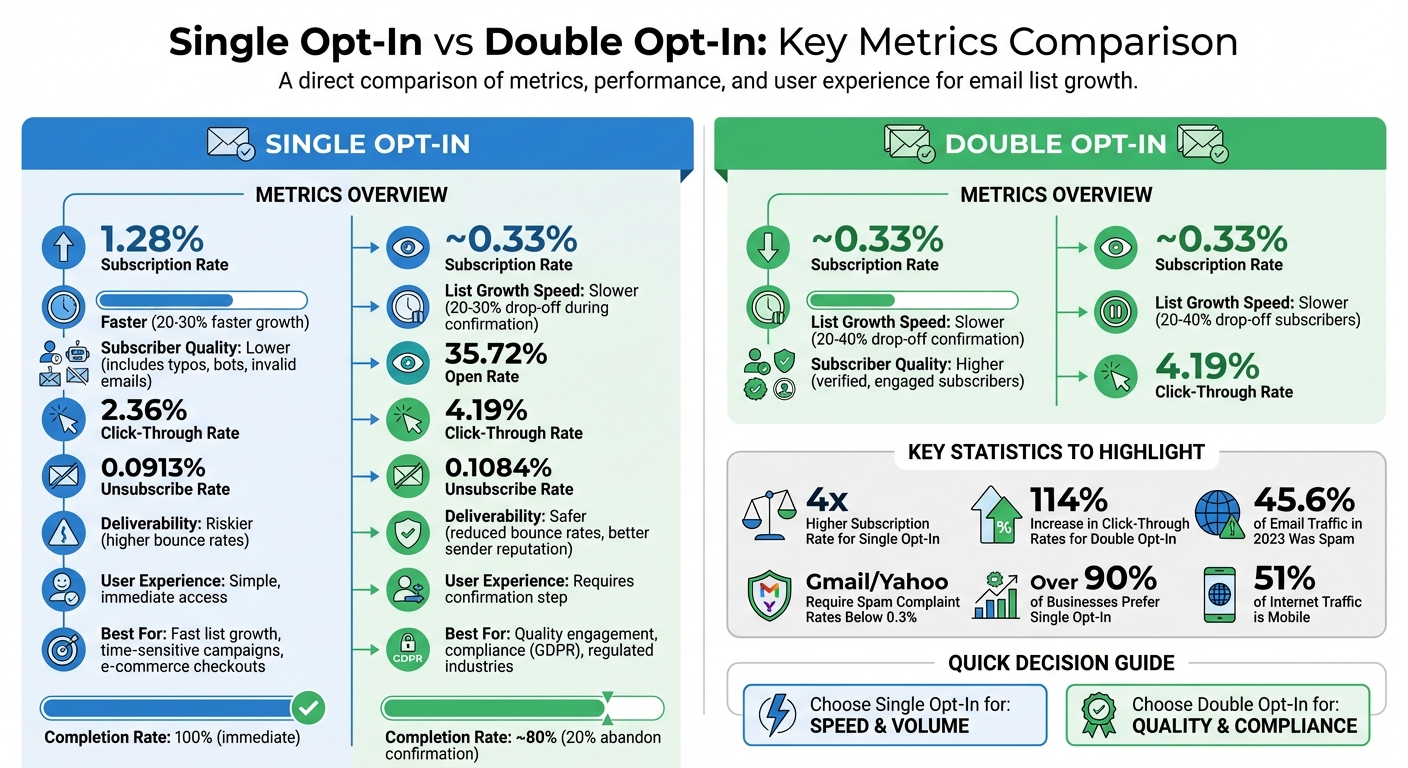
Single Opt-In vs Double Opt-In: Key Metrics Comparison
Single Opt In Versus Double Opt In
sbb-itb-6e7333f
What is Single Opt-In?
Single opt-in allows users to join your email list immediately after submitting a form, skipping the need for a confirmation email. Once someone provides their email address, their status is marked as "Active", making them eligible to receive content and offers right away. This streamlined approach is why over 90% of businesses prefer single opt-in for their subscription forms, achieving an average subscription rate of 1.28%. That’s nearly four times higher than double opt-in's 0.33% rate. Popular email platforms like Beehiiv, Brevo, Constant Contact, GetResponse, and HubSpot often default to single opt-in because it removes extra steps that could cause potential subscribers to drop off.
Let’s break down how this process works in practice.
How Single Opt-In Works
The process is simple. A visitor lands on your website, notices a signup form, and enters their email - whether it’s to subscribe to a newsletter, download a resource, or claim a discount. After clicking "submit", the email platform instantly adds them to your list. No further action is required. An automated welcome email can immediately deliver the promised content. This quick activation is especially helpful for mobile users, as it eliminates unnecessary steps and keeps things hassle-free. This ease of use encourages faster list growth, which is a critical element of successful email marketing.
Common Use Cases
Single opt-in shines when speed and simplicity are essential. For instance, e-commerce sites often rely on it during checkout to capture leads without interrupting the buying process. It’s also ideal for flash sales or limited-time promotions, where delays in confirmation could mean missed opportunities.
Another frequent application is gated content. When someone downloads a whitepaper, template, or similar resource, they expect immediate access. Sending the resource via email not only meets this expectation but also verifies the email address is active.
SMS marketing lists also benefit from single opt-in, especially when only a phone number is collected. This allows for instant interaction. Similarly, transactional emails - like order confirmations or shipping updates - use single opt-in because the action of making a purchase already implies consent. These examples highlight how single opt-in supports scenarios where speed and ease are critical.
What is Double Opt-In?
Double opt-in, sometimes called confirmed opt-in (COI), is a two-step process for email subscriptions. It ensures users verify their email address before being added to a mailing list. Unlike single opt-in, where subscribers are added immediately, double opt-in requires users to confirm their intent via email. When someone submits their email through a form, they’re initially marked as "unconfirmed" and only gain full access after clicking a verification link. This extra step ensures the email is valid and that the subscriber genuinely wants to receive updates.
While double opt-in emphasizes quality over speed, it does come with a trade-off - a lower subscription rate. About 20% of users fail to complete the confirmation step. However, those who do are often more engaged. For example, double opt-in subscribers see an average open rate of 35.72%, compared to 27.36% for single opt-in, and click-through rates of 4.19% versus 2.36%.
Beyond engagement, this method protects your sender reputation. With spam making up 45.6% of all email traffic in 2023, email providers like Gmail and Yahoo demand spam complaint rates stay below 0.3%. Double opt-in helps by filtering out invalid emails, fake signups, and bots, reducing the risk of deliverability issues.
"The way you collect consent says a lot about your brand - and affects your deliverability, compliance, and long-term subscriber relationships." - Martech Zone
How Double Opt-In Works
Here’s how the process unfolds: when someone enters their email into a signup form, their status is set to "unconfirmed." The system then sends an automated email with a unique verification link. To complete the process, the subscriber must click the link, which updates their status to "active." Often, they’re redirected to a thank-you page after confirming.
Timing is key. Sending confirmation emails immediately helps maintain interest. Use clear subject lines like "Action Required: Confirm your subscription to [Brand Name]" to avoid confusion or spam filters. If no action is taken within 24 hours, a follow-up reminder can help recapture their attention.
The email design should be simple, with a clear focus on the call-to-action. Many businesses also use the confirmation page to offer something valuable, like a welcome guide or exclusive content, to engage new subscribers right away.
This careful approach makes double opt-in a great choice when verified consent is critical.
Common Use Cases
Double opt-in is best suited for situations where subscriber quality matters more than sheer numbers. For example, businesses operating in regions like the European Union often use it to comply with GDPR consent requirements, and it’s legally required in Germany. Although single opt-in meets CAN-SPAM standards in the United States, double opt-in provides a timestamped record of consent, which can protect your business in case of disputes.
The best email marketing platforms like Mailchimp, ActiveCampaign, and Klaviyo often default to double opt-in to safeguard deliverability. It’s especially crucial in regulated industries like healthcare and finance, where compliance is non-negotiable. For instance, Mailchimp mandates double opt-in for abandoned cart text messages.
Another benefit is cost efficiency. Many email services charge based on list size, so double opt-in ensures you’re only paying for valid, engaged leads rather than fake or mistyped addresses. As Julie Griffin from Twilio explains:
"Building a quality email list is a marathon, not a sprint. While double opt-in requires a bit more set up and the list growth can be slower, the long-term benefits outweigh these temporary drawbacks."
Single Opt-In: Pros and Cons
Pros of Single Opt-In
Single opt-in skips the confirmation step, making it the quickest way to grow an email list. In fact, it can boost growth by 20–30% faster, achieving a 1.28% subscription rate - nearly four times higher than double opt-in . This method is popular among top online marketers who prioritize rapid list expansion.
The main advantage? Less friction. Subscribers stay on your site without needing to check their inbox or click a confirmation link. This smooth process is especially important for mobile users, who now make up over 51% of internet traffic. It also lets you deliver lead magnets, discount codes, or welcome emails instantly, keeping users engaged while their interest is fresh .
"If your number one goal is to build your mailing list, single opt-in is the way to go." – Hollie Youlden, Marketing Writer, EmailOctopus
Another benefit is avoiding the risk of losing potential subscribers in the confirmation process. With double opt-in, some users might forget to click the verification link or miss it entirely if it ends up in their spam folder. Single opt-in ensures that anyone who signs up is added to your list immediately .
But while single opt-in speeds up growth, it comes with its own challenges in terms of quality and lower email bounce rates.
Cons of Single Opt-In
Single opt-in tends to attract lower-quality subscribers. Without a verification step, the list is more prone to fake emails, typos, and bot signups . Additionally, you may end up with leads who only sign up for a one-time perk, like a discount or free ebook, but lose interest soon after. Engagement metrics back this up: single opt-in lists show open rates of 27.36% and click-through rates of 2.36%, compared to double opt-in's 35.72% and 4.19%.
Deliverability is another concern. Invalid email addresses can lead to higher hard bounce rates, which may damage your sender reputation. Plus, with 43% of users marking promotional emails as spam instead of unsubscribing, there's a greater risk of complaints if subscribers forget signing up. While single opt-in accelerates list growth, these issues with quality and deliverability are why some marketers still prefer double opt-in for certain strategies.
Double Opt-In: Pros and Cons
Pros of Double Opt-In
Double opt-in helps build a more engaged and accurate email list by requiring subscribers to confirm their interest. This extra step ensures that email addresses are valid, resulting in better performance metrics. For example, double opt-in lists average an open rate of 35.72% and a click-through rate of 4.19%, compared to the 27.36% open rate and 2.36% click-through rate for single opt-in lists.
This method also protects your sender reputation by reducing hard bounce rates and eliminating invalid addresses, which helps keep your emails out of spam folders. Subscribers who confirm their interest are also less likely to mark your emails as spam since they remember opting in twice. This is crucial, especially when 45.6% of all email traffic in 2023 was classified as spam.
"Double opt-in verifies that your contact wants your marketing emails before you officially add the contact to your list. This ensures that your list has highly engaged contacts who are excited to receive your emails." – Julie Griffin, Twilio
Another advantage is financial: many email platforms charge based on the number of subscribers. Double opt-in ensures you're not paying for invalid or bot-generated addresses, helping you balance list quality with cost. Additionally, the confirmation process provides a clear record of consent, which is essential for compliance with GDPR and similar regulations.
Cons of Double Opt-In
That said, double opt-in comes with some challenges. Research shows that up to 61% of leads fail to complete the confirmation process, slowing list growth by about 20–30%.
The extra step adds friction to the signup process. Users must leave your site, check their inbox, and click a confirmation link - an extra hurdle that can be especially tricky for mobile users. Technical issues, like emails landing in spam folders, delivery delays, or blocks, can further disrupt the process. On top of that, you'll need to create and maintain additional assets, including confirmation emails, "check your email" landing pages, and success pages.
Subscribers may also feel overwhelmed by multiple automated messages immediately after signing up. While double opt-in improves list quality, it’s worth noting that it can lead to slightly higher unsubscribe rates - 0.1084% for double opt-in compared to 0.0913% for single opt-in.
Single Opt-In vs Double Opt-In: Key Metrics Compared
List Growth Speed
If you're looking to grow your email list quickly, single opt-in is the clear winner. It achieves a subscription rate of about 1.28%, compared to 0.33% for double opt-in. By skipping the confirmation step, single opt-in reduces friction, which results in faster growth. However, with double opt-in, up to 40% of subscribers may drop off during the confirmation process, with some industry cases showing around a 20% loss.
"When you make it easier for subscribers to join your mailing list, you speed up your list growth. Think about it – with fewer steps between a subscriber and your list, more subscribers are going to get there." – Hollie Youlden, EmailOctopus
While single opt-in accelerates growth, it's not just about quantity - subscriber quality tells a different story.
Subscriber Quality
Double opt-in shines when it comes to the quality of your subscribers. It acts as a filter, catching typos, bot sign-ups, and fake email addresses that might slip through with single opt-in. About 80% of potential subscribers complete the double opt-in process, meaning those who do are genuinely interested and using active email addresses. In contrast, single opt-in lists can include invalid or impulsively entered addresses, which may lead to higher spam complaints. For instance, 43% of people mark promotional emails as spam instead of unsubscribing, and email providers like Gmail and Yahoo expect spam complaint rates to stay under 0.3%.
"I would recommend that every sender use a double opt-in all the time. Not only does it ensure you only acquire subscribers who are more likely to engage, but it also helps prevent bots from abusing signup forms, which is a significant email security risk." – Nick Schafer, Sr. Manager of Deliverability & Compliance, Sinch Mailgun
Engagement Rates
Double opt-in lists often lead to higher engagement. Subscribers who confirm their interest are more likely to open emails, click links, and interact with your content. While single opt-in may generate a larger overall volume of interactions simply because the list is bigger, the engagement levels per subscriber are typically stronger with double opt-in. This extra step might slow down list growth, but it fosters a more engaged audience.
Deliverability Impact
When it comes to deliverability, double opt-in has a clear advantage. By ensuring only valid, active email addresses make it onto your list, it reduces hard bounces and protects your sender reputation. This is especially important when nearly 50% of emails sent globally end up flagged as spam. For single opt-in, tools like real-time email verification and security measures such as reCAPTCHA can help minimize issues with invalid or automated sign-ups. Ultimately, the trade-off between speed and quality becomes a key consideration here.
User Experience
From the subscriber's perspective, single opt-in offers a smooth, hassle-free experience. They gain immediate access to content or benefits without jumping through extra hoops, which is particularly appealing for mobile users. On the flip side, double opt-in adds a confirmation step, but this process sets clear expectations and ensures a more engaged and reliable subscriber base.
| Metric | Single Opt-In | Double Opt-In |
|---|---|---|
| Subscription Rate | ~1.28% | ~0.33% |
| List Growth Speed | Faster; lists can grow 20–30% more quickly | Slower; approximately 20–27% of potential subscribers drop off |
| Subscriber Quality | Lower; may include typos, bots, and inactive addresses | Higher; only verified, engaged subscribers |
| User Experience | Immediate and seamless | Requires an extra confirmation step |
When to Use Single Opt-In
For Fast List Growth
If you need to grow your email list quickly, single opt-in is the way to go. Studies reveal that single opt-in achieves a 1.28% subscription rate - equating to about 12,800 subscribers per 1 million visitors - and can grow your list 20–30% faster than double opt-in . While double opt-in lists might show higher engagement rates, single opt-in lists often generate more total opens, clicks, and conversions simply because the initial subscriber base is much larger .
"Single opt-in outperforms double opt-in in every possible regard. According to our research, SOI will grow your email list faster, get more impressions on your emails and you can convert more subscribers into paying customers." – GetResponse
The speed of single opt-in is matched by its simplicity, which helps keep users engaged throughout the process.
For Simple User Journeys
Beyond speed, single opt-in shines in creating smooth and hassle-free signups. This is especially important during checkout flows, where adding extra steps - like email confirmation - can disrupt the process and risk losing a sale. If someone is already engaged in an action, such as purchasing a product or downloading a resource, single opt-in eliminates unnecessary friction.
With mobile users making up over 51% of global web traffic, single opt-in also prevents the frustrating experience of switching between apps or tabs. This simplicity is particularly effective for campaigns offering incentives like discount codes or free downloads. Users expect immediate access to their rewards, and single opt-in ensures they get what they’re looking for while their attention is still focused .
When to Use Double Opt-In
For Quality Over Quantity
When engagement matters more than sheer numbers, double opt-in becomes the go-to strategy. It consistently generates higher engagement rates, making it a smart choice for businesses that value quality leads over a large subscriber base. This approach is especially effective for B2B companies or businesses selling high-value products, where each lead holds significant importance. Subscribers who confirm their interest are often more engaged and more likely to convert.
"Building a quality email list is far more beneficial to you than building a big list. Having a large list can actually hurt your results if it consists of people who are inactive and unengaged." – Campaign Monitor
Double opt-in also serves as a safeguard for your sender reputation. By filtering out fake addresses, typos, and bots, it prevents these issues from impacting your deliverability. Considering that 45.6% of global email traffic in 2023 was classified as spam, this verification step is crucial. A clean list not only improves your email engagement but also ensures your messages reach inboxes, supporting both revenue goals and regulatory trust.
For Compliance and Trust
Double opt-in doesn’t just improve engagement - it also strengthens your brand’s legal and reputational safeguards. By adding an extra layer of verification, it ensures long-term deliverability and protects your brand integrity. This method provides a clear, verifiable record of consent, including details like the subscriber’s IP address, as well as the date and time of confirmation. Such records are far easier to defend in regulatory audits compared to single opt-in. Industries with strict compliance requirements, such as healthcare and finance, benefit greatly from this added level of permission evidence.
"Double opt-in gives email marketers clear permission and proof that a person agreed to have their email address stored on the mailing list and be emailed marketing material." – SmartrMail
Double opt-in also reduces spam complaints, which is critical given that platforms like Gmail and Yahoo enforce strict limits on spam rates. In 2023, 27% of email users flagged junk emails as spam. Having subscribers actively confirm their interest minimizes these complaints, ensuring better deliverability and protecting your email campaigns in the long run.
Conclusion
Pick the opt-in method that aligns with your business goals. Each approach has its strengths: single opt-in offers speed and higher subscription rates, making it great for quickly growing your audience or keeping the signup process simple. On the other hand, double opt-in ensures stronger engagement by confirming subscriber intent, leading to a more active and responsive email list.
The numbers back it up: single opt-in grows lists 20–30% faster, with subscription rates of 1.28% compared to 0.33% for double opt-in. However, double opt-in outperforms in engagement, boasting open rates of 35.72% versus 27.36% for single opt-in and delivering a 114% increase in clicks. Essentially, choosing faster growth often means sacrificing some engagement quality.
Your choice should also depend on your industry and risk tolerance. In fields like healthcare or finance, where compliance is critical, double opt-in provides the necessary consent records. But for time-sensitive campaigns or product launches, single opt-in's speed can be a game-changer - as long as you use tools to verify email addresses and maintain clean lists.
"If your email engagement plummets after you switch to single opt-ins, then the faster list growth rate might not be worth the drop in engagement." - Kayla Voigt, B2B Writer, Litmus
The best strategy? Test both methods to see what works for your audience and goals. For instance, some businesses use single opt-in for general website signups but switch to double opt-in for high-value actions like exclusive content downloads or contest entries. Keep a close eye on metrics like engagement, deliverability, and spam complaints to ensure your opt-in strategy supports both immediate growth and long-term success.
FAQs
What are the benefits of using double opt-in for email deliverability?
Double opt-in is a straightforward yet powerful way to boost your email deliverability. By requiring subscribers to confirm their email address after signing up, you ensure that they genuinely want to hear from you. This extra step helps weed out invalid email addresses, reduces spam complaints, and lowers bounce rates - all of which are key to maintaining a strong sender reputation.
When your email list is filled with engaged, authentic subscribers, your campaigns are more likely to perform well. Plus, double opt-in sets the stage for long-term success by helping your emails consistently land in inboxes instead of spam folders.
What advantages does single opt-in offer for mobile users?
Single opt-in makes subscribing a breeze, especially for mobile users. By cutting down on extra steps, it creates a smoother, faster process that’s easier to navigate.
This hassle-free method is perfect for people on the move, reducing barriers and letting them sign up quickly. The result? A growing email list with engaged and ready-to-act subscribers.
How does double opt-in support GDPR compliance?
Double opt-in is an important tool for aligning with GDPR requirements because it ensures subscribers give clear and traceable consent. With this process, individuals confirm their subscription via a follow-up email, adding an extra layer of clarity and accountability.
Although GDPR doesn’t explicitly require double opt-in, using it shows a strong dedication to protecting personal data. It also minimizes the chances of adding fake or unauthorized email addresses to your list. The result? A higher-quality subscriber base and increased trust from your audience.