A unified sales and marketing workflow, often called "smarketing", aligns these two teams to work toward shared revenue goals. This approach eliminates inefficiencies caused by siloed operations, improves collaboration, and drives better results. Here's what it involves:
- Shared Definitions: Agree on terms like Ideal Customer Profile (ICP), Marketing Qualified Leads (MQLs), and Sales Qualified Leads (SQLs).
- Centralized CRM: Both teams use one system for seamless data sharing and tracking.
- Service Level Agreements (SLAs): Define clear responsibilities, lead quality standards, and follow-up timelines.
- KPIs and Metrics: Track shared performance indicators like lead acceptance rates and pipeline velocity.
- Integrated Tools: Use connected systems for automation, data accuracy, and real-time updates.
Companies with aligned sales and marketing teams report 208% more revenue, 36% higher customer retention, and 38% higher win rates. By mapping the buyer journey, creating shared goals, and leveraging the right tools, you can streamline operations and improve outcomes.
How To Align Sales and Marketing Teams (Follow these Steps)
sbb-itb-6e7333f
Mapping the Buyer Journey for Both Teams
Alignment issues between sales and marketing often stem from mismatched assumptions rather than flawed tools. Both teams might think they're working toward the same goals, but they often use different language, criteria, and frameworks. By mapping the buyer journey together, teams can establish a shared understanding, closing the gaps that lead to inefficiencies. Here's how defining the buyer journey with clear terms can help avoid these common pitfalls.
Defining Funnel Stages and Shared Terminology
The buyer journey typically follows four key stages: awareness, consideration, decision, and post-purchase. Marketing usually manages the first two, while sales takes the lead at the decision stage. However, the transition between consideration and decision is often where things break down - largely because teams haven’t agreed on when and how that handoff should happen.
To fix this, both teams need to collaboratively define key terms and document them. For example, they should agree on what qualifies someone as an MQL (Marketing Qualified Lead), an SAL (Sales Accepted Lead), an SQL (Sales Qualified Lead), and a full Opportunity. Below is a framework to get started:
| Term | Definition | Example Criteria |
|---|---|---|
| ICP | Description of ideal accounts | B2B SaaS, 50–500 employees, uses Salesforce |
| MQL | Lead matching ICP who has shown high intent | ICP match + visited pricing page + downloaded a guide |
| SAL | MQL reviewed and accepted by sales | Sales confirms it's worth pursuing within 24 hours |
| SQL | Lead with a verified buying need | Budget discussed, decision-maker identified |
| Opportunity | SQL with a defined next step in the pipeline | Discovery call completed, demo scheduled |
One key warning: Avoid defining MQLs based solely on easily tracked actions, like attending a webinar. Leads classified this way often lack real intent, causing sales teams to disregard marketing-generated leads entirely.
Finding Process Gaps
Once definitions are in place, the next step is to map out the existing lead flow - not the idealized version - and identify where leads are stalling, getting dropped, or being inconsistently qualified.
Shared KPIs can help pinpoint problem areas quickly:
| Shared KPI | Target Benchmark | Indicates |
|---|---|---|
| Lead Acceptance Rate | >70% | Issues with qualification or ICP alignment |
| Follow-Up Compliance | >90% | Gaps in the sales process or SLA enforcement |
| MQL-to-SQL Rate | 25–40% | Marketing may be sending low-intent leads |
| Pipeline Velocity | Increasing quarter-over-quarter | Friction points in the buyer journey |
Another helpful practice is having marketing review sales call recordings. These recordings often reveal buyer objections that could indicate gaps in top-of-funnel content. For example, if buyers frequently express confusion or misalignment, it could mean marketing content isn’t adequately pre-qualifying leads. Identifying these gaps lays the groundwork for building a unified process.
Creating a Shared Process Document
A shared process document eliminates guesswork and replaces it with clear accountability. This document doesn’t need to be lengthy - a concise, one-page guide can often be more effective than a dense manual no one reads. Key elements to include are:
- Ownership at each stage of the buyer journey
- Handoff triggers between teams
- Required data fields (e.g., source, pages visited, content downloaded, qualification score)
- Follow-up timelines and next steps
"A jointly-created ICP is the Rosetta Stone for your revenue teams. It translates marketing's audience data into sales' real-world conversation targets, ensuring everyone speaks the same language." - Semir Jahic, CEO & Co-Founder, Salesmotion
The document should also address how to handle leads that aren’t ready to move forward. Instead of discarding them, these leads should be placed into a nurturing sequence. To keep the process relevant, schedule a formal review of the document every 90 days, adjusting thresholds and criteria to reflect evolving buyer behavior.
Setting Shared Goals, Metrics, and SLAs
Once a shared process document is in place, the next step is aligning sales and marketing around common revenue goals and measurable outcomes. This stage cements operational alignment, ensuring both teams work toward a unified revenue objective.
Setting Shared Revenue Goals
A common mistake is treating marketing's lead volume and sales' quotas as separate targets. This approach often creates conflicting priorities. Instead, a shared revenue model with joint accountability proves far more effective.
In this structure, marketing takes ownership of pipeline generated - the total dollar value of opportunities created - while sales focuses on pipeline converted, measured by metrics like close rate and average deal size. Both teams share responsibility for the ultimate goal: total revenue closed. This shared accountability eliminates the blame game when deals fall through. Research shows that companies with strong alignment can achieve up to 38% higher sales win rates and generate up to 208% more marketing-sourced revenue.
"Sales and marketing alignment is not a 'soft' team-building initiative. It is a core revenue function that demands a shared operational system, hard-coded rules of engagement, and mutual accountability for the same number: revenue." - Nora Schon, Co-Founder & CEO, Altior & Co.
Defining Key Performance Indicators (KPIs)
Shared goals only work if both teams track the same metrics in a unified system. A dashboard within your CRM offers a single, real-time view of pipeline health. Poor data quality costs businesses an average of $12.9 million annually, making this single source of truth essential.
Here’s a breakdown of key KPIs, including benchmarks and their significance:
| KPI | Healthy Benchmark | What It Tells You |
|---|---|---|
| MQL-to-SAL Acceptance Rate | 60%–80% | Whether marketing is delivering leads that align with sales’ criteria |
| SAL-to-SQL Conversion Rate | 30%–50% | How effectively sales qualifies accepted leads |
| Average Lead Response Time | ≤ 4 hours | How quickly sales follows up on high-intent leads |
| Marketing-Sourced Pipeline % | 30%–50% | Marketing’s contribution to the overall pipeline |
| Follow-Up Compliance | > 90% | Whether sales is meeting SLA commitments |
These KPIs act as the foundation for creating effective SLAs.
Creating and Enforcing SLAs
Once metrics are defined, formal agreements - SLAs - turn alignment into actionable commitments. An SLA clearly outlines what each team is responsible for and the consequences of unmet commitments. Companies with active SLAs see a 34% increase in year-over-year ROI.
A well-structured SLA includes commitments from both sides. Marketing agrees to deliver a specific volume of leads that meet pre-established quality standards, such as including firmographic data or scoring above a set threshold. On the other hand, sales commits to reviewing leads within 24 hours, contacting high-intent leads within 4 hours, and logging detailed rejection reasons in the CRM for unaccepted leads. This feedback loop helps marketing refine its targeting efforts.
"An SLA without consequences is a wish list. Both teams need to know what happens when commitments are missed." - Jeff Pedowitz, President and CEO, The Pedowitz Group
To keep SLAs relevant, schedule quarterly reviews to adjust thresholds based on market changes. Complement this with weekly 30-minute revenue team meetings to review SLA scorecards and address any compliance issues before they escalate.
Choosing and Connecting the Right Tools
Once shared goals and SLAs are in place, the next step is equipping your teams with tools that work seamlessly together. A well-connected tech stack minimizes miscommunication between sales and marketing, but this only works if those tools are properly integrated and exchanging clean, consistent data.
Building a Centralized CRM System
The CRM acts as the central hub for a unified workflow. It’s the go-to source for storing every lead interaction, deal stage, and contact record. This gives both teams a clear view of the pipeline, from the first interaction to the final deal.
"Marketing sees which campaigns open deals. Sales knows which touchpoints closed them. One source of truth for both teams." - GoCRM
A centralized CRM eliminates discrepancies, ensuring accurate data attribution and better resource allocation. Poor data governance between CRM and marketing tools can be costly - mid-market companies lose an average of $2.5 million annually because of it. By serving as the authoritative record, a well-configured CRM resolves these issues. Marketing tools contribute data, but when conflicts arise, the CRM takes precedence. Once your CRM is set up as the core system, automating workflows across connected tools can take efficiency to the next level.
Automating Workflows Across Tools
A CRM alone won’t cut it. Marketing automation tools are essential for handling repetitive tasks like lead scoring, follow-up emails, multi-channel nurturing, and routing leads to the right sales rep as soon as a form is submitted. Integrating these tools with your CRM ensures a smooth handoff between teams.
Platforms like HubSpot make this easier with their all-in-one setup, where everything runs on a single database. On the other hand, middleware solutions like Zapier or Make can connect standalone tools, though they may require more upkeep and could introduce sync delays. For critical data - like demo requests - real-time synchronization works better than daily batch updates.
The benefits are clear. Automated email workflows built on reliable CRM data can generate $16.96 per recipient, compared to just $1.94 for standard broadcast emails. Additionally, a 2022 survey found that businesses using Keap’s automation software saved an average of 10 hours per week and saw a 61% revenue boost.
Even with automation, keeping your data clean and synchronized is critical.
Keeping Data Accurate and Synced
On average, 22–29% of records in an enterprise CRM are either duplicates or incomplete. This can lead to missed leads, misdirected contacts, and unreliable attribution data - issues that can undermine the entire strategy.
To avoid these problems, follow a few best practices. First, use email addresses as the primary deduplication key across all systems. Set sync rules so that new marketing data fills in empty CRM fields but doesn’t overwrite validated sales data - this “fill gaps” approach helps maintain data integrity. Before going live, test your integration with a small sample (10–500 contacts) to ensure field mapping is correct and no data is overwritten.
For email platforms, suppression sync is vital. Unsubscribes must sync immediately from your email tool to your CRM to stay compliant and protect deliverability. If you’re unsure which platforms support this, the Email Service Business Directory is a helpful resource for comparing integration features. When email and CRM systems are fully integrated, businesses can see revenue increases of up to 41% compared to disconnected tools.
Step-by-Step Implementation Plan
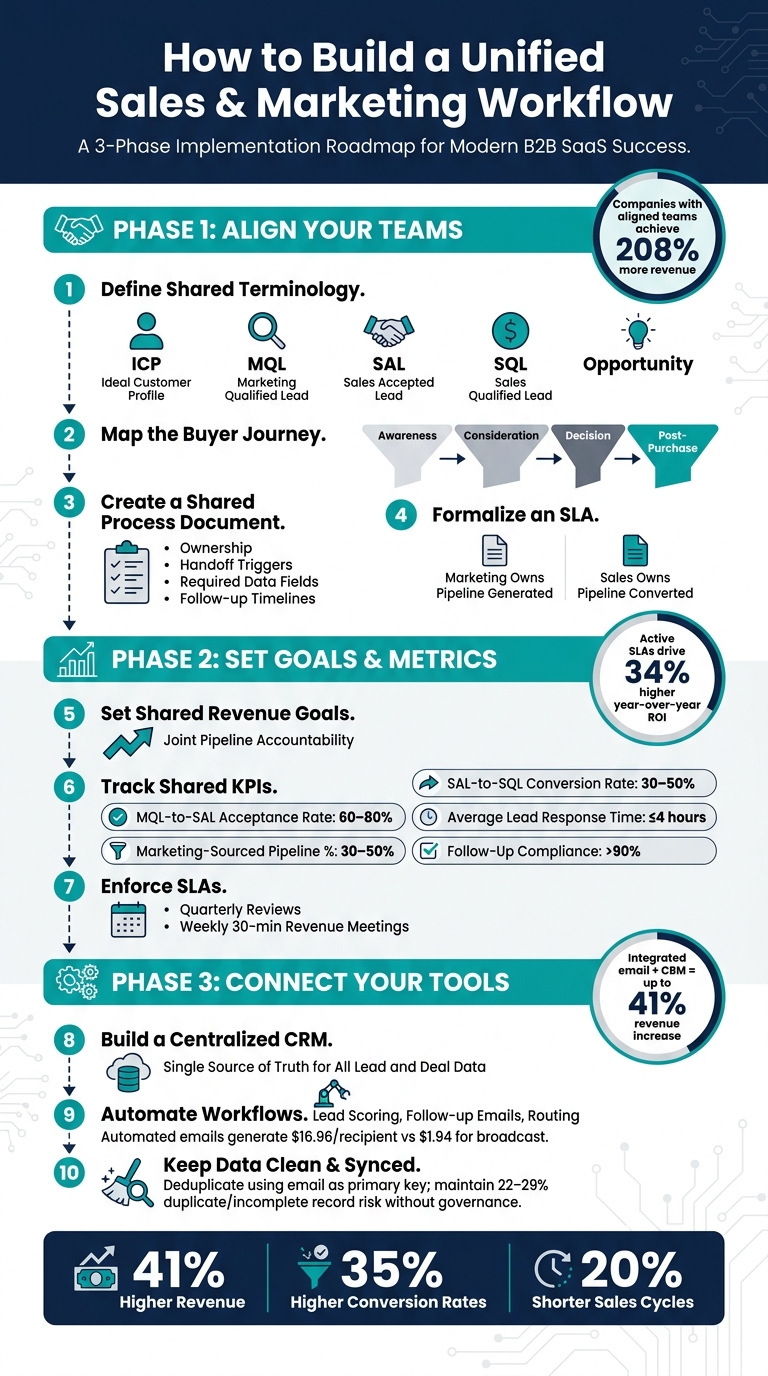
Sales & Marketing Alignment: Unified Workflow Implementation Roadmap
With your unified strategy and integrated tools in place, the next step is to bring your workflow to life. Even the most robust tech stack won't succeed without a well-thought-out rollout plan.
Aligning Teams Before You Start
Before diving into tool deployment, it's critical to get sales and marketing on the same page. Start by jointly defining key terms like ICP (Ideal Customer Profile), MQL (Marketing Qualified Lead), and SQL (Sales Qualified Lead). This builds on the shared process document you've already created. Misaligned definitions often cause handoff issues - not the technology itself.
"Most sales-marketing alignment problems are definition problems, not technology problems." - House of MarTech
Next, formalize roles and responsibilities through a written SLA (Service Level Agreement). For example, marketing should take responsibility for pipeline generated, while sales focuses on pipeline converted. To oversee the rollout, appoint an executive sponsor, establish an alignment council, and set up a monthly working group.
Once you've confirmed alignment, you're ready to move on to configuring tools and assessing email platform compatibility within your processes.
Configuring Tools and Processes
Start with a lead source audit across all channels - forms, ads, webinars, etc. - to ensure you understand how data flows into your CRM. This step is essential to avoid "dirty data" that could disrupt your workflow from day one.
Next, standardize lifecycle stages across your systems (e.g., Subscriber → Lead → MQL → SQL → Opportunity → Customer). Create a detailed field-mapping document to specify sync directions and conflict resolution rules for every shared field. For instance, marketing may own "Engagement Data", while sales controls "Deal Stage". Set up behavior-based handoff triggers so that high-intent actions, like demo requests, are routed to sales immediately rather than sitting idle in a queue. Before launching, test the setup with 10–20 sample records to confirm that field mapping works correctly and no validated sales data is overwritten.
Reviewing and Improving Over Time
A unified workflow isn't something you set and forget - it requires ongoing maintenance to stay effective.
"Alignment is not a simple project with a defined end date – it is a continuous cultural and operational shift." - Megan Cohn, Senior Manager, Product Marketing, Salesforce
Schedule a weekly 30-minute pipeline meeting between sales and marketing. Start with a quick review of the SLA scorecard, then have sales share the three best and three worst leads from the week. This provides actionable feedback for marketing and helps refine the process. Rotate the meeting facilitator between teams to encourage shared accountability.
In addition to weekly check-ins, recalibrate your lead scoring model every six months based on closed-won data to ensure it reflects genuine buying intent. Review SLA targets monthly and adjust them quarterly based on real conversion data. For significant changes, test them with a small group before rolling them out fully.
Conclusion: Key Takeaways and Next Steps
Creating a unified sales and marketing workflow requires a long-term commitment to bringing together people, processes, and data. When done effectively, businesses with fully integrated systems see impressive results: 41% higher revenue, 35% higher conversion rates, and sales cycles that are 20% shorter.
The key lies in transitioning from scattered, disconnected tools to a single source of truth. A centralized CRM where both sales and marketing teams can access the same engagement history, lead statuses, and communication logs is essential. This setup minimizes miscommunication and encourages accountability. Features like automated handoffs, shared KPIs, and a living SLA ensure transparency and measurable progress over time. With this foundation in place, actionable next steps become clear.
"Alignment requires three pillars - not just technology. Success depends equally on people alignment, process alignment, and data governance." - Sam Poole, Associate Content Marketer, Nutshell
Start by auditing your tech stack. List all tools in use, identify data silos or manual processes, and pinpoint duplicate subscriptions. Many small businesses find they can save between $450 and $1,100 per month by consolidating overlapping tools. Opt for native integrations whenever possible to enable real-time syncing and reduce ongoing maintenance efforts.
If you're selecting or upgrading your email marketing platform, the Email Service Business Directory is a helpful resource. This directory allows you to filter platforms based on integration type, business size, and specific use cases. Whether you're managing B2B lead nurturing campaigns or SaaS onboarding workflows, choosing a platform that integrates directly with your CRM prevents data silos and simplifies operations.
FAQs
What’s the fastest way to align on ICP, MQL, SAL, and SQL definitions?
The fastest approach is to work together in sales and marketing workshops to create a one-page "Revenue Language" document. Use three main criteria to define each stage: firmographic fit, behavioral intent, and timing. Once defined, integrate these into your CRM using picklists and automated lead scoring. Support these definitions with SLAs, and ensure accuracy by validating quarterly - this includes backtesting against closed-won data and analyzing conversion performance.
Which shared KPIs matter most for a unified sales and marketing workflow?
To create a stronger connection between sales and marketing, it's crucial to focus on shared KPIs that bridge lead generation efforts with closing deals. Here are some key metrics to keep an eye on:
- MQL to SQL Conversion Rate: This measures how effectively marketing-qualified leads (MQLs) are turning into sales-qualified leads (SQLs). It shows how well the two teams are working together to identify and nurture prospects.
- SQL to Customer Conversion Rate: This metric highlights how many SQLs transition into paying customers, offering insight into the sales team's performance and the quality of leads provided by marketing.
- Time-to-First Contact: The faster your sales team reaches out to a lead, the higher the chances of closing the deal. Quick responses can significantly boost win rates.
Additionally, tracking sales cycle length helps evaluate how efficiently deals are being closed, while monitoring customer lifetime value (CLV) provides a clear picture of long-term success and the overall impact of sales and marketing alignment. These metrics together ensure both teams are working toward common goals with measurable outcomes.
How can we prevent 'dirty data' when syncing our CRM and marketing tools?
To keep your data clean, turn your CRM into the single source of truth. Start by assigning field-level ownership so that CRM data always wins in case of conflicts. Regularly audit lead sources to spot duplicates, and use deduplication rules - like matching by email or domain - to clean up your records. When setting up integrations, make sure they only populate empty fields to avoid overwriting valuable information. Standardize data formats during entry, and keep an eye on sync logs to catch and fix any issues before they snowball.