AI-driven email marketing offers powerful personalization, but it comes with strict GDPR compliance requirements. If your business handles EU residents' data, you must prioritize privacy, secure explicit consent, and follow rigorous data protection rules. Here’s what you need to know:
- Consent is Key: Subscribers must actively opt in. Pre-checked boxes or assumed consent are prohibited.
- Data Minimization: Only collect and process data necessary for your stated purpose.
- Transparency: Clearly explain how AI uses data for personalization.
- Retention Policies: Delete unnecessary data promptly and document all practices.
- Subscriber Rights: Make it easy for users to access, update, or delete their data.
AI complicates compliance with its large-scale data processing and automated decisions. To stay within GDPR guidelines, businesses must document every AI activity, ensure human oversight for impactful decisions, and regularly audit processes. Non-compliance risks hefty fines (up to €20M or 4% of global revenue) and damage to customer trust.
To stay compliant:
- Use GDPR-compliant email tools with strong security and consent management.
- Automate compliance processes like consent tracking and data deletion.
- Train teams on GDPR rules and AI privacy risks.
- Conduct regular audits to identify gaps and improve practices.
Balancing AI’s capabilities with GDPR’s strict requirements is challenging but necessary to protect user privacy and avoid penalties. Always prioritize transparency, consent, and data security when leveraging AI in email marketing.
Does Automating Email Consent Management Reduce GDPR Risks? - TheEmailToolbox.com

GDPR Requirements for Email Privacy
The GDPR sets detailed rules for handling the personal data of EU residents. For email marketers, this means adhering to strict guidelines on how subscriber information is collected, stored, and used - regardless of where your business operates.
At its core, the GDPR is built around seven key principles: lawfulness, fairness, and transparency; purpose limitation; data minimization; accuracy; storage limitation; integrity and confidentiality; and accountability. These principles are designed to ensure that your email marketing practices prioritize the rights and interests of your subscribers.
Compliance with GDPR doesn’t stop at obtaining consent. It’s an ongoing process that involves managing your email platforms, customer databases, and automated workflows. Even a small oversight could lead to regulatory scrutiny, potentially disrupting your entire marketing strategy. Below, we’ll explore the essential principles that guide GDPR-compliant email marketing.
Core GDPR Principles for Email Marketing
Lawfulness, fairness, and transparency: You need a valid legal basis to process data, and subscribers must clearly understand how their information will be used.
Under GDPR, you cannot send marketing emails without explicit opt-in consent. This means subscribers must actively agree to receive emails - no pre-checked boxes or assumptions based on prior business interactions. Consent must be freely given, specific, informed, and unambiguous.
Purpose limitation restricts you to using subscriber data only for the purposes disclosed at the time of consent. For example, if you collected email addresses for product updates, you can’t use that data later for event promotions without obtaining fresh consent.
Data minimization ensures you only collect the information necessary for your stated purpose. By limiting data collection to essential details - such as email addresses and campaign performance metrics - you reduce both compliance risks and potential cybersecurity vulnerabilities.
Accuracy requires keeping subscriber information up to date. This includes maintaining systems that allow users to update their details and promptly removing invalid email addresses that result in bounces.
Storage limitation mandates that personal data should only be retained as long as it’s needed. Clear retention policies, along with regular purges of outdated or unnecessary data, are critical for compliance. Documenting these practices is equally important.
Integrity and confidentiality: Protect subscriber data by implementing encryption, strong authentication methods, and strict access controls.
Accountability obligates you to document your compliance efforts. This includes recording how and when consent was obtained, along with the exact circumstances of each consent capture.
Additionally, GDPR grants subscribers several rights, including the ability to access, correct, delete, or transfer their data. Every marketing email must feature a clear unsubscribe link and options for managing preferences. Opt-out requests must be processed promptly - typically within 72 hours - to ensure no further emails are sent without consent.
GDPR vs. CAN-SPAM Regulations
Understanding how GDPR differs from CAN-SPAM provides insight into why GDPR is considered one of the most rigorous data protection laws worldwide. These two frameworks take very different approaches to email marketing compliance:
| Aspect | GDPR | CAN-SPAM |
|---|---|---|
| Consent Model | Requires opt-in consent before sending marketing emails | Opt-out model; emails can be sent unless the recipient unsubscribes |
| Focus | Emphasizes user consent, privacy, and control over personal data | Focuses on email content and sender behavior |
| Individual Rights | Includes rights to access, correct, delete, and transfer data | Offers limited individual rights |
| Scope | Applies globally to any organization processing data of EU residents | Primarily applies to U.S. commercial email communications |
| Strictness | Enforces stricter data protection rules with higher penalties | Less restrictive compliance requirements |
The difference in consent models is particularly striking. GDPR requires explicit opt-in consent, meaning subscribers must actively agree to receive emails and be informed about what they’ll receive. In contrast, CAN-SPAM uses an opt-out model, where businesses can send emails until the recipient requests otherwise.
Another major distinction is GDPR’s focus on the entire data lifecycle. It governs every stage - from data collection and processing to storage and deletion. CAN-SPAM, on the other hand, primarily regulates the content of individual emails and sender behavior. GDPR also grants subscribers extensive rights, such as the ability to access or delete their data, which are not covered under CAN-SPAM.
For businesses with both U.S. and EU audiences, these differences matter. To comply with both frameworks, you’ll need to meet GDPR’s stricter requirements, which often cover CAN-SPAM obligations as well. However, the reverse isn’t true - CAN-SPAM compliance alone won’t satisfy GDPR standards.
This becomes even more critical when incorporating AI into email marketing. AI-driven personalization, for example, must be disclosed to subscribers, and explicit consent is required. Unlike CAN-SPAM, GDPR’s rules extend to every aspect of data handling, making it essential to align AI practices with GDPR guidelines. These distinctions underscore the need for careful planning to ensure compliance across all regions.
Privacy Challenges When Using AI in Email Marketing
GDPR enforces strict rules on how data can be used, and AI's advanced capabilities are pushing these boundaries further. With AI, email marketing has evolved from simple list management to sophisticated behavioral analysis and predictive modeling. Traditional email marketing might rely on basic segmentation, but AI takes it a step further, analyzing browsing history, engagement trends, purchase behavior, and inferred preferences to train algorithms and make predictions. This level of data processing introduces new compliance challenges under GDPR.
AI operates on a scale that often clashes with GDPR principles. For instance, when subscribers opt into your email list, they usually expect to receive newsletters or promotional content - not to have their behavior tracked in detail. AI can monitor which links they click, how long they spend reading emails, whether they forward messages, and more, all to create detailed behavioral profiles.
This processing often goes beyond what subscribers originally agreed to when they signed up. GDPR requires explicit legal justification for such expanded uses, whether through consent, legitimate interest, or another lawful basis. Each AI-driven activity must be documented separately, ensuring compliance with GDPR's standards.
Another challenge lies in AI's reliance on large amounts of historical data for training. GDPR, however, emphasizes data minimization and mandates timely deletion. To navigate this, you must document every processing activity and ensure complete erasure of data - including backups - when a subscriber requests it. This adds layers of complexity to data handling and compliance.
How AI Affects Data Processing Under GDPR
AI fundamentally changes how subscriber data is managed within marketing systems. While traditional email marketing might store basic details like names and email addresses, AI systems gather far more personal data points to fuel personalization and optimization efforts.
This shift can lead to several GDPR compliance issues if not handled carefully. First, AI's decision-making often lacks transparency, which directly conflicts with GDPR's requirement for clarity. For example, an AI system might segment subscribers and send them tailored emails based on predicted behavior, but explaining how those decisions were made can be difficult. Subscribers have a right to understand why they received specific content, and failing to provide this information violates GDPR rules.
Second, the scope of data collection frequently exceeds what subscribers initially consented to. Signing up for a newsletter doesn't mean they've agreed to have their behavior tracked and analyzed by machine learning algorithms. Most email signup forms fail to inform users about AI's role, making it essential to align AI processing with explicit consent requirements.
Third, using third-party AI platforms for tasks like content generation or predictive analytics introduces additional risks. Subscriber data often needs to be shared with these platforms, raising concerns about data security and transparency. Many AI providers don't clearly disclose their data practices, and if they misuse subscriber data - for instance, by retaining it for their own purposes - you could still be held accountable for GDPR violations.
AI-driven personalization also requires ongoing compliance efforts. If you expand from basic segmentation to deeper behavioral analysis or adjust email frequency based on engagement predictions, you'll need to obtain fresh consent or provide opt-out options. Compliance is not a one-time task; it demands continuous monitoring and adaptation as your AI capabilities grow.
Risks of AI Profiling and Automated Decisions
GDPR Article 22 places restrictions on automated decision-making that has significant effects on individuals without human involvement. In email marketing, this applies to situations where AI makes impactful decisions, such as excluding subscribers from campaigns, determining eligibility for special offers, or deciding whether to send emails at all.
The regulation requires transparency about how decisions are made and gives individuals the right to request human review. Many AI systems fall short here, as they automatically segment subscribers and adjust content without offering clear explanations or human oversight. This lack of transparency violates GDPR and denies subscribers the ability to challenge automated decisions.
AI profiling can also inadvertently introduce bias. For example, if historical data shows lower engagement from certain demographic groups, the AI might reduce email frequency for those groups or exclude them from high-value campaigns. This creates a feedback loop where these groups receive less attention, further lowering engagement and reinforcing the AI's decisions. Such practices risk discrimination, violating GDPR and anti-discrimination laws.
Transparency is key to addressing these risks. Subscribers must be informed when AI influences decisions about the content they receive, the timing of emails, or their inclusion in campaigns. Without this clarity, they can't exercise their rights to object to automated processing or request human intervention.
The stakes are high. GDPR fines for serious violations can reach up to €20 million or 4% of annual global revenue, whichever is higher. Beyond fines, a compliance failure in email marketing could trigger regulatory investigations that disrupt your entire marketing strategy. To stay compliant, you must conduct bias audits, maintain human oversight of automated decisions, and give subscribers the option to opt out of AI-driven processing entirely.
Balancing AI's need for large datasets with GDPR's data minimization principle is another challenge. AI models thrive on comprehensive data, but GDPR limits what you can collect and retain. To manage this, clearly define the purpose of AI processing - such as "optimizing send times" rather than vaguely "improving email performance." Use techniques like data anonymization, pseudonymization, or aggregation to reduce risks, and enforce strict data retention policies to delete unnecessary information once AI models are trained. These steps help ensure GDPR compliance while leveraging AI's potential responsibly.
Steps to Ensure AI and GDPR Compliance in Email Marketing
To align AI-driven email marketing with GDPR guidelines, focus on documenting consent, managing data usage, and implementing strong protective measures.
Setting Up Consent Management Systems
GDPR emphasizes the importance of clear and documented consent. Start by using double opt-in verification to confirm a subscriber’s intent. After someone signs up, send a confirmation email with a link they must click to complete the process. This two-step approach helps prevent accidental signups and provides a clear record of consent.
Offer subscribers flexible options to tailor their consent preferences. For instance, someone might agree to receive general promotional emails but decline personalized content based on behavioral tracking. By separating these choices, you ensure each activity has its own legal basis.
Create a preference center where subscribers can adjust their data and communication settings. This portal should explain how AI is used in your campaigns, including what data is analyzed and how it influences the emails they receive. Also, allow subscribers to opt out of specific AI-driven features without needing to unsubscribe entirely.
When describing AI usage, be specific. Instead of vague statements, explain how AI analyzes behaviors like website visits or email engagement to personalize recommendations. Keep detailed, unchangeable records of consent for regulatory purposes. Lastly, ensure that updates in the preference center sync across all platforms, including your email system, CRM, and any third-party AI tools.
Data Minimization and Retention Policies
GDPR requires you to collect only the data necessary for your goals and to delete outdated information promptly. Regularly review your data collection processes to ensure you’re only gathering what’s essential. For example, if AI personalizes email subject lines using purchase history, there’s no need to collect additional details like physical addresses or phone numbers.
Restrict AI tools to process only the data needed for their specific tasks. Avoid gathering extra information just to enhance AI functionality. For example, if a subscriber provides their email address and name for a newsletter, don’t collect browsing history unless you’ve obtained explicit consent.
Set clear retention schedules to automatically delete data once it’s no longer needed. For instance, if purchase history is used for AI-driven recommendations, keep it for 12 months before purging it. Similarly, you might retain email engagement data (such as opens and clicks) for 24 months before deletion.
Document these policies clearly, outlining what data you collect, why you collect it, how long you keep it, and when it’s deleted. If a subscriber requests data deletion, ensure their information is removed entirely from all systems, including backups and third-party platforms.
Using Automation to Monitor Compliance
Automating compliance processes can save time and reduce errors. Use tools to track consent by recording every interaction - complete with timestamps and permission details. These records are essential for regulatory reviews.
Monitor opt-out requests in real time and update your systems automatically to ensure unsubscribed contacts are suppressed across all platforms. While GDPR doesn’t specify an exact timeframe for processing these requests, acting quickly is critical.
Keep detailed logs of data processing activities, documenting what was collected, how AI used it, and when it was deleted. For example, your logs should show when engagement data was used for optimizing email send times and confirm that it was removed according to your retention schedule.
Set up automation tools to flag potential compliance issues before they escalate. For instance, if an email campaign includes AI-generated content that might require additional consent, your system should alert your team to review it before the campaign goes live.
Generate regular compliance reports summarizing key metrics like consent rates, opt-out handling, data retention, and AI usage. These reports help identify trends, address issues, and provide documentation for audits or regulatory inquiries.
Lastly, maintain version control for privacy policies and consent forms. Archive previous versions with timestamps to ensure you can always verify what subscribers agreed to at the time of sign-up, should questions arise later.
sbb-itb-6e7333f
Choosing GDPR-Compliant AI Email Tools
When it comes to GDPR and AI privacy, picking the right email platform is a must. The tool you choose needs to prioritize security, accountability, and compliance. A wrong choice could expose your business to regulatory risks and weaken your data protection efforts.
Features to Look for in AI Email Platforms
Start by ensuring the platform encrypts data both in transit and at rest. It should have strong authentication measures, like multi-factor authentication and role-based permissions, to limit access to authorized personnel. Detailed access logs are another essential feature that helps track who interacts with your data.
Security certifications are a good indicator of a vendor’s reliability. Look for platforms with ISO 27001 certification or SOC 2 Type II compliance and ask for up-to-date documentation to confirm their practices.
Consent management is another critical area. The platform should support explicit opt-in consent, logging timestamps and context to create a clear audit trail for compliance. Equally important is opt-out functionality. Every email should include a visible unsubscribe link, and the platform must process opt-out requests within 72 hours. Additionally, preference management tools can allow subscribers to fine-tune which AI features they want without opting out entirely.
Data minimization is key. The platform should personalize content without collecting unnecessary or sensitive information, sticking strictly to subscriber-approved data. Avoid tools that gather data beyond what users have consented to.
Always request a Data Processing Agreement (DPA) that outlines how the vendor handles data. This document should align with your internal GDPR audit processes.
Transparency is non-negotiable. The platform should offer clear privacy policy templates explaining how data is collected, stored, and protected. It should also disclose its use of AI through privacy policies, consent forms, or even email footers and preference centers. Additionally, the platform should provide audit reports detailing data processing activities, consent records, and security measures.
Steer clear of vendors that cannot provide a DPA or have unclear data handling and retention policies.
Before committing to a vendor, prepare a questionnaire to assess their compliance. Ask about their incident response plans for data breaches, staff training on GDPR and AI ethics, and how they stay updated on evolving regulations like the EU AI Act. These questions can help you gauge their dedication to staying compliant.
Once you’ve identified the features you need, the next step is finding vendors that meet these criteria.
Using Email Service Business Directory to Find Compliant Tools
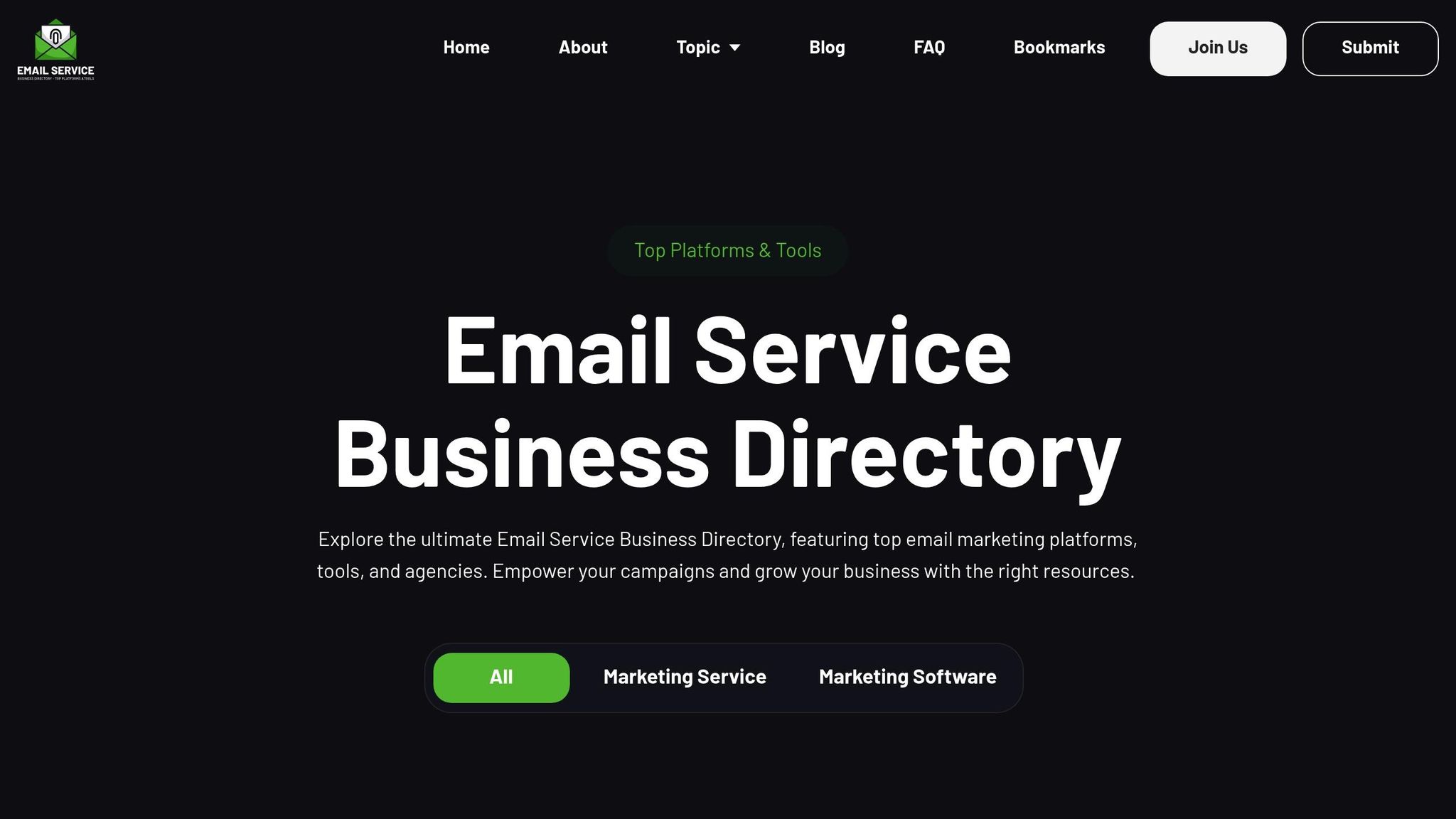
After defining your compliance requirements, you can use the Email Service Business Directory (https://emailservicebusiness.com) as a resource to find GDPR-compliant email platforms. This directory simplifies the process by letting you compare vendors based on their data protection capabilities, compliance features, and security certifications.
When browsing, focus on platforms that explicitly highlight their GDPR compliance and security measures. The directory includes tools for various email marketing needs, from deliverability and cold outreach to AI-driven automation. Pay close attention to vendor profiles that detail encryption standards, access controls, and audit trails. Check for consent management systems with documented compliance features and transparency about AI governance and GDPR training.
Look for vendors with a proven commitment to compliance. Indicators include dedicated compliance teams, routine security audits, and proactive updates to meet new regulations. To narrow your choices, ask for references from other businesses to see how each platform handles opt-outs, data deletion requests, and other compliance-related tasks.
Choosing a GDPR-compliant AI email tool isn’t a one-time decision. Vendors should show ongoing dedication through regular security updates, staff training, and clear communication about any changes to their privacy practices. While the Email Service Business Directory is a great starting point, thorough research and due diligence are essential before making your final decision.
Maintaining GDPR Compliance with AI Over Time
Staying GDPR-compliant isn't a one-and-done task - it requires constant vigilance and updates as AI capabilities evolve. Regular audits are essential to ensure your practices align with GDPR standards and keep your organization on the right side of the law.
Failing to comply with GDPR can lead to steep penalties - up to €20 million or 4% of global revenue. Beyond fines, non-compliance risks data breaches, legal action, and loss of customer trust. Meeting GDPR requirements should be seen as an ongoing commitment to your subscribers, not just a one-time project.
Running Regular Compliance Audits
Regular audits are crucial to verify that your AI-driven processes continue to meet GDPR standards. While annual audits are a minimum requirement, conducting them quarterly is even better. These reviews help identify and fix gaps before they lead to violations. Specific scenarios that call for immediate audits include launching new AI tools, making significant process changes, experiencing a data breach, entering new markets, facing regulatory updates, receiving increased subscriber complaints, or planning major campaigns that involve AI.
Your audit should focus on several key areas:
- Consent Documentation: Ensure you have explicit opt-in records, including timestamps, IP addresses, form versions, and the exact language subscribers agreed to. These records are indispensable during regulatory inspections.
- AI-Generated Content: Review AI-created emails to confirm they comply with legal and ethical standards. Check that your AI tools aren’t processing data in ways that violate GDPR principles and that only necessary data is collected and retained.
- Data Retention Policies: Confirm that data is deleted when no longer needed and that automated deletion systems are working as intended. For email tracking technologies like pixels, ensure you have explicit consent for their use.
- Audit Trails: Verify logs that show who accessed data, when, and for what purpose. This transparency is vital for compliance.
- Integration Points: Test systems to ensure consent status and preferences sync correctly across all platforms, preventing issues like subscribers receiving emails after opting out.
Document everything. Key records include consent logs, historical privacy policies, AI tool assessments, vendor agreements, audit reports, training records, incident logs, retention schedules, and opt-out records. Regulatory bodies will expect to see this documentation during inspections.
Quarterly database audits are also wise. Removing invalid email addresses and expired consents not only keeps you compliant but also improves email deliverability and campaign performance.
Training Teams on GDPR and AI Privacy
Compliance isn’t just about systems - it’s about people. Proper training for your team is just as important as regular audits. Every employee handling subscriber data needs to understand GDPR requirements and the unique privacy challenges AI can bring.
Training should cover:
- GDPR Basics: Core principles like transparency, consent, and data minimization.
- AI Risks: Issues like automated decision-making, profiling, and potential exposure of sensitive data.
- Consent Management: How to collect, document, and verify consent properly.
- Data Security: Best practices for handling subscriber data securely and avoiding unnecessary collection.
- AI Ethics: Identifying bias and using AI responsibly in marketing.
- Privacy Policies: How to explain policies clearly to subscribers.
- Incident Response: Steps to take in case of data breaches or compliance violations.
- Platform-Specific Training: Hands-on guidance for GDPR-compliant tools.
Training should be part of employee onboarding and refreshed annually or whenever regulations change. Document all sessions, including dates and attendees, to demonstrate your commitment to compliance during audits.
Update your privacy policies whenever AI usage changes. Clearly communicate how AI is being used in your email marketing through privacy policies, consent forms, and even email footers or preference centers. Be transparent about AI features like personalization, content creation, and behavioral analysis, and explain how they benefit subscribers.
If AI-driven emails deviate from what subscribers initially agreed to - such as covering new topics or increasing email frequency - offer an opt-out option. Similarly, if deeper personalization or behavioral data usage goes beyond subscriber expectations, provide a way to decline these features. Keep dated versions of all policy updates and notify subscribers of significant changes. For major updates, consider asking for fresh consent.
To ensure lasting compliance, establish a strong governance framework. Appoint a Data Protection Officer or compliance team to oversee AI usage. Set clear policies for implementing, monitoring, and maintaining AI tools. Define who is responsible for approving new AI features and create procedures for reporting violations.
Automation can be a powerful ally in maintaining compliance. Use systems to track consent statuses, delete data after retention periods, flag potential violations, generate audit trails, sync preferences across platforms, and process unsubscribe requests within 72 hours. These tools reduce human error and help ensure consistent adherence to GDPR rules.
Regulatory authorities are increasingly scrutinizing email marketing practices, especially consent management and unsubscribe handling. With cross-border enforcement, a violation in one jurisdiction can trigger investigations in others. Regular audits, ongoing training, and transparent data practices not only protect your organization but also build trust with your subscribers.
Conclusion
AI-powered email marketing has reshaped how businesses connect with their audiences, offering enhanced personalization and efficiency. However, it also comes with a responsibility to uphold strict privacy standards. Under GDPR, businesses handling EU personal data must ensure ongoing compliance, leaving no room for shortcuts or oversights.
The foundation of successful AI and GDPR compliance rests on three key principles: transparency, consent, and security. This means being upfront about how AI is used, securing clear and explicit consent from subscribers, and implementing robust data protection measures. These practices not only build trust but also help avoid hefty penalties. Responsible use of AI involves limiting data collection to only what’s necessary and empowering subscribers with control over their personal information.
As regulations evolve globally, businesses face the challenge of navigating a patchwork of frameworks. While GDPR is among the most stringent, countries like the U.S., China, the UK, Japan, and Canada are developing their own AI-related rules. This makes it crucial for businesses to choose tools that streamline compliance and maintain thorough documentation.
Equally vital is aligning AI strategies with principles of data minimization and transparency. When subscribers understand the value AI brings and trust your approach to privacy, they’re more likely to stay engaged and loyal.
To simplify the compliance process, consider resources like the Email Service Business Directory (https://emailservicebusiness.com). This platform helps identify GDPR-compliant AI email tools with features like built-in consent management, automated data retention, clear privacy controls, and detailed audit trails.
As AI technology continues to advance, businesses must regularly update audits, privacy policies, and team training to stay ahead of regulatory changes. Transparent communication with subscribers is the cornerstone of sustainable compliance. Companies that prioritize privacy protection not only meet legal obligations but also gain a competitive edge in today’s privacy-aware market.
FAQs
How can businesses ensure their AI-powered email marketing complies with GDPR's data minimization requirements?
To align with GDPR requirements in AI-driven email marketing, businesses need to prioritize the principle of data minimization. This means collecting and using only the information absolutely necessary for your campaigns. Start by conducting a thorough review of your data collection practices to ensure you're not gathering unnecessary or irrelevant details. Focus solely on the data that directly supports your marketing objectives.
It's equally important to implement strong data protection measures. Techniques like encryption and anonymization can help safeguard sensitive customer information. Make it a habit to regularly evaluate and update your AI systems to ensure they remain consistent with GDPR guidelines and prevent unintended data use.
Lastly, transparency is non-negotiable. Clearly explain to your customers how their data will be used and make sure to obtain explicit consent whenever it's required. Being upfront not only keeps you compliant but also builds trust with your audience.
What are the risks of using AI for email personalization under GDPR, and how can businesses address them?
Using AI for email personalization while adhering to GDPR requirements comes with its own set of challenges. These include concerns about mishandling personal data, insufficient transparency, and potential violations of user consent. To navigate these challenges, businesses must ensure that all data collection and processing are conducted lawfully and with explicit user consent.
Transparency plays a critical role here. Businesses should clearly communicate how user data is being utilized and confirm that AI algorithms are designed to respect GDPR guidelines.
Conducting regular audits of AI systems and data handling processes is another effective way to spot and address compliance issues early. Additionally, working with reliable email marketing platforms that emphasize strong data protection measures can make staying compliant much easier.
Why is it essential to audit AI tools for GDPR compliance in email marketing, and what should these audits include?
Regular audits of AI tools for GDPR compliance in email marketing are essential for safeguarding customer data, maintaining trust, and steering clear of legal issues. These checks ensure your AI systems manage personal information responsibly and stay aligned with GDPR standards.
Key areas to prioritize during an audit include:
- Data collection practices: Make sure only the information that’s absolutely necessary is being gathered.
- Data storage and security: Confirm that strong protections are in place to keep data safe.
- User consent: Verify that recipients have clearly and explicitly agreed to receive marketing emails.
By conducting these reviews regularly, you can spot potential vulnerabilities and stay compliant as regulations continue to evolve.