Did you know 35–47% of people open emails based on the subject line alone? And 69% mark emails as spam for the same reason. That’s why getting your subject lines right is critical.
AI-powered subject line testing is changing email marketing. Unlike traditional A/B testing, which is slow and limited, AI uses data from past campaigns to predict performance instantly. This approach has been shown to boost open rates by 41% and outperform human-written subject lines by 22%.
Here’s what you’ll learn:
- How AI analyzes language, tone, and user behavior to predict success
- Why companies like Dell and Expedia saw over 20% increases in open rates using AI
- Steps to set up AI subject line testing, including data preparation and workflows
- Key elements that make subject lines perform better, like personalization and emotional triggers
AI doesn’t just save time - it delivers results. From generating 100+ variations in seconds to improving email revenue by 43%, this technology helps marketers achieve better outcomes with less effort.
How To Write A Perfect Email Subject Line With AI
sbb-itb-6e7333f
How AI Improves Subject Line Testing
AI vs Manual Email Subject Line Testing Comparison
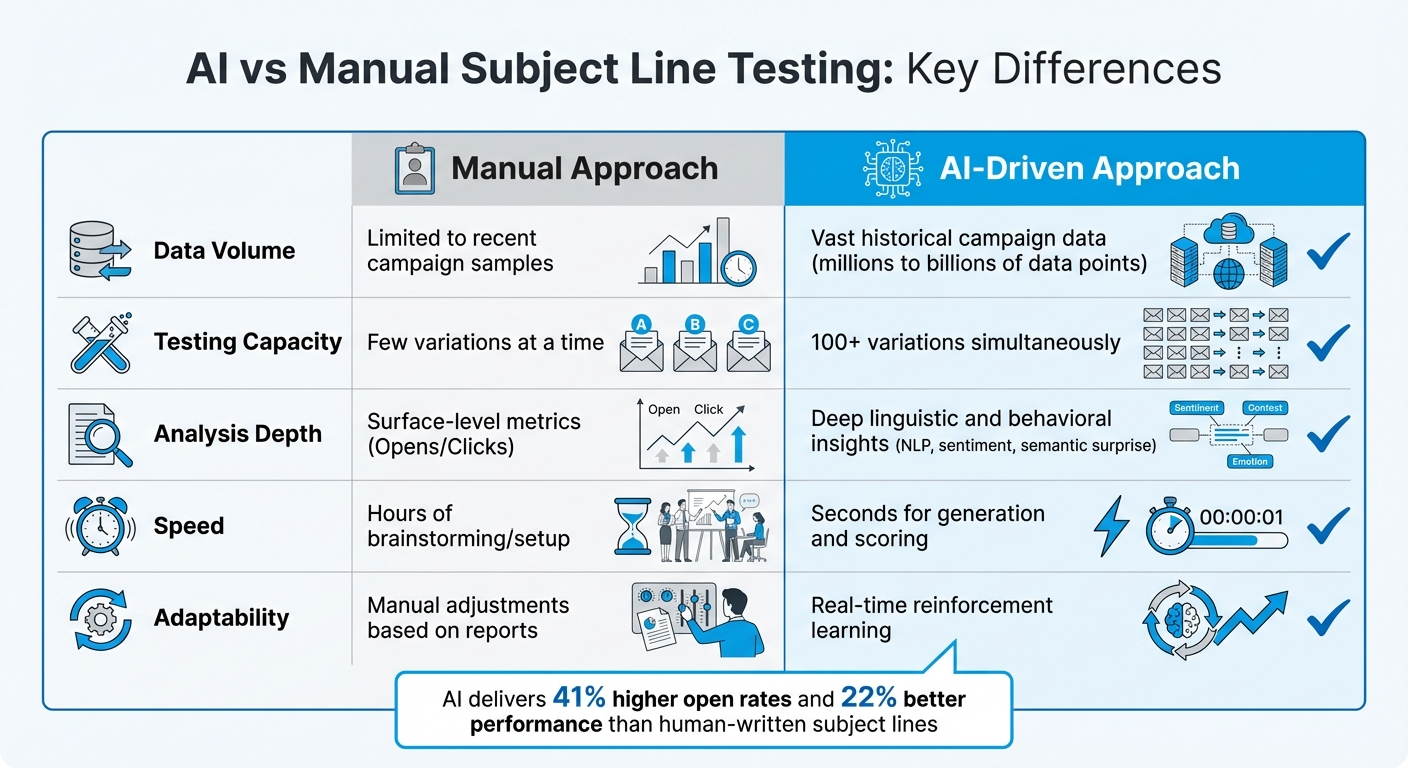
Traditional subject line testing often feels like a guessing game. Teams spend hours brainstorming ideas, relying on intuition, and then wait days for results from limited A/B tests. AI changes the game completely. Instead of relying on gut feelings, AI taps into millions - or even billions - of data points from past campaigns. It analyzes metrics like open rates, click-throughs, conversions, and device usage to uncover patterns that human marketers might never notice. This shift opens the door to advanced tools like natural language processing (NLP) and predictive algorithms, which take subject line performance to the next level.
With NLP, AI breaks subject lines into their core elements - tone, sentiment, word choice, and even "semantic surprise" (a measure of how unique a subject line is compared to others). It then uses advanced algorithms, like XGBoost and Transformers, to assign pre-send confidence scores to each variation, predicting their performance with impressive precision. For example, when Expedia implemented Phrasee's machine learning tools across 24 regions and 6 languages in 2023, the results were striking: open rates increased by 37%, click-through rates by 28%, and conversions by 19% - all within just 90 days.
"The results were beyond what even our best-performing teams predicted".
- Emilie Kroner, Expedia's Global Director of CRM
The speed advantage is another game-changer. While humans might debate a handful of options, AI can generate and evaluate over 100 variations in seconds, cutting through biases and avoiding creative fatigue. It doesn’t stop there - AI continuously improves through reinforcement learning, retraining itself with real-time data on opens and clicks.
eBay’s 2024 holiday campaigns are a perfect example of this. Their custom deep learning engine optimized subject lines based on buyer behavior, leading to a 43% boost in revenue per email and increasing cart abandonment email open rates from 18% to 31%. This highlights the power of moving beyond static, one-time testing to a continuous optimization loop that makes every email smarter and more effective.
| Feature | Manual Approach | AI-Driven Approach |
|---|---|---|
| Data Volume | Limited to recent campaign samples | Vast historical campaign data |
| Testing Capacity | Few variations at a time | 100+ variations simultaneously |
| Analysis Depth | Surface-level metrics (Opens/Clicks) | Deep linguistic and behavioral insights |
| Speed | Hours of brainstorming/setup | Seconds for generation and scoring |
| Adaptability | Manual adjustments based on reports | Real-time reinforcement learning |
The combination of speed, detailed analysis, and adaptability makes AI an essential tool for modernizing your strategy with the best email marketing platforms.
How to Set Up AI Subject Line Testing
Getting started with AI-driven subject line testing requires a solid foundation of organized data and a clear workflow. The first step is ensuring your data is accurate and well-maintained. AI models depend on clean contact details and historical performance metrics to make predictions. Key CRM fields - like first name, lifecycle stage, and engagement history - should be filled out for at least 80% of your contacts. Without this, the AI struggles to personalize effectively or identify what resonates with your audience segments.
Once your data is ready, the next step is setting clear parameters for the AI. This involves defining the tone, style, and brand voice you want to maintain. For instance, you might specify something like "conversational but professional" or "urgent without being pushy" and provide a list of dos and don’ts to guide the AI's creative process.
After that, you’ll need to build a testing workflow. Unlike traditional A/B testing, which compares just a couple of options, AI can generate and test 10–20 variations at once. These variations can target different emotional triggers, such as urgency, curiosity, or logic. A 10/20/70 testing split works well: send initial variants to 10% of your audience, validate the top performers with another 20%, and then deploy the winner to the remaining 70%. This approach minimizes risk while ensuring data-backed decisions.
What Data Your AI Model Needs
AI models thrive on historical data. This includes every subject line you’ve sent, along with its open, click, and conversion rates. Engagement levels, sender names, and addresses also play a role in shaping predictions. Beyond this, behavioral data - like past purchases, browsing habits, and cart abandonment - allows for micro-segmentation. Demographic details, such as industry, company size, and location, further refine the AI's ability to tailor subject lines to specific audiences. Ideally, each segment should have at least 1,000 contacts to ensure reliable insights.
| Data Category | Essential Signals for AI Training |
|---|---|
| Lifecycle Stage | Subscriber, lead, MQL, customer, at-risk/dormant |
| Behavioral Signals | Email engagement history, website visits, purchase frequency |
| Demographic Attributes | Industry, company size, role, location |
| Intent Indicators | Product interests, cart abandonment, pricing page visits |
Keeping your data clean is just as important. Tools for email verification help reduce bounce rates, ensuring the AI learns from valid engagement data rather than noise from inactive accounts. The cleaner your data, the better the AI’s predictions.
Building Your A/B Testing Workflow
To get meaningful results, segment your list randomly and test one variable at a time - whether it’s tone, structure, or personalization. Each segment should represent your entire audience to isolate what truly drives performance.
Modern AI workflows often include automated winner selection. For example, after sending variations to a small portion of your list, the system can automatically roll out the best-performing subject line to the rest of your audience. This typically happens after about 4 hours of testing. When designing your tests, experiment with elements like:
- Tone: Professional vs. conversational vs. urgent
- Structure: Question vs. statement vs. number-led
- Personalization: None vs. first name vs. behavioral tokens
Don’t just focus on open rates. Metrics like click-throughs, conversions, and even unsubscribe rates provide a fuller picture of how your subject lines are performing.
Applying Predictive Analytics
Once your testing workflow is in place, predictive analytics takes things a step further. Instead of waiting for results, AI tools can predict open rates before you even hit send. These models are trained on billions of historical subject lines, factoring in audience characteristics, engagement trends, and sender details.
Mike Sharkey, CEO and Co-founder of Ortto, puts it this way:
"AI is the equivalent of reviewing 5 billion subject lines and then jamming all those learnings into a purpose-built 'brain' that can write high open rate subject lines every single time."
The accuracy is impressive, with predictions often deviating by just a few points from actual results. The potential impact is huge: boosting your open rate by just 10% can result in a 50% increase in revenue, assuming consistent click and conversion rates.
To make the most of predictive analytics, start by creating a benchmark using your top-performing subject lines. This "power group" serves as a reference point for evaluating new AI-generated options. Run tests for 24–48 hours to gather enough data, and feed the results back into your AI model to improve its accuracy over time through reinforcement learning.
This structured approach not only simplifies testing but also sets the stage for ongoing optimization, helping you achieve better email performance with less guesswork.
What Makes AI Subject Lines Perform Well
When it comes to crafting email subject lines, AI brings a unique advantage by analyzing linguistic, formatting, and emotional elements to boost open rates. The trick lies in knowing which elements resonate with your audience and using them strategically. Let’s break down what makes AI-generated subject lines stand out.
Personalization is a game-changer, increasing open rates by 22% when the recipient's company name is included and by 50% overall. AI takes personalization beyond just adding a name. It can pull real-time data - like recent support interactions, browsing habits, or specific product interests - to create subject lines that feel highly relevant and tailored.
Emotional triggers like curiosity, urgency, and empathy also play a big role. Subject lines that create authentic urgency or exclusivity can achieve open rates as high as 44%. However, it’s crucial to avoid false urgency, as it can damage trust and lead to unsubscribes.
Striking a balance between creativity and clarity is equally important. Nathan Thompson from Fullcast shared:
"The number of times I've written an ad or a subject line that I thought, this is so boring... and I A/B-tested it against something that I thought was really creative, clever, and cute, and lost that A/B test."
This highlights how simple, clear subject lines often outperform clever or overly playful ones.
Elements That Drive Opens
Certain elements consistently deliver measurable improvements in open rates. For instance, questions spark curiosity and work especially well for B2B campaigns sent on Tuesdays. But overusing them can come across as clickbait. Numbers, like percentages or list formats, provide clear value but can sometimes feel a bit generic. Brackets, such as [Webinar] or [Case Study], help emphasize details but may seem too formal in casual contexts.
Social proof is another powerful tool, especially when backed by real credibility. Phrases like "Join 10,000+ leaders" tap into the reader’s desire to belong to a larger community. Meanwhile, pain-first language, which addresses specific challenges, can be highly effective for re-engagement campaigns. However, it’s important to avoid sounding overly negative or "salesy".
Since many people read emails on mobile devices, where subject lines are truncated after 25–30 characters, it’s smart to front-load the most important information within the first 36–50 characters.
Pros and Cons of Each Element
| Element | Impact on Opens | Risk Factors | Best Use Cases |
|---|---|---|---|
| Questions | High | Overuse may annoy; can feel like clickbait | Curiosity-driven campaigns; B2B Tuesday sends |
| Numbers | Moderate | May feel generic or like a listicle | Discounts and data-backed claims |
| Brackets | Moderate | Can feel too formal or technical | Highlighting details like [Webinar] or [Case Study] |
| Social Proof | High | Requires real credibility/data | Testimonials, "Join 10,000+ leaders" |
| Pain-First | High | Risk of sounding negative or "salesy" | Problem-solving emails; re-engagement |
| Personalization | Very High | Data errors (e.g., "Dear [First Name]") erode trust | Abandoned carts, loyalty rewards, renewals |
| Urgency | High | False urgency leads to unsubscribes | Flash sales, limited stock, event deadlines |
Getting these elements right isn’t just about improving open rates - it’s about fostering trust and keeping your audience engaged. For example, a 10% boost in open rates can lead to a 50% increase in revenue. On the flip side, 35% of people decide whether to open an email based solely on the subject line, while 69% mark emails as spam for the same reason. Clearly, the stakes are high, and success depends on nailing the right combination of these elements.
Using AI Tools and Resources for Testing
Choosing the right email marketing service and AI tool for subject line testing can feel like a daunting task. The key is to focus on features that align with your goals and fit within your budget. Below, we break down the essential AI capabilities that can elevate your subject line strategy.
Key AI Features to Look For
Predictive scoring uses your historical data and industry benchmarks to estimate open and click-through rates. For example, AI-generated subject lines have been shown to increase open rates by up to 22%, while personalized ones can achieve a 26% boost. This approach helps you eliminate guesswork and fine-tune your email campaigns.
Real-time analysis provides instant feedback as you write subject lines. These tools evaluate factors like ideal length (61–70 characters for a 32.1% average open rate), language optimization, and mobile compatibility. Since mobile devices often truncate subject lines after 25–30 characters, these insights are crucial for making your main message stand out.
Spam filter detection identifies potential red flags, such as excessive punctuation or all-caps, to ensure your emails avoid spam folders.
Advanced tools may also include sentiment and tone adjustment through Natural Language Processing (NLP), tailoring subject lines to match your brand's voice and audience preferences. Additionally, automated A/B testing can generate multiple variations, test them on a small audience, and automatically roll out the best-performing option.
When exploring pricing, options range from free tools like Groupmail Tools to premium solutions like Phrasee, which costs $24,000 annually. Mid-tier options include Lavender AI at $27 per month, Copy.ai at $49 per month, and Jasper AI at $59 per month. Notably, Groupmail Tools has a 4.8/5 rating for its free features, while Jasper AI is known for speeding up draft creation by five times.
Finding Tools Through Email Service Business Directory
After identifying the features you need, the Email Service Business Directory can streamline your search for the right tool. This resource offers curated lists of email platforms with verified AI subject line testing capabilities, saving you time and effort. You can filter options based on criteria like budget, team size, or specialized features such as send-time optimization.
The directory also compiles user reviews from platforms like G2, Capterra, Reddit, and Trustpilot, giving you insights into real-world experiences. For example, Seventh Sense is highly regarded for its send-time optimization tailored to B2B marketers, while Phrasee excels in enterprise-level natural language generation. Additionally, the directory highlights how these tools integrate with popular Email Service Providers (ESPs) like HubSpot or Salesforce, enabling you to leverage real-time subscriber data and engagement metrics.
Whether you're a small business exploring AI for the first time or an enterprise team managing large-scale campaigns, the directory's decision framework can guide you toward the best solution. Free options like Groupmail Tools or SubjectLine.com are great for beginners, while growing businesses might consider mid-tier tools like Copy.ai or Lavender AI. Enterprises, on the other hand, may find the higher investment in Phrasee worthwhile for its advanced features. This curated resource ensures you find tools that not only meet your needs but also integrate seamlessly into your existing workflows.
Improving Results Over Time
AI subject line testing works best when it’s part of a continuous improvement process. Each test cycle provides valuable data that can be fed back into your AI model, helping it identify and refine patterns that boost engagement. This feedback loop connects early testing efforts to long-term campaign success.
To build on these early successes, keep a detailed log of every test. Include the date, the variable tested (like emoji usage or character count), key metrics, and the results. Over time, this creates a brand-specific library of insights that can guide future decisions.
It’s also important to go beyond open rates and examine secondary metrics like clicks, conversions, and unsubscribes. This ensures your subject lines aren’t misleading. AI can even detect subtler patterns that might escape human attention, such as "inbox fatigue" from repetitive structures or the impact of unexpected wording ("semantic surprise"). For example, during their 2024 holiday campaigns, eBay’s machine learning team used such insights to increase revenue per email by 43% and improve cart abandonment open rates from 18% to 31%.
Audience segmentation is another key factor. Different groups - like new subscribers versus long-time customers - often respond differently. Use each successful variant as the new starting point for future tests, creating a cycle of ongoing improvement. To ensure accurate results, keep your sample size at a minimum of 1,000 recipients per variant. This helps achieve 90–95% statistical confidence and avoids misleading conclusions. Over multiple testing cycles, you’ll uncover seasonal trends and emotional triggers that resonate with specific segments, transforming your AI testing into a reliable growth strategy.
Conclusion
AI has transformed email marketing by replacing guesswork with data-driven precision. Its ability to generate multiple variations in seconds slashes campaign preparation time from hours to minutes, offering a major speed advantage. Even more compelling are the results: AI-generated subject lines can increase open rates by 41% - a game-changer for marketers. As one marketing expert noted, clear and straightforward subject lines often outperform overly clever ones, an area where AI excels.
The real magic lies in AI's ability to learn continuously. Unlike traditional testing that stops after identifying a winner, AI operates within a feedback loop, using insights from each campaign to improve the next. This iterative approach shifts the focus from surface-level metrics like open rates to meaningful business outcomes such as lead quality, pipeline growth, and revenue generation.
For those ready to take the next step, tools from the Email Service Business Directory can enhance your strategy. These platforms offer features like predictive analytics, spam trigger detection, and sentiment analysis, helping you optimize campaigns with industry-specific insights. Such tools go beyond basic generators, enabling true optimization through advanced capabilities.
To see results, set clear objectives, test one variable at a time, and ensure sample sizes of at least 1,000 contacts per variant to achieve statistical reliability. Keep track of both successful patterns and failed experiments to create a tailored playbook for your brand. The resources and technology are already available - the only question is whether you’ll take advantage of them to elevate your email marketing efforts.
FAQs
How much historical data do I need for AI subject line testing to work?
The volume of historical data required can vary based on the tools and techniques being employed. However, AI tends to deliver better results when it has access to a large dataset. Key metrics like open rates, click-through rates, and engagement trends are crucial for training the system. The larger the dataset, the more accurate the predictions, which can lead to crafting subject lines that perform exceptionally well. While the exact data requirements may differ, having more historical information generally boosts the AI's ability to fine-tune and improve subject line optimization.
What’s the fastest way to test many AI subject line variations without hurting deliverability?
The fastest way to experiment with multiple AI-generated subject lines without risking deliverability is by leveraging AI-powered tools. These tools can quickly generate variations that align with your brand and facilitate large-scale A/B testing. They also use data to predict which options are likely to perform best, helping you test efficiently while avoiding spam issues and staying compliant. This method simplifies your workflow and ensures your campaigns stay effective.
How do I measure success beyond open rate when using AI subject line testing?
To truly understand how well your email campaigns are performing, it's important to look past open rates. Metrics like click-through rate (CTR), conversion rate, and overall engagement provide a clearer picture of success. Pay attention to recipient actions - such as how many people click on links or complete desired actions (like making a purchase) - to gauge the real impact of your efforts.
Leveraging tools like AI insights and predictive analytics can take this a step further. By analyzing these metrics, you can fine-tune future campaigns and gain a deeper understanding of what resonates with your audience. This approach gives you a more well-rounded view of performance rather than relying solely on open rates.