Investing in a consent management platform (CMP) is a smart move to avoid compliance penalties and build trust with your audience. Here's what you need to know:
- CMP Costs vs. Fines: GDPR fines can hit €20 million, and CPRA violations cost $7,988 per infraction. CMPs, however, range from $20/month for small businesses to $10,000+ annually for larger enterprises.
- Pricing Models: CMPs use tiered subscriptions, traffic-based pricing, or custom enterprise quotes. Costs depend on features, traffic, and domains.
- Hidden Fees: Setup fees ($10,000–$50,000), overage charges, and storage costs can inflate the total expense.
- Compliance Updates: TCF v2.3 and Google Consent Mode v2 are now mandatory. Non-compliance risks lost ad revenue and fines.
- Market Growth: CMPs are projected to grow from $802.85M in 2025 to $3.59B by 2033, reflecting rising demand for compliance tools.
Key takeaway: A CMP is an affordable way to ensure compliance, prevent fines, and maintain operational continuity. Evaluate your needs, compare pricing models, and plan for hidden costs to make an informed decision.
Consent Tool Pricing Models Explained
Consent management platforms generally follow one of three pricing approaches: subscription tiers, traffic-based pricing, or custom enterprise quotes. Knowing how these structures work can help you anticipate costs and avoid surprises as your business scales.
Subscription Tiers and Features
Subscription tiers offer a range of plans, from free options to enterprise-level packages, each unlocking different features. Most vendors provide 3–5 tiers (e.g., Free, Starter, Pro, Enterprise), with advanced plans offering features like IAB TCF v2.2 compliance, multi-language support, and the removal of vendor branding.
Free plans often include 3,000–5,000 monthly sessions and are limited to a single domain. Entry-level paid plans start at around $6.99 to $150 per month, covering essentials like geotargeting and basic script blocking. Mid-tier plans, ranging from $17 to $1,250 per month, add tools such as A/B testing, white-labeling, and analytics. Enterprise-level packages, starting at $500 to $2,500+ per month, include advanced features like automated data subject requests (DSR), AI-driven optimization, and dedicated account management.
Opting for annual billing can reduce costs by about 10%. However, some essential features - like Google Consent Mode v2 or IAB TCF support - might not be included in lower-tier plans. It’s crucial to align your specific needs with the features offered at each level. While tiered pricing simplifies budgeting, traffic-based costs may still apply, adding complexity.
Traffic-Based Pricing and Domain Limits
Traffic-based pricing is tied to metrics such as monthly pageviews, sessions, or unique visitors. Vendors define these metrics differently: pageviews count total page loads, while sessions track 30-minute windows of visitor activity.
Costs scale with traffic volume. For instance, Consentmanager charges €23 per month for 100,000 views on a single site but increases to €219 per month for 10 million views across 20 sites. Similarly, Usercentrics offers plans starting at $8 per month for 1,500 sessions, going up to $795 per month for 1 million sessions.
Domain limits can complicate pricing further. Subdomains (e.g., blog.example.com and shop.example.com) are often treated as separate entities, requiring higher-tier plans. Vendors handle traffic overages differently: some upgrade you to a higher tier automatically, others charge €0.02 to €0.11 per 1,000 additional views, and some simply stop showing the consent banner once limits are reached.
"If the monthly maximum is reached, the Consent Manager costs do not increase. The cookie banner will then no longer be displayed, so that your visitors can no longer give their consent."
– ConsentManager
Enterprise Custom Quotes
For businesses with complex needs, enterprise solutions offer tailored pricing models.
"Enterprise contracts often start at $2,500+/month but can reach $100K+ annually for large publishers or global brands."
– Osman Husain, Content Lead, Enzuzo
OneTrust, for example, calculates costs based on factors like daily visitors, the number of data subject profiles captured, and the size of your privacy asset inventory. Enterprise packages often bundle consent management with additional tools like automated DSR handling and data mapping. These solutions typically include perks such as custom integrations (e.g., Salesforce, Adobe), dedicated support, and service-level agreements (SLAs) to ensure reliability and quick issue resolution.
sbb-itb-6e7333f
What Drives Consent Tool Costs
Consent tools come with a price tag influenced by traffic, compliance features, and optional add-ons. Knowing these cost factors helps you plan your budget and avoid unexpected charges. Each of these elements not only impacts your monthly expenses but also shapes your overall investment in the tool over time.
Traffic Volume and User Base
Most consent tools base their pricing on metrics like Monthly Tracked Users (MTUs), pageviews, or sessions. For websites, a session is counted when a visitor loads a page, and any reload after 30 minutes is treated as a new session. In mobile apps, the focus shifts to Daily Active Users (DAU), which refers to unique users opening the app at least once per day.
More traffic means higher costs. For instance, Usercentrics charges $56 per month for 50,000 sessions across 10 domains but increases to $795 per month for 1 million sessions across 100 domains. Similarly, CookieYes offers a free plan for up to 15,000 monthly pageviews but charges $55 per month for unlimited pageviews. Some tools, like Cookiebot and FitConsent, include the number of subpages in their pricing, which can push websites with over 6,000 pages into higher-priced plans.
"Costs fluctuate with traffic spikes or seasonal trends."
– Stephen Cooper, IT Consultant
Another factor is consent record storage, as platforms must retain audit logs for legal compliance. This becomes especially costly for businesses handling millions of consent actions. Sites with high traffic may also incur additional fees for frequent API calls used to validate consent across systems. To avoid surprise charges, it’s a good idea to estimate your average monthly pageviews and plan for growth. If your business experiences seasonal traffic spikes, consider negotiating flat-rate pricing or an annual average instead of monthly limits.
These traffic-related costs are just the beginning. Compliance features add another layer to consider.
Features and Compliance Requirements
The level of compliance you need has a direct impact on your costs. For example, tools that only support GDPR are generally less expensive than those covering multiple regulations like GDPR, CCPA, and LGPD. If your business operates globally, you’ll likely need multi-region logic, which often requires higher-tier plans.
Advanced features like IAB TCF v2.3 (mandatory by February 28, 2026) or Google Consent Mode v2 typically come with premium subscriptions. GDPR also requires detailed documentation of consent, so features like granular consent logs, versioning (linking consent to specific policy versions), and tamper-proof storage can significantly increase costs.
Paid tools often include compliance automation, such as preventing "dark patterns" (ensuring equal prominence for accept and reject options) and automated script blocking (stopping trackers from loading before consent is given). Free tools usually lack these capabilities. Additionally, automating Data Subject Access Requests (DSAR) for user data access or deletion is often reserved for enterprise-level plans.
"GDPR consent management isn't just about slapping a banner on your site anymore. It's the systematic process of obtaining, documenting, and respecting user choices about their personal data - and getting it wrong means regulatory exposure."
– Secure Privacy
Before choosing a tool, assess your compliance needs. If you only need GDPR, you may save money compared to broader global coverage. Also, ensure that the tool actively blocks scripts before consent is given - some lower-cost options only display a banner without enforcing compliance, which could lead to fines.
Add-Ons and Custom Integrations
Integrating consent platforms with tools like Adobe Experience Cloud, Salesforce, or Segment can significantly raise costs, often requiring custom enterprise quotes.
Small businesses may see price increases when adding extra domains, removing vendor branding, or managing compliance across multiple regions. Mid-sized businesses often pay more for advanced features like custom CSS styling, geolocation rules, cross-domain consent sharing, and automated translation. Meanwhile, enterprise-level organizations face the highest expenses for features like A/B testing, cross-device synchronization, dedicated infrastructure, and GRC integrations (e.g., vendor risk assessments and DPIA automation).
Mobile apps and Connected TV (CTV) platforms also require specialized SDKs, which can extend development timelines from hours to weeks. Before committing to upgrades, evaluate whether a no-code solution meets your needs or if a full API/SDK integration is necessary. Small and mid-sized businesses should look for vendors with clear, tiered pricing to avoid hidden costs.
Next, we’ll dive into hidden fees and how they influence long-term expenses.
Hidden Fees and Long-Term Costs
The advertised price of a consent tool often tells only part of the story. Beyond the basic subscription fees, there are several hidden costs that can significantly increase what you end up paying. These additional expenses - ranging from setup fees to support contracts and overage charges - can quietly add up, impacting your overall investment over time. From the initial setup to ongoing maintenance, these factors play a big role in determining the long-term cost of ownership.
Implementation and Setup Costs
Getting a consent tool up and running often involves more than just downloading software. Enterprise platforms, in particular, may come with hefty implementation fees, which can range from $10,000 to $50,000 in the first year alone. These costs typically cover tasks like technical setup, data mapping, stakeholder coordination, and sometimes even mandatory consulting sessions. Osman Husain, Content Lead at Enzuzo, points out:
"Implementation fees can add $10,000–$50,000 to your first-year costs".
For smaller businesses, the process might be more straightforward. Many no-code platforms allow for installation in just a few hours, keeping costs lower. However, if your setup requires custom integrations, expect to pay extra.
Support Contracts and Price Increases
Basic subscription plans often come with limited support options. On the other hand, enterprise-level plans may include perks like dedicated account managers, 24/7 customer service, and guarantees on response times - all of which come at a premium.
Price hikes are another critical factor to consider. For example, OneTrust has announced a minimum annual deal size of $10,000 across all tiers starting in Q2 2026. This marks a significant change for businesses currently on lower-tier plans. As Osman Husain explains:
"OneTrust is increasing its pricing to a minimum of $10,000 annually, across all tiers... effective from Q2, 2026 onwards".
To avoid unexpected rate increases, consider negotiating annual contracts instead of opting for monthly billing. This approach can lock in your pricing and protect you from mid-year surprises.
Overage Charges and Maintenance Fees
Many consent tools charge based on metrics like monthly pageviews, user sessions, or tracked users. Exceeding these limits can lead to automatic overage fees. Stephen Cooper, an IT Consultant and Writer, cautions:
"Session-based pricing... becomes unpredictable: Costs fluctuate with traffic spikes or seasonal trends".
Traffic surges or seasonal spikes can quickly drive up your costs. Additionally, some vendors charge separately for each website or subdomain, adding another layer of expense.
Another hidden cost comes from compliance requirements. Consent records must often be stored securely for at least two years, which can result in ongoing storage and audit trail fees. Features like automated daily scanning for new cookies, while useful, are typically reserved for higher-priced plans.
To manage these unpredictable costs, review your vendor's auto-billing policies carefully. If your website traffic varies seasonally, you might want to negotiate a flat-rate or more predictable pricing model instead of sticking with usage-based billing.
Cost Comparison of Popular Consent Tools
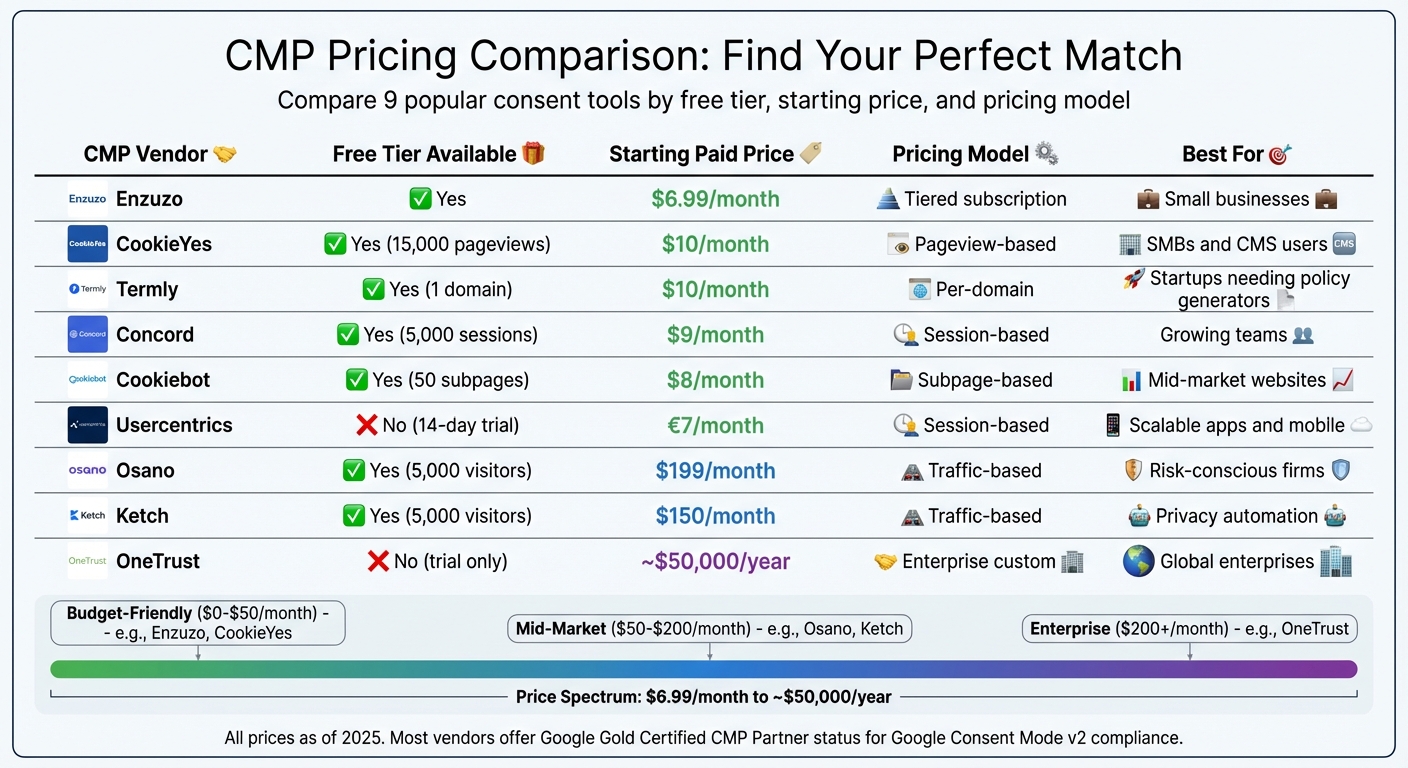
Consent Management Platform Pricing Comparison: 9 Popular CMP Tools
Getting a clear picture of the costs associated with consent tools is essential for managing compliance and operational budgets effectively. Pricing structures and tier benefits can vary widely, from free plans ideal for small websites to enterprise-level contracts that can surpass $50,000 annually. Most consent tools follow one of three pricing models: flat-rate subscriptions, usage-based pricing tied to traffic or sessions, or per-domain charges. Below, we break down the options across budget, mid-market, and enterprise levels, along with a table summarizing key details.
For budget-friendly solutions, tools like CookieYes and Termly stand out. CookieYes offers a free plan with 15,000 monthly pageviews, while Termly provides a free plan for one domain with 10,000 pageviews. Concord takes a session-based approach, offering 5,000 free sessions monthly, with a Lite plan starting at $9/month. For agencies managing multiple clients, Secure Privacy begins at $14/month and includes white-labeling capabilities.
Mid-market solutions like Cookiebot and Usercentrics are designed to scale with site traffic. Cookiebot provides a free plan for websites with up to 50 subpages, with premium plans ranging from $8 to $96/month depending on site size. Usercentrics, on the other hand, starts at €7/month for 1,500 sessions, using a session-based pricing model. Osano offers a free tier for up to 5,000 visitors and includes a "No Fines, No Penalties" guarantee, covering penalties up to $200,000.
At the enterprise level, OneTrust is a leading choice, offering extensive Governance, Risk, and Compliance (GRC) features. However, its premium capabilities come at a high cost, with annual contracts often exceeding $50,000. These tools are designed for global compliance, supporting regulations like GDPR, CCPA, and LGPD.
The table below provides a side-by-side comparison of popular tools, highlighting their free tiers, starting prices, pricing models, and ideal use cases:
| CMP Vendor | Free Tier | Starting Paid Price | Pricing Model | Best For |
|---|---|---|---|---|
| Enzuzo | Yes | $6.99/month | Tiered subscription | Small businesses |
| CookieYes | Yes (15,000 pageviews) | $10/month | Pageview-based | SMBs and CMS users |
| Termly | Yes (1 domain) | $10/month | Per-domain | Startups needing policy generators |
| Concord | Yes (5,000 sessions) | $9/month | Session-based | Growing teams |
| Cookiebot | Yes (50 subpages) | $8/month | Subpage-based | Mid-market websites |
| Usercentrics | No (14-day trial) | €7/month | Session-based | Scalable apps and mobile |
| Osano | Yes (5,000 visitors) | $199/month | Traffic-based | Risk-conscious firms |
| Ketch | Yes (5,000 visitors) | $150/month | Traffic-based | Privacy automation |
| OneTrust | No (trial only) | ~$50,000/year | Enterprise custom | Global enterprises |
Many of these tools are now Google Gold Certified CMP Partners, which is particularly important for maintaining ad performance through Google Consent Mode v2 in regions like the EU and UK. When comparing costs, it's also worth considering whether you need support for multiple regions. Compliance with global regulations like GDPR, CCPA, and LGPD often requires higher-tier plans, which can significantly impact your total cost of ownership.
How to Calculate Total Cost of Ownership (TCO)
Getting a clear picture of your Total Cost of Ownership (TCO) is essential when evaluating a consent tool. The real costs often go well beyond the advertised subscription fee. For instance, a tool priced at $50,000 annually can end up costing close to $150,000 once you factor in implementation, training, and maintenance costs. In fact, subscription fees typically make up only 50–70% of the total yearly expense. To calculate TCO accurately, you need to break down all the cost components.
Base Subscription and Add-On Costs
Start by calculating the base subscription cost over the duration of your contract. For example, if you're paying $1,100 per month for a mid-market consent tool, that’s $13,200 annually. Then, add implementation costs, which usually account for 20–30% of the first-year spend. In this case, implementation might add around $3,300 for setup and integration.
Next, include training costs, which typically range from 10–15% of the first-year spend (approximately $1,980 in this example). Ongoing support contracts add another 15–25% annually, or about $2,640.
Here’s a simple formula:
TCO = (Subscription × Years) + Implementation + Training + Maintenance + Overages.
Using this formula, for a three-year contract with a $1,100/month tool, you’d pay $21,120 in Year 1 (including setup) and $15,840 annually for the following years (subscription plus support). This totals $52,800 over three years.
Also, don’t forget to account for potential cost increases and opportunity losses in your calculations.
Opportunity Costs and 3-5 Year Projections
Many multi-year contracts include annual price increases, typically ranging from 3% to 15%. When forecasting, base your calculations on the 75th percentile of your expected traffic growth rather than your current average. This helps you anticipate potential overage fees, especially if your pricing is tied to traffic volume.
The opportunity cost of picking the wrong tool can be steep. If you need to switch tools later, migration expenses - such as data export, re-integration, and staff retraining - can rival or even exceed your initial implementation costs. On top of that, failing to meet compliance standards for regulations like GDPR or CCPA could result in fines as high as 4% of your global annual revenue.
To avoid these pitfalls, it’s worth investing in a tool that delivers long-term value. For example, OneTrust customers reported a 227% ROI over three years with a payback period of just seven months.
When planning, build a three-to-five-year cost model. Include Year 1 setup costs, recurring operating expenses with price increases, and internal labor costs. Managing a 100-user tool can require 5–20% of a full-time employee’s time, which is a "hidden" cost that often surprises businesses during budget reviews.
How to Reduce Consent Tool Costs
Cutting down on consent tool expenses doesn’t mean compromising on compliance. With software profit margins often ranging between 70–80%, there’s plenty of room for negotiation. Interestingly, about 70% of SaaS contracts require some form of negotiation before being finalized. Here's how you can trim costs while staying compliant.
Starting with Free and Low-Cost Options
If you're running a smaller website, much like choosing the best email marketing platforms for small business, free or low-cost consent management tools can be a great starting point. For example:
- CookieYes: Free plan supports up to 100 pages and between 5,000 to 25,000 monthly views.
- Illow: Offers up to 100,000 page views per month on its free tier.
- Cookiebot: Covers 50 subpages on a single domain for free[40,41,42].
Before committing to a free tool, make sure it meets key compliance standards, such as being Google-certified, supporting IAB TCF v2.2, and Google Consent Mode v2. Also, check if it provides legally auditable consent records and automatic cookie scanning. Keep in mind that some free plans only offer quarterly scans instead of monthly ones[40,41].
When your traffic grows beyond these limits, upgrading to paid plans is relatively affordable, starting at $6 to $14 per month[27,40]. This freemium model gives you the chance to test the tool’s functionality before scaling up. Once the free options no longer meet your needs, you can move on to negotiating custom contracts.
Negotiating Contracts and Custom Pricing
For larger or enterprise-level tools, never settle for the list price. Vendors expect negotiations, and being proactive can save you a lot of money. Let them know you’re evaluating multiple solutions and have a specific timeline for making a decision.
"If you don't ask for better pricing, your sales rep isn't going to offer it."
- Jen Challburg, Executive Buyer at Vendr
Push for pricing that decreases as your usage grows - like tiered rates for 10, 50, or 100 seats. If the vendor won’t budge on subscription fees, ask for extras like free onboarding, additional training, or access to premium features at no extra cost. You could even offer to participate in a case study or let them use your company logo in exchange for a discount[37,39].
For tools you plan to use long-term, consider multi-year agreements. These often come with deeper discounts and protection against annual price hikes, which typically range from 5% to 10%[37,39]. Early negotiations can lock in lower rates and shield you from future increases.
Measuring ROI and Compliance Benefits
Once you’ve secured a favorable deal, it’s time to measure the return on investment (ROI). Avoiding regulatory fines is one immediate benefit. GDPR violations, for instance, can cost up to €20 million or 4% of global annual revenue[7,45]. Investing $1 in data privacy initiatives can yield up to $2.70 in return, and avoiding even a single GDPR penalty could cover years of consent management platform (CMP) expenses.
Automating tasks like consent logging, cookie scanning, and Data Subject Access Requests (DSARs) not only saves time but also reduces the risk of human error[44,45]. An optimized consent banner can increase opt-in rates from 30% to 70%, which directly boosts ad revenue and improves analytics accuracy. Plus, properly consented first-party data leads to better marketing outcomes, with conversion rates improving by 15% to 20%.
Beyond financial benefits, strong compliance practices enhance customer trust. Transparent consent practices build loyalty, and 71% of consumers say they would stop doing business with a company that mishandles their sensitive data. By prioritizing compliance, you’re not just avoiding penalties - you’re also setting the stage for stronger customer relationships and better business outcomes.
Conclusion
Picking the right consent tool isn't just about the subscription price - it’s about understanding the full financial landscape and ensuring it aligns with your compliance goals. As outlined in this guide, the total cost includes much more than the monthly fee. You need to account for implementation costs, overage charges, maintenance fees, and how the tool might affect your marketing ROI.
Consider this: GDPR fines have reached nearly €6 billion since its inception, and CCPA violations can cost up to $7,500 per individual affected. These penalties make it clear that the cost of non-compliance far outweighs any tool’s subscription fee. For businesses operating in California, even a single violation could lead to substantial financial repercussions.
To avoid these risks, careful financial and compliance planning is key. Start by projecting your website traffic and growth to sidestep surprise overage fees. Identify which regulations apply to your business - tools designed solely for GDPR compliance are often less expensive than those covering global regulations. Don’t overlook implementation costs either, which can range from $10,000 to $50,000 in the first year. Take advantage of free trials to evaluate how a tool impacts both user experience and site performance.
It’s worth noting that around 75% of the top 100 websites in the U.S. and Europe fail to meet basic privacy standards. A well-chosen and properly implemented consent tool can shield your business from these compliance risks. Use the cost comparison tables and negotiation tips in this guide to secure the best deal while ensuring full compliance. Whether you’re starting with a free option or investing in a high-end enterprise solution, making informed decisions now can save you from costly mistakes down the road.
FAQs
What pricing model is best for my traffic?
When deciding on the best pricing model, it’s all about your email list size and how you prefer to handle payments.
- Contact-based pricing is ideal if your email list is growing because the costs adjust as your audience expands.
- A pay-as-you-go model is great for businesses with inconsistent email volume, allowing flexibility when your sending needs vary.
- If your traffic is steady, a monthly subscription plan provides predictable costs, making budgeting easier.
Think about your list size, how often you send emails, and your budget to find the option that fits your needs.
What hidden CMP fees should I expect?
Hidden fees for Consent Management Platforms (CMPs) can sneak up on you, especially when it comes to advanced features like customization, analytics, or integrations. Depending on the platform and your business needs, these costs can vary widely - from free plans to enterprise-level options that can hit $50,000 annually. To avoid any unpleasant surprises, it's crucial to review pricing details thoroughly before committing.
How do I estimate 3-year CMP total cost?
When calculating the cost of a 3-year Consent Management Platform (CMP), you'll need to think about several factors: setup fees, subscription costs (monthly or annual), and extra charges like customization or compliance assistance. For instance, if the platform charges $199 per month, the total over three years would be $7,164. Don't forget to account for possible price hikes or upgrades during that time. Make sure to include all expenses, even hidden fees, to get a clear picture of the total cost based on your specific platform and requirements.