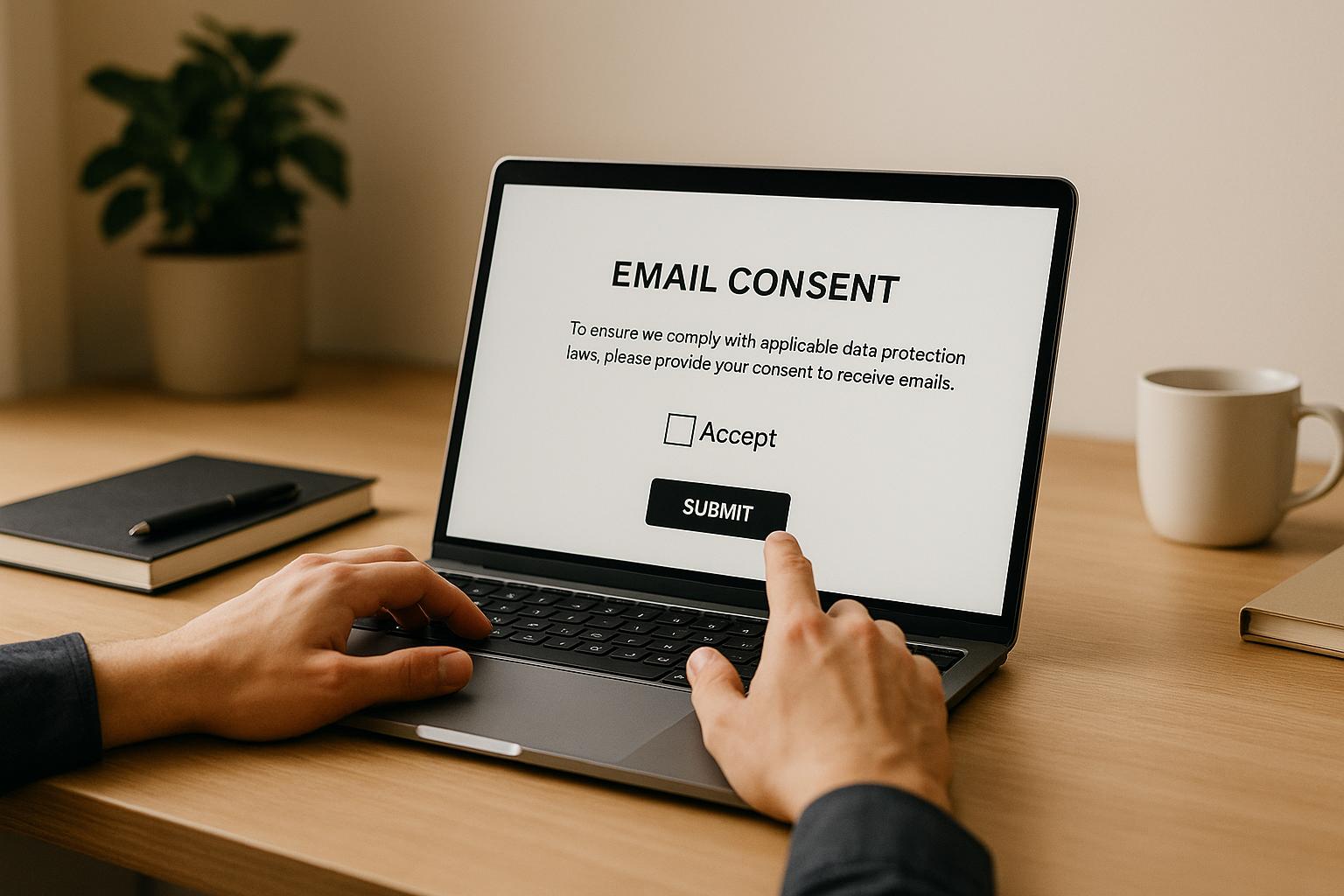
If you want one customer record instead of three partial ones, start with email. I’d sum it up like this: email is the most stable first-party ID for matching people across devices, sessions, and systems, and it works far better than guess-based matching.
Here’s the short version:
- Deterministic matching uses exact IDs like email and can reach 99%+ accuracy
- Probabilistic matching relies on signals like IP or device type and often falls around 70%–85%
- Email helps link web, CRM, ecommerce, SMS, and offline activity to one profile
- Validation, bounce handling, and deduplication keep bad records out
- SHA-256 hashing, opt-outs, and consent tracking help with U.S. privacy rules
- Better identity matching can improve CLV, cart recovery, suppression, and ad spend efficiency
- Delayed data hurts results: 60%–80% of behavioral signals may be lost because of sync lag
I’d look at it this way: email does two jobs at once. It helps me identify the person and clean the profile. Then I can connect anonymous browsing, campaign clicks, purchases, and stated preferences to one record instead of leaving them split across different email marketing platforms.
| Area | What email helps do |
|---|---|
| Matching | Connect records with exact identifiers |
| Profile quality | Reduce duplicates and bad addresses |
| Tracking | Tie clicks and site visits to known users |
| Compliance | Support hashing, consent, and opt-outs |
| Performance | Improve segmentation, suppression, and timing |
So the main point is simple: when I put verified email at the center of identity resolution, customer data becomes easier to match, cleaner to use, and more useful across channels.
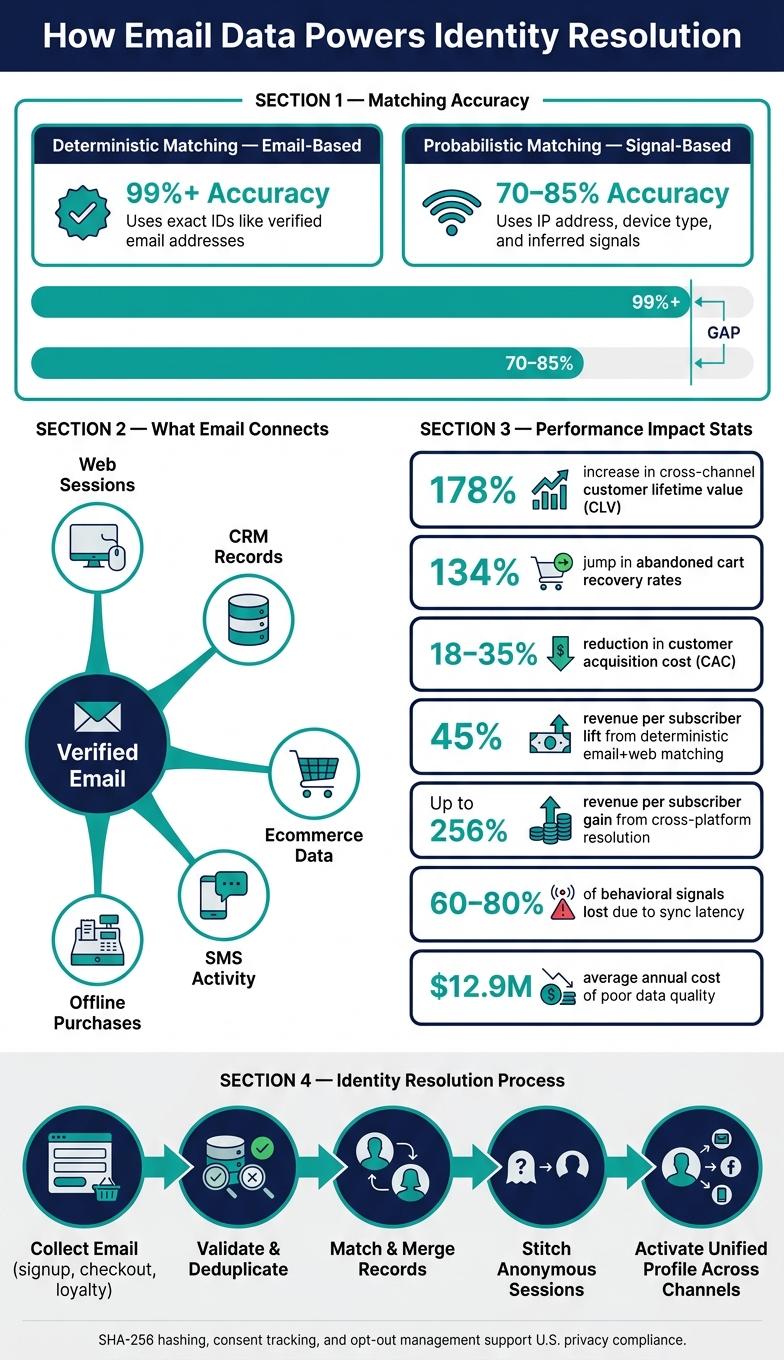
Deterministic vs. Probabilistic Identity Matching: Key Stats & Outcomes
How Email Data Improves Match Accuracy and Profile Quality
The Email Address as the Primary Customer Key
A verified email address can tie together CRM and ecommerce records because the same address often shows up across both systems. It can also connect anonymous website sessions to a known customer record after someone logs in or completes a purchase.
Email gets collected in a lot of common moments too, like signups, loyalty offers, and saved preferences. Every one of those moments adds another clue to the same customer profile. Without that shared key, those touchpoints sit in separate places and never come together.
Once email becomes the anchor for the record, teams can layer on validation, behavior, and purchase data.
Which Types of Email Data Add the Most Identity Value
Profile quality gets better when email data includes validation, behavior, and transaction history. But not every signal pulls the same weight.
- Core Identity (Email Address): Serves as the main key for deterministic matching and connects cross-device, online, and offline records.
- Validation and Suppression: Checks that the address is active and reachable; sends invalid or opted-out addresses to suppression lists to remove bad profiles and support compliance.
- Engagement Data (Clicks): Connects clicks to anonymous web sessions, adding recency and behavioral context.
- Transactional and Preference Data: Ties marketing activity to revenue and customer value; adds stated interests for sharper segmentation.
Clicks are one of the most useful signals here. When a customer clicks a link in an email, that action can tag the browser session and connect it back to the known profile. That turns an anonymous visit into a recognized one. Transactional data does another job: it ties marketing activity to actual revenue, which is what makes lifetime value calculations possible.
How Validation, Bounce Data, and Deduplication Clean Records
Even a strong identifier starts to lose value when the data behind it is messy. Invalid, bouncing, or duplicate addresses add noise instead of clarity.
Real-time validation on signup forms and checkout pages stops bad addresses before they enter the system, which helps keep record quality from slipping over time. Poor data quality costs organizations an average of $12.9 million per year through lost opportunities and flawed decisions. When a hard bounce comes back, that address should go straight to a suppression list to avoid misrouted sends and bloated audience counts. Deduplication then finds cases where two or more records belong to the same person, whether it's the same address entered with different capitalization or one customer using both a work and personal email, and merges them into a single golden record.
Clean, merged records make identity rules and enrichment workflows more dependable.
sbb-itb-6e7333f
Practical Ways to Use Email Data in Identity Resolution Workflows
Building Deterministic Matching Rules Around Email
After you clean the records, use email as the main match key in your identity workflow. Put verified email at the center of customer-facing matching. If the same verified address shows up across different systems, the system should merge those records into a single profile. That setup works especially well for channels like email and SMS.
There are edge cases, sure. But the core rule stays the same: if behavior suggests two addresses belong to the same person, deduplication logic can pull them together. Still, the authenticated identifier should always carry more weight than inferred signals.
Linking Anonymous Browsing to Known Customer Profiles
Once email matching is set up, you can connect earlier anonymous activity to the known profile. The minute a visitor fills out a form, logs in, or finishes checkout, the system can tie that email to all the anonymous session data gathered before then: pages viewed, products browsed, and ads clicked. What looked like a scattered browsing trail now becomes part of a known customer profile.
Email campaign clicks work in much the same way. When a subscriber clicks a link, that click can include an email-based identifier that tags the new browser session. The visit is tied back to the known profile right away, linking email engagement with on-site behavior without asking the user to do anything else. That helps with more accurate attribution, tighter audience segments, and better-timed triggered messages, like browse-abandonment or purchase-triggered flows sent while intent is still high.
To make this hold up in practice, server-side tracking is worth adding. It records events before they hit the browser, so ad blockers and iOS privacy rules are less likely to break the data flow.
Using Engagement and Preference Signals to Enrich the Golden Record
After session stitching, use engagement signals to keep the golden record up to date. If a customer uses more than one email address, recent engagement history can help you spot the one they use most and tie the golden record to that address.
Preference data matters too. If a subscriber changes their content interests or adjusts how often they want emails, that stated preference should update the profile right away. Pairing stated preferences with observed behavior gives segmentation a stronger base for lead nurturing and retention campaigns.
Unsubscribe activity needs close attention as well. It’s not just a list-cleaning signal. It’s a governance trigger. When someone opts out, the profile should automatically limit activation across connected channels, not only email. Store consent as a live profile field so cross-channel orchestration stays compliant and dependable.
How Stronger Identity Resolution Improves Cross-Channel Marketing Results
Once email data resolves identity, those unified profiles start improving performance across channels.
Building Unified Profiles Across Email, SMS, Web, and Offline Channels
When email-linked identity ties together transactions, page views, preferences, and service interactions, the customer journey turns into one timeline. A shopper who browses on one device, clicks an email, and finishes a purchase in-store is still one person - not three disconnected records.
That single view makes everyday journeys work better. Abandoned cart recovery gets faster and more relevant when the cart email reflects what the customer also viewed in other places. Post-purchase flows can point to the exact discovery channel - whether that was TikTok Shop, Google Shopping, or organic search - instead of sending the same follow-up to everyone.
This tends to show up first in high-intent journeys, where timing and context matter most. In February 2026, Coastal Home Goods unified 40,000 touchpoints into 14,000 profiles in six weeks, lifting click-through rates from 2.3% to 8.7%. That jump came from resolved browsing and purchase data feeding straight into triggered messages, not from copy or design changes alone.
Which Metrics Improve When Identity Resolution Gets Stronger
Better identity resolution improves revenue outcomes, not just opens. Brands using cross-platform resolution have reported a 178% rise in cross-channel customer lifetime value (CLV) and a 134% jump in abandoned cart recovery rates. Customer acquisition cost (CAC) often falls 18–35% in the first quarter after resolved identity data is put to work, mostly because brands can suppress existing customers from repeat acquisition campaigns and cut ad spend waste.
Identity quality also changes the metrics marketers care about most. When identity quality is low, profiles stay siloed, messaging turns generic, and unsubscribe risk climbs because the content misses the mark. Deterministic matching connects email and web journeys and lifts revenue per subscriber by about 45%. Cross-platform resolution allows real-time behavioral personalization, lowers unsubscribe risk, and has been tied to revenue per subscriber gains of up to 256%.
There’s a simple reason those numbers hold up: better resolution also improves suppression accuracy. If a brand keeps sending the wrong message to the wrong person, people notice fast. In fact, 71% of consumers cite excessive brand messaging as their top frustration with owned-channel communications, and only 6% find promotional emails well-suited to their needs.
Governance, Data Timeliness, and Retention Requirements
These gains depend on data that stays current. Identity graphs only work when the data is current. Research suggests that 60–80% of behavioral signals are wasted because of sync latency between systems. If a customer browses a product and that event takes hours to reach the email platform, the abandoned browse window may already be gone. Real-time event processing is the difference between a triggered message that converts and one that shows up too late to do anything.
It also pays to audit the identity graph on a set schedule. Remove stale identifiers. Update preferences. Clean up records that no longer match reality. Stale graphs create false positives - mismatched profiles, wrong personalization, and inaccurate messaging that 76% of consumers say makes them view a brand negatively.
Routine refreshes help keep the graph reliable enough to act on. Without that upkeep, even the best messaging logic starts to fall apart.
Choosing Email Tools and Services That Support Identity Resolution
What to Look for in an Identity-Ready Email Platform
These gains depend on the platform you use to resolve identities in the first place. Email only helps with identity resolution if the platform can store, match, and merge that data the right way. A platform built for this job does more than send campaigns. It keeps customer records tied together instead of scattered across systems.
Here’s what to look for when you’re narrowing down vendors:
- Deterministic matching with confirmed first-party identifiers: Put deterministic matching first, using email addresses and phone numbers instead of probabilistic inference.
- Email as a durable cross-device identifier: The platform should treat email as a main identifier that stays connected across mobile, desktop, and tablet sessions.
- Anonymous-session stitching and server-side event capture: It should pull pre-signup or pre-purchase browsing into the customer profile after identification, with server-side event capture that can hold up even with browser limits.
- Built-in validation, normalization, and deduplication: You want validation, normalization, and deduplication built in so records stay clean and accurate.
- Merge priority rules: The system should have a clear merge order for profile IDs, external IDs, email, and phone, so it knows which record becomes the golden record.
- Two-way CRM and ecommerce sync: Look for deep integration with your CRM and ecommerce stack so marketing activity connects back to actual purchase records.
- Consent management and role-based access controls for CCPA and GDPR: Consent sync, access controls, and audit trails should already be part of the platform.
One small detail can create a big mess: some platforms treat case differences as separate records. If one person signs up as JaneDoe@example.com in one place and janedoe@example.com in another, that can split the profile in two. Automatic email casing standardization helps stop that kind of record fragmentation.
How Email Service Business Directory Helps with Vendor Research

If you want to cut down research time, Email Service Business Directory gives you a simpler way to compare email marketing platforms and service providers. You can filter options based on things that matter in day-to-day marketing, like omnichannel integration, abandoned cart recovery, lead nurturing, customer retention, and transactional email.
Conclusion: Using Email Data to Build More Reliable Customer Identities
The goal is simple: keep email-linked profiles accurate as new data comes in. Email is a durable first-party identifier that lasts longer than cookies and device IDs, linking sessions across mobile, desktop, and tablet. When email sits at the center of your identity resolution setup, records stay cleaner, profile stitching gets more accurate, and your customer view becomes more dependable across channels. The right platform keeps those email-linked identities tied together as new signals come in.
FAQs
Why is email more reliable than cookies or device IDs?
Email addresses tend to be more reliable because they are persistent, deterministic identifiers. In plain English, that means they usually stay the same over time and point to one person with far less guesswork.
That’s a big deal. Cookies expire. Device IDs can change. IP addresses shift and run into privacy limits. An email address, on the other hand, often stays consistent across devices, browsers, and sessions.
There’s another reason this matters: customers hand over email addresses directly as first-party data. That makes identity resolution more accurate and privacy-compliant. It also helps tie together past activity and cross-channel behavior, so you get a clearer view of how someone interacts with your brand over time.
How do you handle customers with multiple email addresses?
By using identity resolution, you can connect separate records and build one unified customer profile. Deterministic matching links exact identifiers like email addresses, phone numbers, or loyalty IDs.
But people don’t always show up the same way every time. A customer might use one email for work, another for personal purchases, and a third for guest checkout. That’s where probabilistic matching comes in. It infers links based on signals like name variations, nearby addresses, and behavior patterns. The payoff is simple: fewer fragmented messages and fewer redundant emails.
What do you need to validate email data for identity resolution?
You need strong verification systems to confirm each email address is accurate, active, and safe to use. It also helps to normalize data by trimming whitespace and converting entries to lowercase so your records stay consistent.
You should also use identity matching to link multiple addresses to a single user and prevent duplicate records. The Email Service Business Directory can help businesses find tools for managing and validating email marketing data.