Feature engineering is the process of transforming raw customer data - like clicks, cart additions, and email opens - into structured insights that enable businesses to deliver better customer experiences across multiple channels. This approach solves the issue of fragmented data, which often leads to disconnected messaging and poor customer retention. Here's what you should know:
- Unified Data: Combines identifiers like email, loyalty IDs, and cookies into one profile for consistent customer experiences.
- Real-Time Integration: Tools like Kafka or AWS Kinesis allow immediate updates to customer profiles, enabling timely actions.
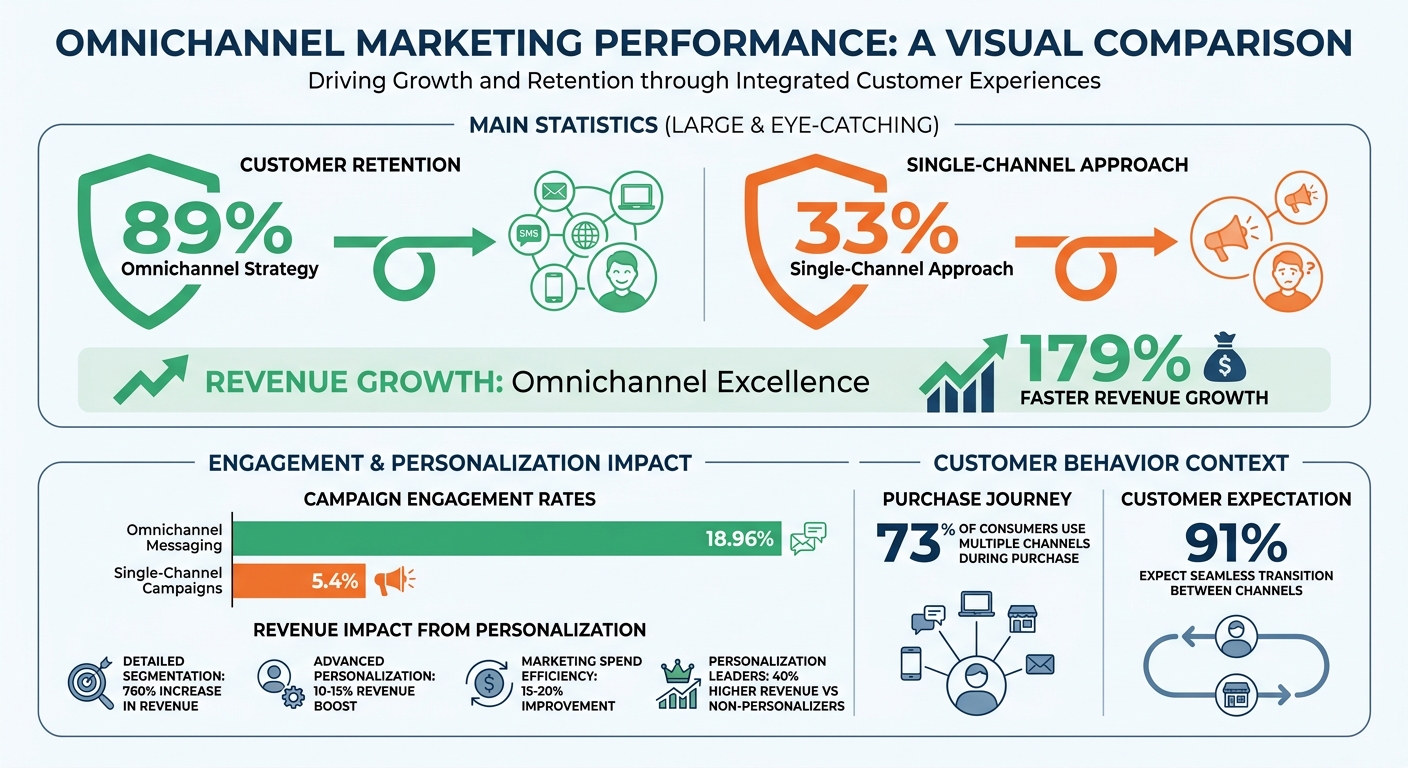
- Proven Results: Companies with strong omnichannel strategies retain 89% of customers, compared to 33% for single-channel approaches.
- Tools That Help: Platforms like D·engage and Iterable offer unified interfaces for designing journeys across email, SMS, and more, while CDPs like Algonomy enhance personalization through data unification.
The key takeaway? Unified feature engineering and integrated tools are critical for creating personalized, responsive customer journeys, leading to higher revenue, better engagement rates, and improved customer loyalty.
Omnichannel vs Single-Channel Marketing Performance Statistics
1. Unified Feature Engineering Methods
Feature Unification
Feature unification tackles the challenge of mismatched customer identifiers across various channels. Think about it: a customer might be recognized by their email in your CRM, their loyalty ID at the checkout counter, or even a cookie in web analytics. Unified feature engineering steps in to create a "golden record" - a single, reliable profile that consolidates all these fragmented identifiers into one seamless identity. This ensures a smoother customer experience. For example, it prevents scenarios where a customer who just made an online purchase ends up receiving redundant promotional emails or has to repeat their details when switching from chat to phone support.
A standardized event model is another key piece of the puzzle. It organizes data from various sources to consistently capture the "who", "what", "when", and "where" of customer actions. Whether it’s a website pageview, a mobile app purchase, or a service call, every event is aligned to a uniform structure. This consistency allows for meaningful comparisons across channels - like linking a web session to a CRM lead or connecting an in-store visit to digital activity.
Data Integration
Unified profiles are only as powerful as the data feeding into them. Take Starbucks in 2018 as an example. At the time, the company was dealing with 60 million monthly visitors, most of whom had no digital relationship with the brand. By enabling in-store Wi-Fi access through email registration, Starbucks added 10 million digitally registered customers to its database. This move bridged the gap between offline store visits and app purchase histories, paving the way for personalized features like order-ahead options and birthday discounts.
Today, modern data integration relies on hybrid lakehouse architectures. These systems combine raw clickstream data with structured CRM and POS records. Tools like Kafka or AWS Kinesis enable real-time profile updates, allowing businesses to trigger immediate, cross-channel actions. This kind of integration is essential for creating a seamless omnichannel customer experience.
Impact on Personalization
Unified data integration has a direct and measurable impact on personalization efforts. The results speak for themselves: targeted omnichannel messaging powered by unified data achieves an engagement rate of 18.96%, compared to just 5.4% for single-channel campaigns. Additionally, detailed segmentation using unified data has been linked to a staggering 760% increase in revenue. Advanced personalization efforts, fueled by integrated data, can further drive a 10–15% boost in revenue and improve marketing spend efficiency by 15–20%. These outcomes are made possible by unified features that allow AI to interpret customer intent in real time, enabling dynamic adjustments to customer journeys.
sbb-itb-6e7333f
Hyper-Personalized Experience: Managing the Omnichannel Customer Journey
2. Email Service Business Directory Tools
Email Service Business Directory tools bring together multiple communication channels into one platform, simplifying workflows and enabling real-time data integration for better customer engagement.
Feature Unification
These tools eliminate the hassle of switching between platforms by offering a unified interface. For example, D·engage and Iterable provide visual flow builders that allow users to design customer journeys across email, SMS, WhatsApp, push notifications, and web - all from one canvas. This ensures that personalization and customer data remain consistent, no matter which channel the customer prefers.
Customer Data Platforms (CDPs) play a key role in this unification. Algonomy's platform, for instance, helped McDonald's India grow its omnichannel customer base by 33% year-over-year. By using unified data, they created hyper-personalized campaigns that responded to customers' most recent actions, whether it was browsing the website or making an in-store purchase.
Data Integration
Real-time data integration is a game changer for these tools. Take MCB Funds as an example - they saw an 83% improvement in account funding ratios, a 60% boost in operational efficiency, and a 30% increase in transaction size within a year of using D·engage's real-time data sync and AI-driven targeting. The platform captures live signals like page visits, cart activity, and customer support queries, adjusting customer journeys instantly instead of relying on delayed batch updates.
"We boosted our efficiency with D·engage through automation, real-time data sync, and AI-driven targeting... This is truly phenomenal."
– Monis Usman, EVP Head of Digital Business & Marketing, MCB Funds
Luxury retailer Beymen also benefited from real-time data. Using D·engage, they achieved a 30% increase in click-through rates and a 15% boost in monthly revenue. Automated segmentation saved them 15% in operational time, ensuring that customer communications were both timely and relevant. By integrating directly with channels like email, SMS, and push notifications, these platforms eliminate data delays, keeping every interaction aligned with the customer’s current journey stage.
Impact on Personalization
Unified data enhances personalization by providing real-time insights into customer behavior. CoinStats used Iterable to create a trust-focused onboarding process based on transactional signals, reducing account setup abandonment by 35% and improving email open rates by 50%. Similarly, Sportive saw a 38% increase in transaction value and a 17% rise in shopping frequency by using D·engage CRM to deliver personalized, automated omnichannel journeys.
AI tools like Zeki AI and Nova Intelligence take this a step further by analyzing live behavioral signals to determine the "next best action." These systems fine-tune the timing, content, and delivery channel in real time, ensuring that every message feels tailored to the recipient.
Scalability
Scalability is crucial for maintaining performance as businesses grow. Platforms like Courier handle nearly one trillion digital interactions annually, processing events in sub-second time. For industries with strict data security needs, Fibabanka implemented an on-premise version of D·engage, achieving 0% downtime, an 18% reduction in operational time, and a 35% cut in overall costs.
"Sending SMS and email messages without any disruptions is very important in banking processes. Any interruptions can affect our entire sales process. Therefore, the 24/7, high-availability of the platform we use is extremely critical for us."
– Korhan Kocabıyık, Platforms Development Director, Fibabanka
These platforms offer flexibility, whether through cloud-based solutions for fast scaling or on-premise setups for tighter data control. No-code interfaces empower marketing teams to create and adjust workflows without needing engineering help, making it easier to scale from thousands to millions of interactions. Businesses that embrace this level of personalization report 40% higher revenue compared to those that don’t.
Pros and Cons
Feature engineering strategies play a critical role in helping brands unify and make the most of customer data across multiple channels. Choosing the right approach for omnichannel journeys involves balancing benefits against factors like cost, complexity, and technical capacity. Here’s a look at some common methods, along with their trade-offs.
Integrated CDP Platforms
Platforms like Segment or Adobe provide fast results with user-friendly interfaces and built-in real-time activation capabilities. They’re a great option for teams that want to get started quickly without requiring deep technical expertise. But these platforms come with high licensing fees and the risk of vendor lock-in. As House of MarTech aptly puts it, "The technology problem is the easy part. The coordination problem takes real work". Another downside is that these systems can act as "black boxes", making it hard to audit or customize data logic.
Composable or Lakehouse Approaches
Solutions like Snowflake or Databricks offer unmatched flexibility by leveraging existing data warehouse infrastructure. They support advanced features like ACID transactions and schema evolution, giving engineering teams complete control. However, these approaches demand strong DevOps expertise and higher maintenance efforts, making them a better fit for organizations with robust technical resources.
CRM-Led Unification
Platforms like HubSpot provide a cost-effective entry point for small and medium-sized businesses. They offer straightforward setup and a unified view of sales and marketing data. However, this method may struggle with handling large volumes of behavioral data and often lacks the identity resolution capabilities of dedicated CDPs.
AI-Driven Identity Resolution
AI-based systems outperform traditional rule-based methods by dynamically linking partial identities with greater precision. This advanced personalization can lead to a 10–15% boost in revenue and a 15–20% improvement in marketing spend efficiency. On the flip side, these systems require high-quality training data and are harder to audit for compliance, which can create challenges when explaining processes to regulators.
Conclusion
Building effective omnichannel journeys hinges on aligning your strategy with both your technical capabilities and your business objectives. A cohesive approach, like the one outlined here, forms the backbone of a successful omnichannel plan. Whether you use integrated CDP platforms for speed, composable stacks for adaptability, or AI-driven identity resolution for personalization, the key is to ensure your tools and goals work in harmony.
Once your strategy is in place, the next critical step is to ensure the accuracy and reliability of your data. Start by auditing your existing data. As House of MarTech points out, fragmented customer profiles must be addressed first - no matter how sophisticated your journey builder is, it can't overcome poor data quality. With nearly 73% of consumers using multiple channels during a single purchase and 91% expecting a seamless transition between them, a solid data foundation is essential to deliver the experience they demand.
Prioritize 4–6 high-impact journeys, such as cart abandonment recovery, onboarding, or churn prevention. To avoid overwhelming your audience, implement global frequency caps and use holdout groups to evaluate whether your efforts are driving meaningful results. Research shows that companies excelling in omnichannel engagement experience 179% faster revenue growth and retain 89% of their customers, compared to just 33% for those with weak strategies.
The rise of real-time sensing and agentic AI is making rigid, pre-planned workflows a thing of the past. Modern systems dynamically adapt to customer behavior, creating a more intuitive experience. As Zigment AI aptly states:
"The best journeys aren't mapped in advance, they're sensed in real time. Systems that adapt to behaviour will always outperform systems that force customers to adapt to them".
Achieving this level of agility requires not only advanced technology but also strong collaboration across marketing, sales, and support teams, all working toward shared customer-focused goals.
If email is part of your omnichannel strategy, tools like the Email Service Business Directory can help you find platforms that integrate with your customer profiles to deliver timely, relevant messages. This ensures that every interaction feels personalized and aligned with your broader strategy.
FAQs
How do you build a single customer profile from email, loyalty IDs, and cookies?
To build a unified customer profile, start by using identity resolution techniques to connect various identifiers like email addresses, loyalty program IDs, and cookies. Make sure to normalize these identifiers across different systems to ensure consistency. Then, apply two key methods: deterministic matching, which relies on exact matches, and probabilistic matching, which uses behavior patterns to link identities. Once the identities are resolved, consolidate the data into a single, reliable "golden profile." This profile should prioritize the most accurate and up-to-date information, giving you a clear and consistent view of your customer across all channels.
What data should be streamed in real time to update journeys instantly?
To keep customer journeys up-to-date, stream data like customer interactions, behavioral signals, and contextual details across all channels. This includes everything from website visits and app usage to email opens, clicks, social media activity, chat interactions, and even in-store actions. By enabling real-time data flow, systems can quickly identify customer behavior, gauge intent, and deliver personalized, relevant responses. This approach ensures smooth, connected experiences no matter which touchpoints customers interact with.
How can you measure if omnichannel personalization is actually working?
To gauge how well omnichannel personalization is working, start by examining customer interactions across every channel. Pay close attention to consistency, engagement, and satisfaction - these are key indicators of success. Omnichannel analytics tools can help you track performance effectively, ensuring the customer journey feels seamless. Focus on how well integrated data contributes to delivering tailored experiences that resonate with your audience.