Want to improve customer retention and marketing ROI? Start by defining clear roles for your channels.
Channels like email, social media, and paid ads often work in isolation, causing disjointed customer experiences and wasted resources. Businesses that align their channels with specific customer journey stages see:
- 89% customer retention (vs. 33% for poorly coordinated strategies).
- 32% higher marketing ROI and 27% better acquisition efficiency.
- Examples like FedPoint and Gym+Coffee show how role clarity boosts satisfaction, retention, and revenue.
Key Takeaways:
- Assign roles to channels based on customer needs (e.g., social for awareness, email marketing platforms for nurturing).
- Use unified data to coordinate messages and avoid redundancy.
- Measure channel performance with metrics like conversion influence and retention rates.
This approach eliminates friction, ensures consistent messaging, and improves customer experiences, leading to higher loyalty and profits.
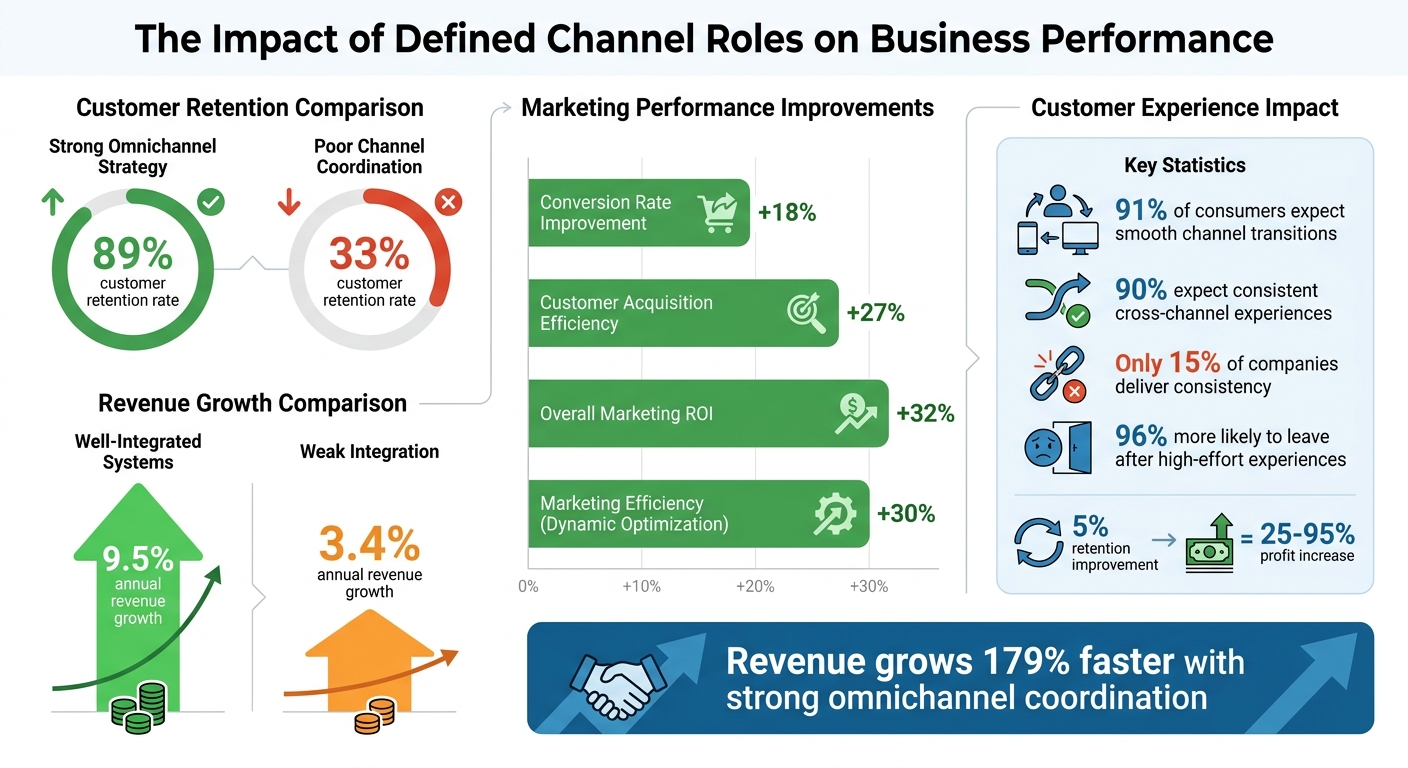
Impact of Channel Role Coordination on Customer Retention and Marketing ROI
What Are Channel Roles and Why Do They Matter?
Defining Channel Roles
To make sense of fragmented marketing efforts, it’s important to understand channel roles - essentially assigning specific purposes to each marketing platform. These roles align with business objectives like building awareness, driving consideration, or pushing conversions, and they tie directly to different stages of the customer journey.
Here’s how it works: platforms like social media and SEO are great for building long-term visibility. Tools like email and webinars help educate and nurture potential customers. Meanwhile, SMS or push notifications are perfect for sparking immediate action, thanks to their high engagement rates. By defining these roles clearly, businesses can avoid the confusion that comes with overlapping or conflicting messaging.
Why Role Clarity Matters
When channel roles aren’t clearly defined, chaos ensues. Channels end up competing for the same audience and budgets, which leads to problems like redundant promotions - imagine receiving a discount offer right after making a purchase. This is a major issue, especially since 91% of consumers now expect smooth transitions between channels.
Defining roles solves these problems. It stops the wasteful practice of bombarding customers with duplicate messages, which not only annoys them but also drains resources. Plus, it ensures a consistent brand voice across all platforms, so customers experience seamless, cohesive interactions instead of disjointed ones. This consistency directly improves the customer journey, reinforcing the ROI and retention benefits discussed earlier.
The numbers back it up: companies with strong omnichannel strategies retain 89% of their customers, compared to just 33% for those with poor coordination. They also see revenue grow 179% faster.
Here’s a real-world example: In late 2024, Gym+Coffee used mobile push notifications exclusively for daily urgency messages leading up to Black Friday. The result? A massive 571% year-over-year increase in mobile push revenue.
sbb-itb-6e7333f
Research Findings: How Defined Channel Roles Affect Business Performance
Customer Retention and Satisfaction
The numbers speak volumes: businesses with clearly defined channel roles consistently outperform those without. For example, companies with strong omnichannel strategies retain 89% of customers, compared to just 33% for those with weak coordination. That’s a massive gap that highlights the financial importance of role clarity.
The revenue impact is just as striking. Businesses with well-integrated omnichannel systems experience 9.5% annual revenue growth, nearly three times the 3.4% growth seen in companies lacking such integration. And here's a compelling stat: improving customer retention by just 5% can lead to a profit increase of 25%–95%. Clear channel roles also enhance customer satisfaction, with CSAT scores improving by up to 20% when channels are well-coordinated.
"Well-executed customer journey optimization can improve customer satisfaction scores (CSAT) by up to 20%." - McKinsey
On the flip side, poorly defined channel roles create frustrating, high-effort experiences for customers. In fact, these issues make customers 96% more likely to leave. When people are forced to repeat themselves across channels or receive conflicting information, it’s no surprise they take their business elsewhere. Beyond retention, clear channel roles also have a profound effect on conversions.
Conversion Rate Improvements
Defining channel roles strategically doesn't just keep customers happy - it also boosts conversion rates. Companies that prioritize audience-first planning see conversion rates jump by 18%. This approach ensures prospects are reached at the right time and place, reducing friction throughout their buying journey.
The efficiency gains are hard to ignore. Businesses that optimize their channel strategies outperform competitors by 27% in customer acquisition efficiency and enjoy a 32% boost in overall marketing ROI. Additionally, dynamic channel optimization can improve marketing efficiency by as much as 30%. These results show how a well-thought-out channel strategy can turn marketing investments into measurable business growth.
How to Assign Channel Roles Effectively
Aligning Roles with Customer Decision Paths
To make the most of your channels, start by aligning them with specific stages of the customer journey. This isn’t about what’s available - it’s about what the customer actually needs at each step. For example:
- Awareness: Use tools like SEO and social media to help new audiences discover your brand.
- Consideration: Share case studies and product demos to answer detailed questions and build trust.
- Purchase: Focus on live chat and seamless checkout processes to eliminate any buying obstacles.
- Post-purchase: assessing email platform compatibility for onboarding emails and support channels help retain customers and keep them engaged.
- Advocacy: Referral programs can turn satisfied customers into brand ambassadors.
The secret lies in matching each channel’s strengths to the mindset of your audience. For instance, paid search works best for capturing demand from people actively seeking solutions, while paid social excels at creating demand by reaching those who may not yet know they need your product.
"Orchestrate channels around campaigns, not around channel owners" - Alexander Chua, Co-Founder of Growigami
This approach ensures that the output from one channel - like a blog post - can naturally feed into others, such as paid social, email, or organic posts. By treating channels as part of a unified strategy, you set the stage for better coordination and impactful results.
Using Unified Data for Coordination
Unified data is the backbone of effective channel coordination. A Customer Data Platform (CDP) can help by consolidating behavioral, purchase, and support data into a single profile. This profile should answer three key questions:
- Who is the customer?
- What actions have they taken recently?
- Which channels do they prefer?
Real-time decision-making is essential here. Instead of relying on pre-scheduled messages, use systems that respond immediately to customer actions - like cart abandonment, a support inquiry, or a visit to a product page.
"A sophisticated builder running on fragmented data produces fragmented experiences" - House of MarTech
Clean, well-organized data allows for better timing and more relevant messaging. When all channels are working from the same playbook, you can deliver a seamless experience that feels personal and timely.
Coordinating Channel Timing and Frequency
Getting the timing and frequency right is critical to avoid overwhelming your audience. No one wants to be bombarded with emails, SMS, and push notifications all at once. To prevent this, set global frequency caps across all channels. This not only improves the customer experience but also reduces the risk of opt-outs.
Leverage AI-driven channel selection to determine the best communication method for each customer based on their history. Add strategic wait times (e.g., a 24-hour delay after sending a notification) to give customers a chance to respond. For urgent opportunities, real-time triggers like geofencing can send notifications when a customer enters a store.
To fine-tune your approach, use tiered urgency responses:
- Sub-minute reactions for highly personalized messages.
- A few hours for thoughtful follow-ups.
- Days for loyalty-building initiatives.
This level of precision ensures you’re reaching customers at the right time, through the right channel, and with the right message.
Common Challenges in Channel Role Coordination
Breaking Down Information Silos
Customer data often gets stuck in separate systems - your enterprise email marketing solutions might not sync with your CRM, and your ecommerce platform could be running entirely on its own. This lack of integration makes it hard to get a full picture of your customers' needs and behaviors. Things get even trickier when channel teams focus on their own KPIs, creating even more gaps in the data.
Take Isadore, a cycling apparel brand, as an example. In July 2025, they tackled this issue by linking their email campaigns with website behavioral data. By combining insights from browsing habits and email engagement, they were able to recommend products more effectively. The result? A 50% boost in revenue from email campaigns and a 29% drop in product returns.
"Customers don't experience departments, they experience a brand. When marketing, sales, and support operate in isolation, the gaps between them become visible to customers as inconsistency."
– Chris Reaburn, Chief of Strategic Execution, Nextiva
The first step in solving this is to unify customer data, making it accessible across teams in real time. Once that's in place, the focus can shift to addressing another major challenge: inconsistent messaging.
Resolving Messaging Conflicts
Even when data silos are addressed, inconsistent messaging can still disrupt the customer experience. When channels operate independently, there's a risk of sending redundant or conflicting messages. As Customer.io puts it, "Sending someone an email, an SMS, and a push notification about the same promotion at the same time isn't omnichannel - it's just annoying three times over."
The numbers back this up: 90% of customers expect a consistent experience across all channels, but only 15% of companies actually deliver one. And the stakes are high - companies with strong omnichannel strategies keep 89% of their customers, compared to just 33% for those with weak strategies.
To tackle this, businesses can establish clear messaging standards and lean on AI-driven tools for channel selection. These platforms use past engagement data to choose the best channel for each customer, reducing guesswork and avoiding message overload. Setting global frequency caps across all channels also helps prevent overwhelming customers, while real-time automation adjusts messaging based on immediate customer behavior.
Ensuring Smooth Channel Transitions
Today's customers switch between mobile, desktop, and in-person interactions with ease. They expect businesses to keep up, remembering their preferences and previous interactions no matter the channel. Forcing customers to repeat themselves across touchpoints creates friction, and that frustration can lead to a 96% increase in churn risk.
"Modern consumers move fluidly between touchpoints. They browse products on mobile during lunch, research reviews on desktop that evening, and expect you to remember their preferences in tomorrow's email. This seamless behavior exposes the glaring gaps in traditional marketing approaches."
– Michael Lee, Senior Editor, Bloomreach
To support this fluid movement, you need to design smooth handoffs between channels. Centralizing communication history ensures every team member has the full context of a customer's previous interactions. For instance, in July 2025, Venture Group combined email with WhatsApp messaging for time-sensitive offers. This strategy allowed them to connect with customers on their preferred platforms, achieving an impressive 87% read rate on WhatsApp - far outperforming their typical email or SMS engagement. By ensuring context travels with the customer across all interactions, businesses can maintain continuity and build stronger relationships, all while laying the groundwork for better measurement and optimization.
Measuring and Improving Channel Role Performance
Tracking Performance Metrics
Once coordination is ironed out, the next step is to evaluate how well your channel roles are performing. But don't settle for basic metrics like email open rates or ad clicks. Instead, focus on activity-based metrics that track touchpoints, such as emails sent, LinkedIn interactions, or website visits. Just keep in mind that sheer volume doesn't automatically equate to impact.
For deeper insights, use channel influence metrics to see how each channel contributes to conversions, even indirectly. For example, you could measure the percentage of leads who engaged with a LinkedIn video ad before converting via email. Here's an eye-opening stat: the average B2B buyer reads 13 pieces of content before making a decision, with eight of those coming directly from the brand.
"Multi-channel reporting isn't just about attributing a lead to a single touchpoint. It's about understanding how each channel influences the overall likelihood of buying." - Rob Harlow, Co-founder and Chief Innovation Officer at Sopro
To get a clearer financial picture, measure marginal ROI - the return on every additional dollar spent - rather than relying on average ROI, which can mask diminishing returns. Companies that fine-tune their channel mix through systematic analysis often see a 15% to 30% boost in marketing ROI without increasing their total spend. By plotting spend against revenue, you can pinpoint the saturation point where adding more budget stops delivering results.
This approach ties directly into the broader theme of optimizing performance, ensuring that every dollar and effort contributes to continuous growth.
Improving Through Continuous Feedback
Once you’ve gathered performance data, use it to refine your channel roles through ongoing feedback. Metrics are only as good as the actions they inspire. For instance, incrementality testing - which uses geographic or time-based holdouts - helps determine whether a channel is genuinely driving conversions or merely correlating with them. This allows you to fine-tune roles based on actual results, not assumptions.
When it’s time to reallocate budgets, start small - adjust around 10%-15% initially - and watch for any ripple effects on other channels. Sometimes, a channel with a higher cost-per-acquisition might still be worth the investment because it brings in customers with better lifetime value and retention rates. That’s why tracking downstream metrics at the individual level is critical, rather than focusing solely on immediate conversions.
Maintain a consistent review schedule to stay on top of changes. For example:
- Monitor channel performance daily.
- Review attribution reports weekly.
- Adjust attribution rules and channel roles quarterly.
This steady cadence ensures you're adapting to shifts in customer behavior without overreacting to short-term trends. Striking a balance between long-term brand-building and short-term performance is key - following the "60/40 rule" (60% of your budget for brand-building, 40% for performance) helps maintain a healthy pipeline for both immediate and future results.
Mastering Cross-Channel Marketing For A Seamless Customer Journey
Conclusion
Defining clear roles for each channel creates a seamless customer experience, guiding them smoothly from their first interaction to making a purchase. When channels work together instead of acting independently, you eliminate the frustration that 87% of consumers experience when they have to repeat information across different touchpoints. The results speak for themselves: customers who engage across multiple channels tend to spend more and remain loyal longer compared to those who stick to just one channel. This unified approach not only boosts satisfaction but also sets the stage for a more strategic, journey-focused way to measure success.
Adopting a journey-led mindset means rethinking how success is measured. Instead of focusing on isolated metrics, shift to tracking progression rates - essentially, how effectively customers move through each stage of their journey. Research emphasizes this perspective shift: “The unit of strategy is no longer the channel. It is the journey,” as ALM Corp highlights. This requires assigning specific roles to each channel based on its strengths. For instance, email serves as the identity anchor, social media builds awareness and rekindles interest, while paid media reinforces key decision points.
To take action, start with a fragmentation audit to pinpoint where messaging breaks down or where team handoffs falter. Then, consolidate your customer data into a single source of truth. This ensures that actions in one channel - like clicking a link in an email - can automatically trigger responses in another, such as a retargeting ad. Marketing teams often see initial improvements within 3–6 months of implementing coordinated workflows, with significant ROI gains typically appearing within 6–12 months.
Additionally, map out your high-value customer journeys, standardize definitions across teams, and adopt multi-touch attribution to see how channels complement each other instead of competing for credit. With machine learning enabling real-time optimization and first-party data becoming essential in a cookie-less world, businesses that treat their channels as a unified system - rather than isolated campaigns - are better positioned for success. This coordinated strategy directly enhances campaign performance and optimizes the customer journey, as demonstrated throughout this research.
To strengthen your email marketing efforts - the cornerstone of a coordinated strategy - check out the Email Service Business Directory for top platform recommendations.
FAQs
How do I decide each channel’s role across the customer journey?
To determine the role of each channel, begin by mapping out the customer journey. Dive into your data to pinpoint the key touchpoints where customers interact with your brand. Assign specific roles to each channel - whether it's driving awareness, aiding consideration, or supporting post-purchase engagement - based on how effective they are at those stages. Leverage AI tools to make real-time adjustments and respond to customer behavior as it evolves. The key to success lies in strategic planning, thorough data analysis, and ongoing measurement to create a smooth and engaging experience across all channels.
What data do I need to coordinate channels without silos?
To ensure channels work together smoothly and avoid silos, it’s crucial to rely on detailed data about customer behaviors, preferences, and interactions across all touchpoints. This includes real-time insights, historical engagement patterns, and consent preferences. By creating a unified customer view, you can better understand their journey, pinpoint areas of friction, and fine-tune each stage for improvement.
Leveraging AI-driven tools can take this a step further, helping refine strategies so that channels stay aligned. This approach not only ensures a seamless experience but also delivers personalized interactions that can adapt in real time.
How can I measure a channel’s real impact beyond last-click attribution?
To truly understand a channel's impact beyond just last-click attribution, you can explore several methods. Multi-channel attribution is a great starting point, as it assigns value to multiple touchpoints throughout the customer journey, not just the final click.
For more advanced insights, media mix modeling can help uncover indirect and long-term effects of your marketing efforts. This approach analyzes how various channels work together over time.
By combining different attribution models, integrating data from multiple sources, and factoring in halo effects (when one channel indirectly boosts another), you can get a clearer picture of each channel's contribution. This deeper understanding allows for smarter marketing decisions and more effective use of resources.